Milo 2017 – Life Goes on with a change of plan

We had much to celebrate on our return to Milo on the June 9th, 2017.  First was Ian’s “all clear” on the cancer front; second was joining the twins in Edinburgh for their 10th birthday celebrations on June 6th and third was the surprise meeting up with Ken and Gina Falcon on Tiftie on our first day starting on our journey back through the Caledonia Canal.

The transformation of Ian’s 8-year-old Non-Hodgkin Lymphoma (NHL) cancer from the slow growing to the fast growing variety meant 3 months of a rather aggressive chemotherapy for Ian starting in January and a delay to our plans for joining the boat in late April, sailing to the Orkney’s and returning to Lyme Regis via the East Coast by the end of the season to guarantee that we kept our mooring.  Dorset CC and the harbourmaster at Lyme Regis came up trumps and allowed us an extra year away, so the plan changed – if Ian was well enough we’d return through the Caledonian Canal to the Western Islands – Why?  We’d been advised by Ian’s consultant to take it easy, to begin with, as it could take Ian 3 months to get back to full strength.  So, doing a week through the canal would be a gentle lead-in to sailing again. And, who knows, by September when both of us will be fully retired, we may have the time and energy to round Cape Wrath and circumnavigate Sutherland and Caithness, a long-term aim of Ian being to visit the land of his forefathers.

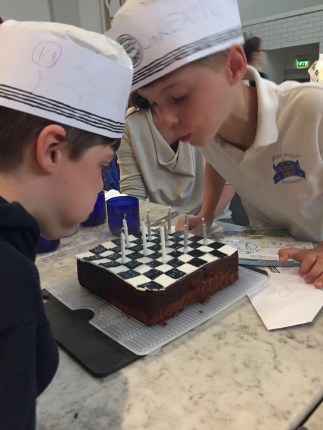
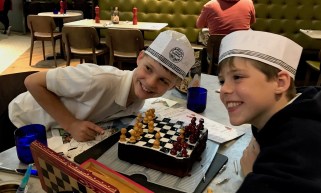
Receiving the “all clear” at the end of May, we flew to Edinburgh to help look after the twins, Hugh & Percy, and Skye while Andrew and Rebecca were on call. What a busy schedule the children have.  With their sport, music, school fete and other extra-scholarly activities, they kept us really busy.  The plan for their birthday had been a barbecue on the beach but the forecast was for heavy rain all day, so it was postponed and we went to see the fabulous Wonder Woman film instead,  followed by a birthday meal at the Pizza Express culminating in a special birthday cake lovingly made and decorated by Rebecca in the form of a chess board (Percy’s passion).
IMG_1121IMG_1124 (1)

A Chess Board Cake – it was sad to eat it after that first game of chess.

The following day we took the train to Inverness, but it arrived quite late, so rather than staying on the boat which would require a degree of decommissioning from its winterisation, Ros had found an interesting hotel, 2 miles out on the Beauly road called the Bunchrew House Hotel, looking more like a castle than a house and described on the web as “steeped in history, a 17th century Scottish mansion, offering excellent hotel accommodation and award-winning cuisine”. We had a room overlooking the Moray Firth and although facing north we had stunning views of the sunset in the NW and its rise again before 5am in the NE.

The Bunchrew House Hotel is steeped in history from its earliest settlement in the early 16th century, through the times of the Jacobite rebellion, the battle of Culloden and the Highland clearances.

The boat was much cleaner than we expected after being in the Marina for 6 months, particularly as it had been covered in an industrial dust at one point following an “incident” after which the Marina management had to arrange for the professional cleaning of every boat in the Marina. After cleaning, provisioning and having a last meal out in Inverness, we stayed up till 11pm to hear the first results come in from the election.  We could not believe the exit polls, but when we woke in the night at 2pm we stayed up until 3:30am fascinated by what was developing and that the exit polls, predicting a hung parliament, were right after all.

We eventually left early the next morning for the sea lock of the Caledonian Canal, half an hour later than expected and made good progress through the initial staircase locks to Caley Marina, but they had no berths available and so we headed on through Tomnahurish Swing Bridge toward Dochgarroch lock where we planned to berth. Two miles on from Tomnahurish Swing Bridge, we passed another yacht, Tiftie, going in the opposite direction – they gave us a friendly wave and Ian thought the helmsman looked rather like Ken Falcon who he was at university with – Ros immediately looked up “Ken Falcon Tiftie” and found their blog “TIFTIE – around mainland Britain and beyond” so we did an immediate “U” turn and tried to call them on the VHF radio on the Canal channel 74 to no avail.  Ian then called up the Swing Bridge operator at Tomnahurich to ask him to give the crew of Tiftie a message that they’d just passed the Sutherlands and that we were coming back to rendezvous with them.

Tiftie – best restaurant on the water we’ve been to for a long time!

Meanwhile at the swing bridge, Tiftie and her crew were waylayed by the swing bridge operator who kept the bridge closed – “friends of your are coming back to meet you”.  Ken said later, “we knew some Sutherlands, but they were in Bristol – they could not possibly be up here, I thought it may be some Sutherlands who knew the previous owner as our boat was well known in the area”.  But then we turned up and all became clear.  A great reunion took place and a wonderful improvised meal and lots of wine was enjoyed by all.  They tried to persuade us to turn round and join them on the way to the Orkneys.  It was tempting, but we decided to take the easy option of heading west.
IMG_1166

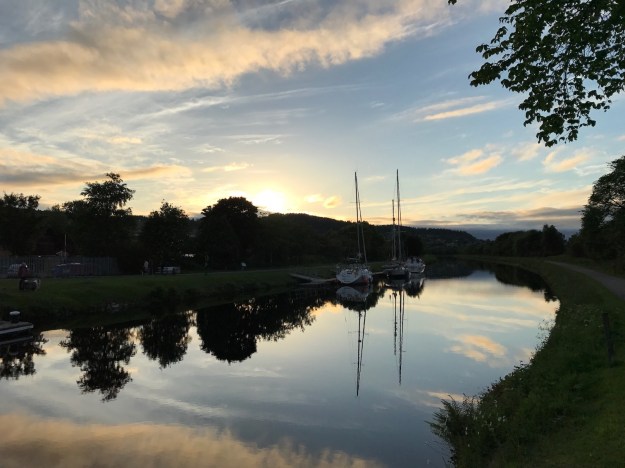
Sunset from Tomnahulich Swing Bridge after a wonderful meal on Tiftie

Next day Tiftie left early at 8am and had already passed under the Moray of Firth Bridge by 10am.  They continued all day arriving in Wick at about 10:30pm in the evening.  In contrast, we left in the afternoon after the rain stopped, had wind on the nose in Loch Ness and had to motor all the way to our planned overnight destination of Temple Quay, one third of the way down Loch Ness near Urquart Castle. We arrived at 4pm, both had a nap and then enjoyed a leisurely meal.
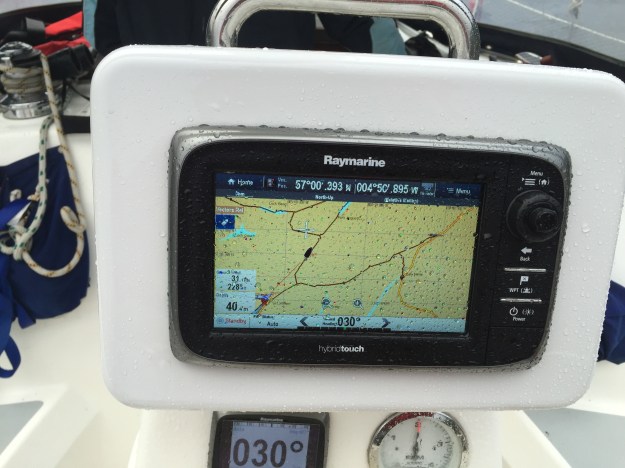
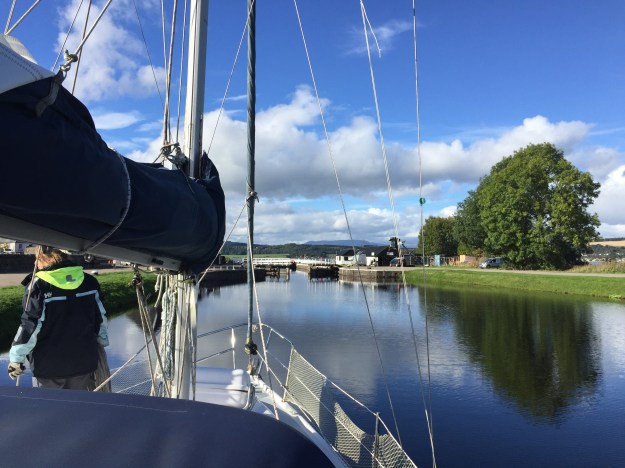
Caledonia Canal – coming down to Inverness

When we had our early morning dip in our sheltered mooring at Corriegour Lodge we were not expecting conditions to be quite as wild as they were when we headed out into the main part of Loch Lochy to continue our voyage to the head of the loch. It was too windy to raise the sail – we had a following wind (luckily) which blew us along with our spray hood acting as a shute! Winds were force 6 gusting to force 8 so we motored as fast as we could toward the shelter of Ceann Loch at Laggan Locks. As we approached the head of the loch, the waves were high and over spilling, pitching us this way and that – as we arrived a small motor cruiser was leaving and I thought that I would not like to head into wind in those wave conditions.

img_3608Force 7 gust of 31 knots – later a 35 knot gust (Force 8) was recorded

The lock keeper asked us what the sea conditions were like on the loch – I told him that the sea state was rough and that we’d experienced a gust of 35 knots at gale Force 8 – “Ahhh” he said, “I’ll not let any more small craft out today – it’s a pity about the one I’ve just let through” and as he was speaking we saw that it was returning – we spoke to the skipper later – he’d found it much too rough – he’d hired the cruiser from Inverness and was not experienced.

img_3612 Entering the shelter of Laggan Lock

After passing through Laggan locks we were now at the highest point of the Caledonian Canal, but storm force 9 gales were forecast for that night so we turned Milo round and berthed her head to wind on the same side as the Eagle Barge, which we later discovered was a pleasant respite from the storm when we developed cabin fever – it had a wood burning stove, which was very welcome in the wet conditions. It was also a sort of floating museum as well as a bar and a restaurant. Ros and I had a drink there and I enjoyed reading about the Maria Asumpta, a tall ship, which broke up in 5 minutes to matchwood when its engine failed upwind of a rocky coast. A stark reminder to get my engine fixed as soon as we reach a safe marina on the East coast.

The Eagle Barge with its wood burning stove in the bar, display of many artefacts and a pictures of how the tall ship Maria Asumpta met her demise on the rocks

Having time on our hands, we were able to read up on the construction of the canals. I had not realised that Telford had designed them. It was fascinating to see how major construction projects were managed in the early 1800s

img_3675Construction techniques used when building Laggan Locks from 1819 to 1822

Now at the top of the canal we passed through the narrow, windy, but picturesque Loch Oich on our way to Fort Augustus, where we started to go downhill for the first time. There was a four lock staircase at Fort Augustus. Going downhill is much easier than going uphill as there is no turbulence in the lock, as there is when you let the water in. We were both able to leave Milo floating and lead her fore and aft down the staircase. At the bottom we were now at the entrance to Loch Ness but berthed for the night as the weather had turned bad again. Sadly my visit to the Canal Museum was thwarted as it was closed for the two half days we were there.

img_3759Passing through Loch Oich

Leading Milo down the staircase locks at Fort Augustus

With the weather delays, we were behind on our plan to reach Findhorn by Friday evening of 30th September. It was now Thursday morning and the winds were force 6 gusting 9 until 1pm the next day. On Friday we left at 1:15pm with the wind moderating. We motored at first and later came to a safe place where we could head to wind and raise the sails – we were running with the wind most of the length of Loch Ness – 26nm we were told, but my log measured it as 20nm, but with the strong winds we made good time. We thought we saw the Loch Ness monster, but it turned out to be a floating piece of driftwood.

Various scenes from Loch Ness: Ros on the lookout; sighting the monster; the setting sun and one of Povlsen’s houses

Toward the head of Loch Ness going NE we came across a very impressive lochside house. Later we learnt that it belonged to Anders Holch Povlsen a Danish billionaire and the second largest private landowner in Scotland. Ros had learned about him when talking to Ruth Kramer who owns the Danish Moshi Moshi clothes shop in Vals, Switzerland. Ruth has been carrying out the interior designs for Killiehuntley Farmhouse, owned by Povlsen. Ros was interested to learn about this as she remembered reading about Povlsen in Monbiot’s book “Feral”. Monbiot writes in his blog of May 2014 that “Across 100,000 hectares, the RSPB, the Forestry Commission, the National Trust and Wildland Ltd (owned by the Danish textiles billionaire Anders Holch Povlsen) – are seeking to reverse the destruction, reduce the deer to reasonable numbers and get trees back onto the braes. On Povlson’s estates, the area of woodland has doubled (to 1400ha) since 2006, solely through the control of deer. It’s not land reform, but it’s the best that can be done with the current, dire model of Scottish ownership”. Ros is very interested and excited about these experiments in rewilding, and she hopes that Lynx and wolves will be reintroduced to Scotland within her lifetime.

 After the narrows at the end of Loch Ness we passed down through two further locks to Dochgarroch where we berthed for our final night on the Canal.

img_3790img_3786 Approaching the final lock and then the road swing bridge before entering the final approach to the sea lock and the rail swing bridge.

The next day we came into Inverness and down the lock staircase at Muirtown. Finally passing through the last road swing bridge before our final approach to the sea lock. We passed Caley Marina, which later became pivotal for our engine repairs. At the sea lock we learned from the lock keeper that we should take a wide berth in approaching Inverness Marina to avoid the shallows. We radioed ahead to book a berth at the Marina as we realised we could not possible reach Findhorn that day, besides, the chart plotter was not giving any detailed charts – why – I did not know.

img_3798Approaching the final sea lock before leaving the Caledonian canal and entering Beauty Firth on the ebb tide.

As we left the safety of the lock, I was surprise by the strength of the ebbing tide. We headed across the bay but when approaching Kessock Bridge you could see the turbulence at the edge of the rip tide. Approaching river Ness, again I was surprised, from the shifting background, how fast we were being swept sideways – I had to compensate by heading 45 degrees into the ebbing flow. At last we made the harbor entrance to be greeted by the marina manager, David Findlay, who took our lines.

img_4229Passing closed to the Kessock Bridge as we turned to enter the River Ness and Inverness Marina

We soon learned that Findhorn was a long and difficult sail away and challenging to approach. We did not take too much persuasion to stay on a berth in Inverness marina for the winter. David Findlay explained that we were just in time to get the 2016 rate and with our chart plotter not working, we were easily convinced to stay where we were. It was extremely sheltered and with easy access for walking on and off the boat, good proximity to washing facilities and showers plus the electric hook up – we quickly signed up for the winter. The only negative was the one mile walk into the centre of Inverness – we did it once to find that on a Friday night, most restaurants were fully booked – we rather unadventurously decided to eat at the Pizza Express restaurant, relieved to be safe for the winter and thankful to have almost a day to sort out the servicing and maintenance of the boat (later we learned that this was where our son Andrew usually eats when he visits Inverness to carry out his clinics).

img_4207 Milo in Berth A16  with the Kessock Bridge in the background
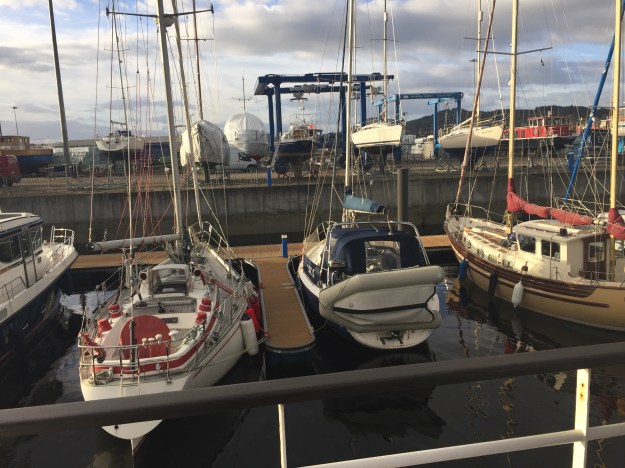
David, the marina manager, drove me next day to Caley Marina, which is on the Caledonian canal, to arrange for the engine to be repaired and winterised before my return at the End of October. Inverness Marina also had a sail repair service offered by Owen Sails – with a pick up point at the marina. I arranged with them to pick up our hood and sail cover for repair while we were away and re-fitted them at the end of October when I returned for a couple of days. By then Caley had fitted a new seawater pump and a new stay to the back of Milo and checked out the batteries. I was hoping to take Milo for a last sail but then remembered that the engine had been winterised– replacing salt water with freshwater antifreeze,– so instead I took the Dolphin Spirit trip out into the bay. Unfortunately we did not see any Dolphins but I learned a lot about the local pods, their names and how long they had been around and how and where they slept – if you think about it, it must be difficult to sleep when you are a breathing mammal in the sea. I learned that they are often sighted on the rising tide. But we did see a lot of birds including a large flock of geese just taking off for their annual migration. We passed nearby Culloden and I’ve heard enough about it now to visit the visitor’s centre next year before we set sail. It signified a turning point in history between the Jacobites and the British government at the time. It was a complicated situation with Britain at war with France and the French supporting the Jacobites who were supporting Prince Charles Stuart in order to return him to the throne – but it was not to be.

So, Milo is now ready for the winter with a refurbished and winterised engine, a sailcover and hood that look like new. We look forward to joining her again in late April when we plan to sail first to Wick to visit the old Pulteney Town (now South Wick) where Ian’s great-great-great grandfather, Robert Sutherland, used to be a fisherman until his untimely death at the age of 40 – Ian is keen to do some research in the local record offices before sailing on to the Orkney Islands and then who knows where the winds will take us. img_4220Milo in her final resting place at Inverness Marina (A16) – with refurbished hood, sail cover and engine

The Caledonian Canal – on the way up

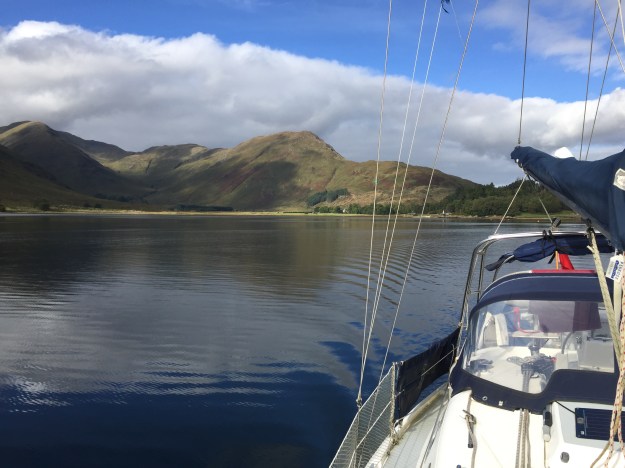
We had been talking about our passage through the Caledonian Canal for months and on Sunday 25th September we set out from Ballachulish full of expectations. The timing of our departure from Ballachulish had to be carefully timed to precede the inflow starting at 8:30am and be in time to catch the tidal flows through the Corran narrows so that they were in our favour. With the winds force 4 gusting 6 it was a windy choppy start as we were nearly head to wind leaving Loch Lever under the Ballachulish bridge so we waited until we were through the narrows and had passed all the over falls before we reached calmer waters and were able to head into wind to raise the sails. We were cautious and put one reef in the main.

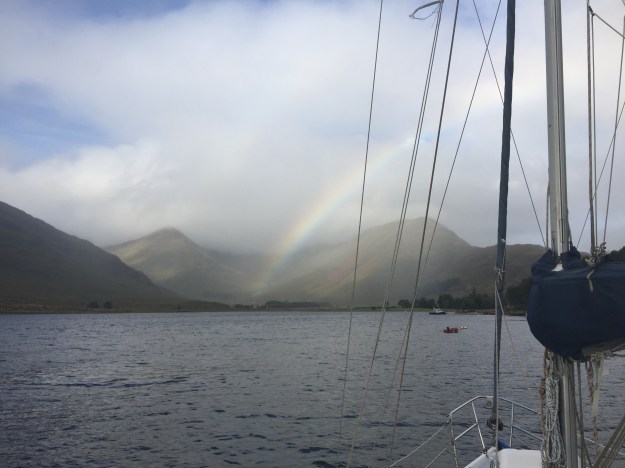
Approaching Ballachulish Bridge leaving Loch Lever; a rainbow arched over the entrance of the Corran Narrows to the NE; strong winds and choppy seas coming from the SW up Loch Linnhe and passing through the Corran Narrows

We were soon approaching Corpach Basin way ahead of schedule with these strong winds and tides with us. We had spoken to the lock keeper Donna on the phone and she greeted us and took our warps as we reached the holding pontoon. Lock keepers take lunch between 12.00 and 1.00 and she worked out that we should wait until just after 1.00 when they would take us up the first two locks, then another wait for the descending boats to arrive before tackling Neptune’s staircase.

Arriving at Corpach Basin reaching the shelter of the sea lock

img_3539Our Caledonian Canal experience was about to start – next stop Neptune’s Staircase

Entering Neptune’s Staircase with the overspill preceding the filling of the first lock; Ros holding the bow warp during the rise and then climbing ashore to tow Milo through to the next lock.

A rhythm ensued. Ian on the helm at the stern threw the stern warp to the lock keeper who passed it round a bollard, stopped forward progress and passed it back to Ian. Then Ros, with the bow warp coiled, threw to the lock keeper. This was heavy and the locks were deep and so this warp rarely reached the lock keeper’s outstretched arms and fell back into the lock water. Thankfully the lock keeper usually had another warp on shore, which she was able to throw down to Ros on Milo to make sure that she was secured before the lock gates were closed. Once the gates were closed they opened the upper sluice gates to let water into the lock from the lock above – this caused quite a whirlpool in the lock so you had to be very careful to hold your lines securely to stop Milo turning around. However Ros came into her own when we ascended the 8 locks of Neptune’s staircase. She disembarked and walked along the tow path, pulling Milo along like a horse. Ros actually meant, as if she were pulling a horse, but I pointed out that in the olden days it was the horse that pulled the barges along the canals, so it could mean that she was the “horse”!! Neptune’s Staircase is a staircase lock built by Thomas Telford between 1803 and 1822, it is the longest staircase lock in Britain. The system was originally hand-powered but has been converted to hydraulic operation today which makes their operation much more slick than the earlier experience we had going through the Crinan Canal.

img_3587Entering the last lock before reaching Loch Lochy at Gairlochy.

After Neptune’s staircase we moored for the night in Banavie, eating on board. The next day we entered Loch Lochy and set sail across the loch with two hours of relaxed sailing on a dead run often goose-winged.

Goose-winging is a relaxing way to sail particularly on an inland loch

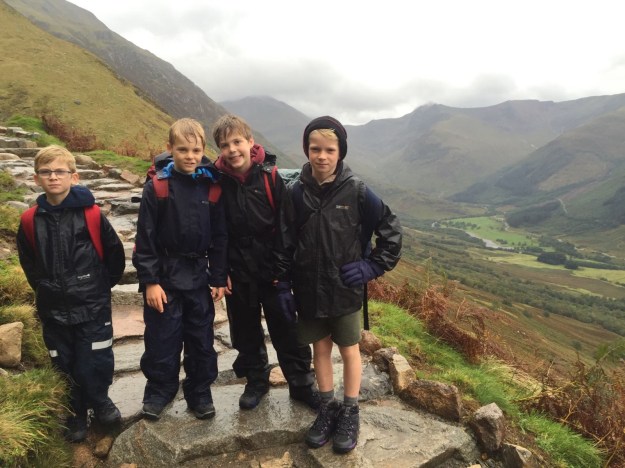
The sail along the loch was beautiful and we enjoyed looking at the peak of Ben Nevis in the distance and imagining Andrew and Adam and four young boys summiting the day before.

img_3573The boys Albie, Hugh, Percy and Patrick after their summit of Ben Nevis (sent later by Adam)

Ian was anxious as we approached the pontoon at Corriegour Lodge because of the water depth and the shortness of the pontoon. Ultimately we did manage to berth and we had 0.9m clearance under the keel – as it was non tidal – this was not an issue.

img_3601The rickety and shallow pontoon at Corriegour Lodge hotel and restaurant.

The view down the Loch was stunning, but marred by the heavy and noisy traffic on the road, which ran along the shoreline. After sprucing up as best as possible we disembarked and made our way to the restaurant. We were made very welcome by the host in the coal-fired sitting room where we ordered our food for the evening. Ian chose Aberdeen Angus steak and Ros cod and samphire. We later enjoyed the comforts of the dining room and after finishing our meal chatted over coffee to some of the other guests staying in the hotel (from Germany and Australia) who were very enthusiastic about their travels in Scotland and didn’t once complain about the weather. We made our way back to Milo and Ros said that she planned to swim in the Loch before leaving next morning.

img_3605Wild swimming the next morning

It was now near the Autumn equinox and daylight here in Scotland is from about 7.00 in the morning to 7.00 in the evening. The trees are just beginning to turn and Ros was reminded that on the island of Mull the leaves on the trees were only just beginning to unfurl when we arrived there in the middle of May. Just over four months for the deciduous trees. Slowing down along the canal, battling the elements and sleeping when it is dark, feels very different from our modern way of life in Bristol. But a wood-fire on Milo would have been welcome as we sat through hours of rain at Laggan Locks waiting to set sail and we are already fantasising about lighting our wood-burning stove when we return to Bristol on Sunday.

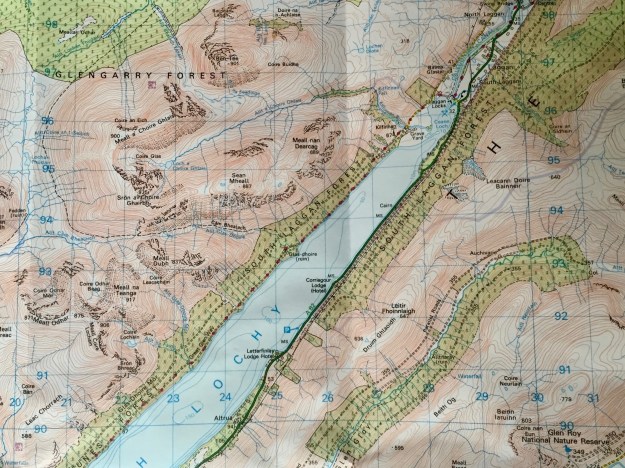
img_3599-1The top of Loch Lochy with the Corriegour Lodge Hotel about central and Laggan Locks in the top right hand corner where we weathered out Force 9 overnight storm force winds.


All Aboard

Today was the day when Andrew and his old school friend would join us for the first stage of their Highland adventure. We had just finished provisioning for lunch when they arrived. Andrew + the twins, Hugh and Percy (9) and Adam and his two boys Patrick (10) and Albert (Albie – 7). Ballachulish Marina had been build where the old slate quarry used to be, so the first thing the boys did was to explore the shore for skimmers – Percy said that these were the best skimmers ever. Then we had lunch – a huge fry-up cooked by Andrew.

img_3469 All aboard for a fry-up – Andrew is cooking at the galley and Adam sitting on the gangway steps.

After lunch we cast off and headed down Loch Lever for a sail and to see if we could find the Lochleven Seafood Café. The wind was gusty and variable and Andrew found it difficult to avoid constantly jibing, which kept everyone on their toes. After an hour of sailing we spotted the café and started the engine, lowered the sails and picked up a mooring – the only problem was that it was 3:40pm and we were not booked at the restaurant until 6pm. Clearly a shore party was needed. Andrew, Adam, and three boys (Percy stayed behind with Rosamund to play cards) came with Ian in the dinghy – beached on a sea-weedy beach and visited the café. After a quick visit to their fish tanks we decided to do a walk to get the boys in training for the next day. Walking along the road towards the narrows – we soon came across a footpath heading up the hill to our left – surprisingly this was a footpath to the lost village of Camus na h Eirghe a prehistoric village abandoned in the early 19th century. It was a lovely walk up through a tree lined path (an advantage in pouring rain) and the dry stone walls of all the buildings and paddocks could be clearly seen, although there were a number of trees growing in the middle of the complex so it was difficult to make out the original plan, particularly as some of the local farmers were using parts to store pallets and other farming detritus.

Afternoon walk to the lost village of Camus na h Eirghe

Returning to the loch, we set off back to Milo to get ready for returning again for our meal. This took two trips in the tender to land everybody ashore. We then lifted the tender clear of the rising tide before attempting the slippery sea-weedy assent to the restaurant.

img_3490-1Meal in the Lochleven Seafood Café

It was a fantastic meal and the staff were very friendly and helpful – we ate early as we were hoping to leave before it got dark at 7:30, but we were enjoying it so much that it was 8:30pm before we left – it was pitch black and we only had two torches between us. The path to the tender was treacherous in the dark – so slippery on the seaweed. Yet we managed to get the first party on the dinghy and pushed off so that the motor could be started. I have to give honourable mention to Adam’s sacrifice here. He pushed the dinghy out despite getting trousers, socks and shoes thoroughly soaked. The second party helped the returning dinghy to find them by shining a torch (iPhone) from the beach, but sadly the outboard got tangled up with weed and never did start after that, so Ian had to row the tender back to Milo against quite a strong head wind – it took ages.

Once back on the boat, the dinghy was secured in tow and we slipped the mooring. The problem was that it was pitch black – navigation lights were on and Ian was able to set waypoints to aim for and get the boat to track toward them, but he found the brilliance of the chart recorder ruined his night vision so when it eventually came to getting back to home port he relied on Adam and Andrew up front with a powerful torch and night vision respectively shouting out instructions to the helm – “left a bit” – “careful of that boat to starboard” – “what boat, I can’t see it “ says the helm, “watch out for that buoy dead ahead” says Andrew – helm adjusted quickly to starboard. Watch out for that headland on the right. Helm adjusted quickly to port and so on until we got to our berth in a very narrow inlet. When first coming in by daylight, Ian managed to turn in one “U” turn but this time it took four back and fourths to get into position.

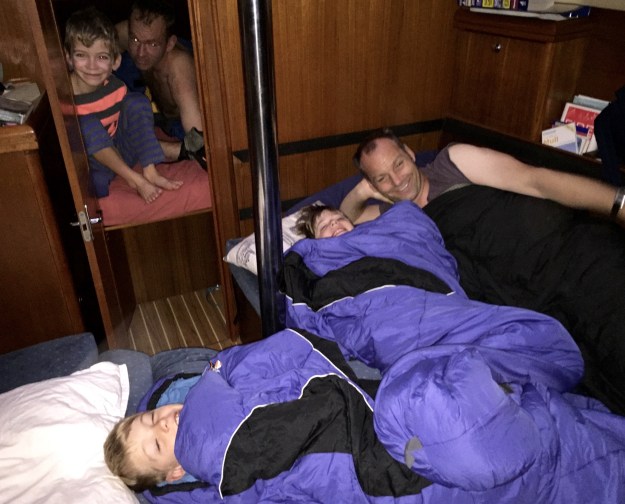
Then the bedding – how would we sleep? – four boys in the front cabin and Adam and Andrew sleeping together in the main cabin? In the end natural selection won the day – with Adam and his two boys sleeping in the front cabin and Andrew and his two boys in the main cabin, with Ros and Ian in our usual cabin in the stern of Milo.

The next morning it was difficult to get going. The fact that the table in the main cabin lowers to make an enormous bed is very useful on Milo, particularly as Andrew managed to fill the gangway with cushions from various main cabin settees (4 in all) and ultimately made the whole cabin into a huge bed.  My biggest problem was persuading him to get up in the morning so that I could lay the table for breakfast.

img_3494-1 All aboard Milo in the morning

Eventually we had breakfast – Patrick yet again enjoyed his bacon butties – having three in a row. We then went swimming in the Isles of Glencoe Hotel pool. The boys enjoyed the Jacuzzi.

img_3501Boys swimming in the Isles of Glencoe Hotel pool

The mountain climbing party left just before lunch to provision and set off for Fort William. The plan was to park as close to the ascent as they could – then set off and set up a base camp near Loch Meall, leaving early next morning for the ascent – returning to break camp in the afternoon. I learned later that all went to plan with the whole team summiting at about 13:00 hours. Meanwhile, Rosamund and I had an afternoon nap sheltering from the downpour.

img_3512Mountain climbing party setting off on the first part of their assent to Loch Meall the planned site for their base camp
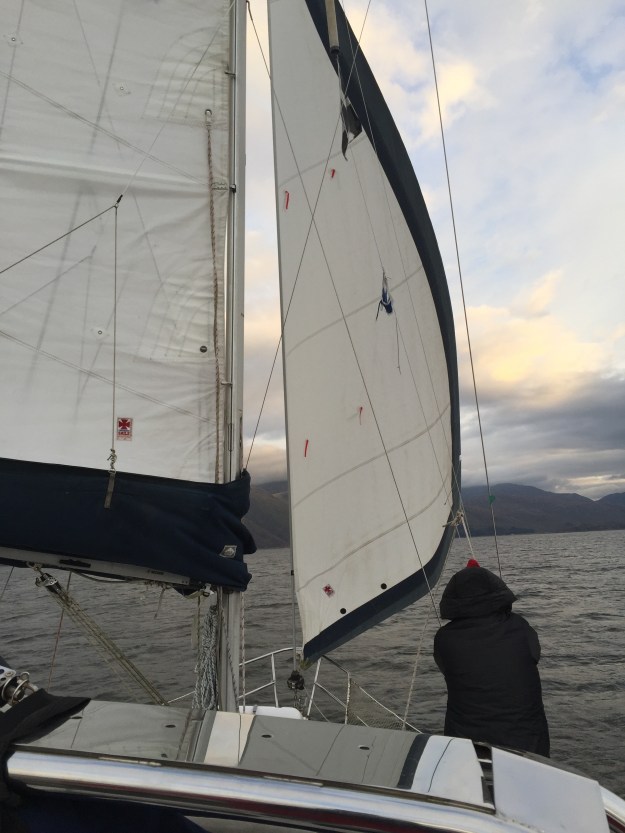
Port Appin to Ballachulish in Loch Leven

We had to enter Loch Leven under the Ballachulish bridge by 10:30am to avoid having strong tidal flows against us. Combine this with winds rising to force 6 and the tidal stream up Loch Linnhe turning at 9:30 meant that we had to be away by 7am. I checked the height of Milo’s mast (13m) as the bridge has a low clearance (16m) – should be OK.

We raised the main while still on the mooring as she was pointing into wind and soon had the engine off as we slipped the mooring and sailed away northward through the Lynn of Lorn toward Loch Linnhe. The Lynn of Lorn was quite narrow so you had to concentrate to keep on course, particularly approaching Shuna Island as it is confusing to begin with whether to pass it to port or starboard, but a quick check of the chart convinces you that doing a dogleg into Loch Linnhe was by far the safer course. As we were approaching the main loch we were goose-winged but then as we headed more NE we slowly moved towards a broad reach.

img_3402

The weather forecasts (Windfinder and XCWeather) were both predicting force 4 but gusting to 5 at first then 6 later. I wondered how they could predict this so precisely, but found later that this was accurate. On my chartplotter I have set up true ground wind speed and on a separate gauge have apparent windspeed. This is useful as it helps me keep a track of how strong the gusts are. Also, I noticed a pattern on this trip – at force 4 we were going at about 4 knots, at force 5, 5 knots and gusting force 6 we reached 6 to 6.3 knots. Once we had a force 7 gust and she reached 7knots – so Milo seems to have a relationship with the Beaufort wind scale. The Force 6-7 wind gusts were difficult to hold with full sail and she tended to head up into wind taking all my strength to get her back on course. She healed over a lot in the gusts, even on a broad reach, causing items below to crash across the cabin.

 Our track from Marine traffic and our waypoints from the chart recorder

We had such a brilliant sail that we reached Ballachulish bridge one hour ahead of schedule so had the tide still with us when passing under the bridge. The mast did look as though it would hit the bridge, but this was probably an optical illusion. But arriving at Ballachulish Marina pier was a bit of a mystery as we could not get hold of anyone. We picked up a visitor’s mooring and then I took the tender ashore. The gate had a combination lock and I could not get out. Luckily Simon was there – he was about to take out a boat trip. Sadly, he said the owner of the Marina had died last month, so things were rather chaotic at the moment. I had noticed signs of neglect – the visitor’s mooring chain had nearly corroded through and some of the wooden pier boards were rotten with some broken.

 Milo’s mast just clearing the Ballachulish Bridge entering Loch Lever

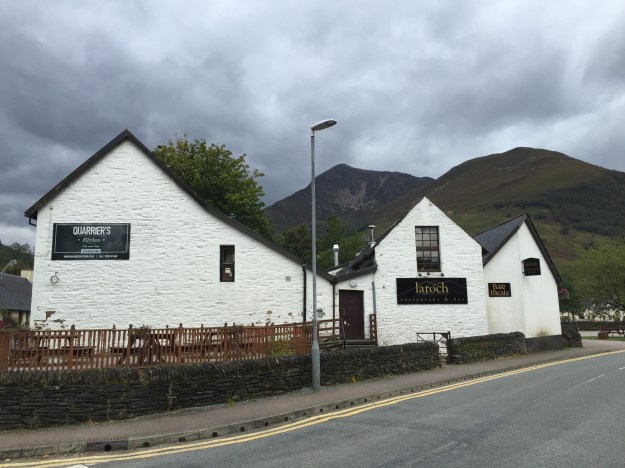
Leaving early meant that we’d arrived very early in Ballachulish – mid morning. The Marina had an arrangement with the local Isles of Glencoe Hotel so we could use their pool and sauna. We arrived early afternoon to find that we’d coincided with a children’s swimming lesson and only half of quite a small pool was available, but it was still good to freshen up and have a shower. The hotel also had a good internet connection and a lovely view across Loch Leven.   One drawback of the marina was its proximity to a main road, so there was occasionally some traffic noise, but within a short walk under the road bridge there was a well-stocked Co-operative store open 7am-10pm, a visitors’ Centre and café for lunches and afternoon teas and a hardware store. Also, just round the corner was Quarrier’s fish and chip shop and the Laroch Restaurant and Bar where we booked and ate later in the evening and were delighted with the food.

img_3430 Quarries and the Laroch Restaurant and Bar where we ate the night we arrived
The next day was sunny and we should have explored Loch Lever, but Ian discovered a serious leak from the engine water pump, which became apparent when the automatic bilge pump suddenly started pumping water overboard at 8am in the morning. Apart from the bilges being flooded, the well under the engine was full and water was continuously dripping from the water pump. This was the pump that (we thought) had been successfully repaired in Tobermory by Philippe – clearly a new pump was called for. It took 8 bucket loads to clear the bilges – 2 of which came from the engine well. From now on, if we were to limp to Findhorn with this engine problem, we had to use our 2 bucket engine well capacity wisely and empty it regularly and remember to turn off the engine stop-cock after switching off the engine. Ian had worked out that the water pump was under the water line, which is why it was dripping continuously.

The main part of the day though was getting Milo shipshape for the arrival of Andrew, Adam and the four children the next day. Normally we use the front cabin as a dumping ground and general store. Now we had to be creative with where we put things and were surprised how quickly we could stow luggage so that the front cabin became usable.  The plan was to eat at the Seafood restaurant down Loch Leven on the north side, for them all to stay the night on the boat and then for them to leave the next day to climb Ben Nevis, but the weather forecast was so bad that we were suggesting to Andrew that we should drive to the restaurant rather than sail as it would be pouring with rain with winds gusting to force 7.

img_3436View from our mooring in Ballachulish after a night of rain
Exploring Loch Linnhe

After starting the season in the calm waters of the Firth of Clyde in May, we had passed through the Crinan Canal to the Inner Hebrides on our first trip, experiencing some of the turbulent waters through the Sound of Luing up to the Firth of Lorn before leaving Milo moored at Tobermory on Mull. On our return in June we explored the outer Hebrides and experienced some of the wilder weather and waves that the Minch can bring. Now returning to Milo after a 10 week break we were ready to explore the inner lochs and experience calmer waters once again.

Lochaline. This is the Loch where we left Milo moored for 10 weeks for the wilder part of the Scottish summer. Characterised by the silica quartz sand mine at the narrow entrance and the destination of the Fishnish/Lochaline ferry from Mull, the Loch has been renowned over the ages as a safe anchorage. The winds must have been quite severe over the summer though, as only one of our 6 pennants was left flying – the other 5 had been ripped to threads.

img_3348Shower approach in Loch a’Choire

img_3357Leaving Loch a’choirs later in sunshine

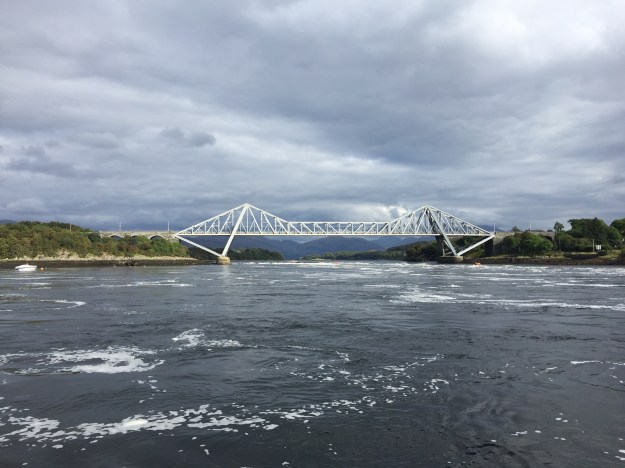
Loch a’Choire. We’ve described our experiences in Loch a’Choire and at the Boathouse Cafe in the previous blog. After a further day on the mooring in this Loch, we were keen to move on to Dunstaffnage where there was a marina with showers and the promise of an electric hookup to charge all our flat batteries and an internet connection. We had a peaceful sail across Loch Linnhe and down the Lynn of Lorn as the wind was on the nose the whole way so we mostly had to motor, although we tried tacking for a while on full sail in the wider part of the Lynn of Lorn after Eileen Dubh. As we approached Dunstaffnage we had a glimpse of Connel Bridge at the mouth of Loch Etive, our next destination. There was a seething mass of white water which we later learned were the “Falls of Lora”

img_3376Turn left at the Merry Monster and you’ll find your way to the village” – in the background Dunnstaffnage marina

Loch Etive. Dunstaffnage is about one nautical mile from the Connel Bridge and the entrance to Loch Etive. As we arrived at the marina we noticed a fast westerly stream crossing our bow – we had been given a berth number (D7) and put the fenders out on the port side and slowly came into the berth, but something was wrong. I could not get near enough for Ros to jump off with the warp. As I reversed out to try again we were drifting dangerously toward the adjacent boat and we got pinned against her anchor, which pierced our netting (and almost pierced Ros’s stomach). It took all our strength to push Milo away from her and head back out to sea for a second attempt. This time Ros did manage to jump ashore and tied the forward warp, but in no time at all Milo was swung broadside and it was when I was fixing a long mooring warp to her stern and started pulling her back round that I noticed that there was a strong tidal stream pushing into the berth – in the opposite direction from the tidal stream we had met coming into the marina, We later learned that there were cyclical tidal streams crossing this marina that always caught out yachtsmen when entering for the first time.

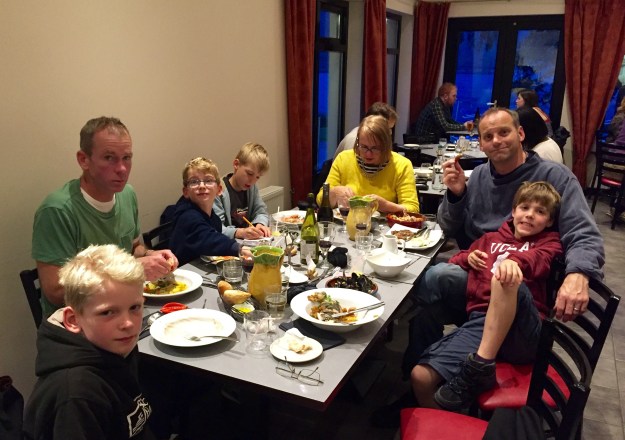
Ian’s surf & turf eaten while discussing the risks of entering Loch Etive

We booked to have an evening meal in “The Wide Mouthed Frog Hotel” that overlooked the bay and the marina, and while Ros stayed on board, Ian set out to find out more about entering Loch Etive. Ros had been inspired to sail into Loch Etive from reading the book “Off in a boat” written in 1937 by Neil Gunn.

One yachtsman who was just leaving when asked if he was local said, “no but I berth my boat here” – “oh great I said, can you tell be the best time to enter Loch Etive and are there any tricks I should know”. “No” he said, “I haven’t yet plucked up enough courage to do that”. The receptionist showed me a video of the “Falls of Lorna” – they looked terrifying. “Ask the Marina boys about it” she said. I did – none of them had gone through. “Ask the local fisherman – you’ll recognise him – he’s the guy with no hair at all” said one – “he goes through daily”.   After a long walk into the village, I did come across the local fisherman. “How powerful is your motor?”, “5knots max” said I. “Well you’d better time it right then – I’ve found that the guides get it wrong – leave it for an hour and a half after slack before going through – better in neaps”. By the time I had met Colin Taylor, the skipper of Moonshadow yacht charter limited, I had almost been persuaded to try sailing under the bridge. He had done this on a smaller boat. His 68ft Oyster was too tall to go under the bridge. He kindly showed me the charts and went through the procedures to follow to get through into Loch Etive and the obstacles to look out for. He and his wife took guests on 10 day cruises as far as Kilda and the Orkneys over the summer months and then spent the winter maintaining the boat. The crew guests who were leaving had been delighted by their trip and all seemed very happy.

img_3379Approaching Connel bridge at the entrance to Loch Etive at slack water

I chickened – decided it was too much of a risk. I’d prefer to study a few other yachts going through before trying myself. Besides there were further narrows higher up. I felt I had considerable local knowledge now and would try it one day when I did not have a time commitment later in the week. The meal that evening at the Wide Mouthed Frog Hotel & Restaurant was reasonably good. Ian had a surf and turf which was great on the surf side but the steak on the turf side really let it down. The next day I spoke to the proprietor, Rick Gothard, whilst eating a bacon buttie bap and having a coffee in the breakfast bar. It turned out that he ran a restaurant in Tenerife – in fact he’d worked there 20 years and planned to retire there. It was his wife who’d bought the hotel about 5 years earlier. It reminded me to call Pat, my sister, who owns a time-share on Tenerife.

We left Dunstaffnage fully charged, watered and fueled. Furthermore Ian had replaced his sailing boots lost in Loch Miodart, the oars lost in the Crowlins and our worn out sailing gloves, so we were starting afresh. We motored up to the mouth of Loch Elive and that was the nearest we got to passing through into the lock. Even though it was slack tide the water was still gushing through under the bridge creating whirlpools off the entrance. We understood now why the hour and a half was so important, but left Loch Etive for another day as we headed north again toward Port Appin.


Port Appin on the Lynn of Lorn. We’d read that we could moor off the Pier House Hotel and Restaurants. We had a very peaceful sail on a dead run to get there – making slow progress between 2.5 to 3.5 knots – we had the benefit of the tidal stream so we were in time to get the earlier sitting. The meal at this restaurant was not as good as we had expected. Ros’s fish dish was too fussy and Ian’s plaice not fresh enough. Back on the boat we had a good night’s sleep before setting sail for Ballachulish the next day at 7am to catch the early tidal streams and keep ahead of the strengthening winds.

img_3386Milo moored off the Pier Hotel & Restaurant with ferry from Lismore arriving in the distance
 

Lochaline to Loch a’Choire

Wednesday September 14th – a day in London for Ros – meetings followed by the theatre with Ian at the young Vic – Yerma by Lorka – a powerful and distressing play about a young woman’s despair at remaining childless. Whether it was the effects of the play or some of the stresses of work, Ros was seized by stomach cramps in the night whilst staying with Joanna in Clerkenwell. In the morning on Thursday September 15th it was a transitory pleasure to take Vyvan to school,  but a relief to sleep all the way to Bristol and when home into the early evening. This left very little time to pack and prepare for the journey to Glasgow the next morning, and the onward trip to the Western Isles and our to return to Milo.

The next day on Friday September 15th we caught an early flight to Glasgow and arrived to an unexpectedly glorious day. We took a taxi to Queen’s Street Railway station where we caught a train to Oban,  passing through the most spectacular scenery. By 3:45 p.m. we were on the Ferry to Craignure where the Tobermory bus met us and took us to Fishnish just in time to catch the short ferry back to the mainland again at Lochaline. We were met by Fiona from the ferry on a covered Quadbike and were transported to the marina.

The transition from Bristol to the Western Isles had been like a dream – the sun was shining, there was a seal and an otter playing off the marina and two Swans who’d been there earlier in the year had returned for the first time as we arrived. The troubles and pains of the last few days started to disappear. Fiona transported Ian to Milo in the marina rib and waited to see if she started – she did – first time. Ian had accidentally left the battery switch on in the 1+2 position and this appeared to have kept both batteries fully charged from the solar panel. Milo was brought into the marina single handed by Ian and given a free berth for the night to recharge her batteries and to be filled with water. We spent the evening discussing what to do in the next few days. Our long term plan was to travel through the Caledonian Canal and leave the boat near Inverness where we had return flights booked for Sunday 1 October.

After reading our pilot guides and the Charles Warlow “Scottish Anchorages” book that Andrew had given Ros for her birthday, we decided we would spend the first week exploring Lochs Linnhe, Etive and Lever before meeting up with Andrew and Adam + the four boys in Fort William early on Friday morning.

img_3323Our neighbour’s Yacht leaving Lochaline

Fiona had suggested that we spend the first night on a mooring in Loch a’Choire and eat at the recently re-opened Boathouse Café. We contacted the restaurant and booked a table for the following evening. The sun was still shining the next day and after motoring out of Lochaline and the Sound of Mull with the wind on Milo’s nose, we set sail on a broad reach up Loch Linnhe to our destination. We could see the sun falling on a cloud topped Ben Nevis in the distance – the whole mountain range looked magnificent in the evening sun and we hoped the weather would remain set fair for Andrew and Adam’s planned adventures for the weekend ahead.

img_3330Ros keeping warm in the weak sunshine on the way to Loch a’Choire
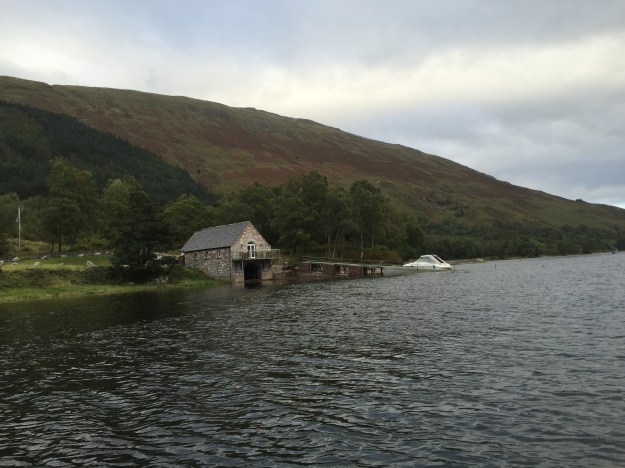
As we entered Loch a’Choire we were impressed by the immenseness of the surrounding mountains – Charles Warlow had said “the surrounding hills positively invite you to jump up them directly from the deck, they seem so close”. With the tender pumped up and emptied of water, we set off for the Boathouse Café. Just in time Ros suggested we put the anchor light on as it would be dark when we returned. The restaurant was a beautifully converted boathouse and the couple running it were very friendly. Unfortunately, Ros found the food very disappointing. Her leek and potato soup was very watery and her steak and kidney pie glutinous and overly salty. Ian enjoyed his bacon wrapped scallops and black pudding and also his venison pie which was tender and tasty, but even he was disappointed by the pastry which was a tiny flaky strip placed on the top when he was expecting a proper pie crust. As we left for the tender we realised we had left the torch behind and precariously, using Ros’ iPhone torch, we launched the tender which had been left high and dry by the tide. We realised that it was so dark, that even with a powerful torch (let alone the iPhone one) we would have never seen where Milo was without the anchor light on. With the anchor light, it was like sailing down a moonbeam and with relief we eventually clambered on board

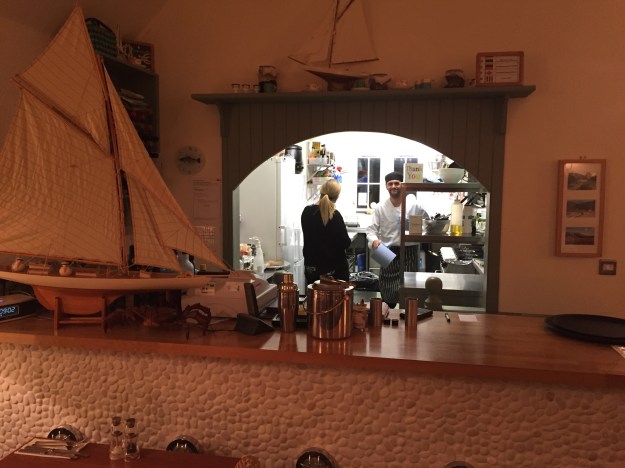
img_3334The Boathouse Cafe – Loch a’Choire

img_3339A yachting theme at the Boathouse Cafe with the chef in the open kitchen in the distance
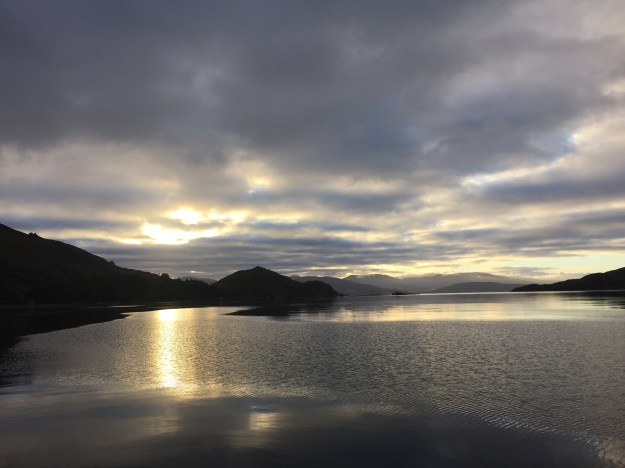
The next day, as was predicted by the weather forecast, it was overcast with a cold front with heavy rain passing over from 10am to 6pm. Ian got on with some work and Ros bunkered down and started to read “Off in a Boat” by Neil Gunn,  given to her recently by Anna Edwards. As she became more deeply  involved in the book she became fascinated by stories written in 1937 of the author’s travels with his wife around the west of Scotland. She started with one of the later chapters where the author writes about entering the Corran Narrows – “It was a day of tall cloud, sun and fragrance after the rain – a transformation that makes life on the west so dramatic; from glooms and drowning deeps to sky shepherd driving his white flocks down the blue fields of paradise (page 320)”

IMG_3345.jpgSunrise in Loch a’Choire

Kyleakein to the Cullins and our return to Tobermory via Muck

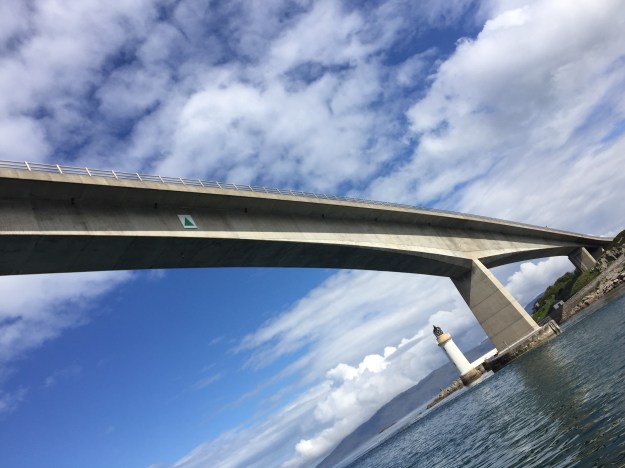
Sailing under the bridge from Kyle of Lochalsh to Kyleakin must always be spectacular. We passed by the Crowlin Isles and anchored in the north inlet, had lunch and then a quick swim. Quick because the water was so cold. The local cormorants (or shags) looked on in amusement while they hung out their wings to dry.

img_1853Passing under the bridge linking Skye with the mainland

img_1845A “Quick” swim off our Crowlins anchorage
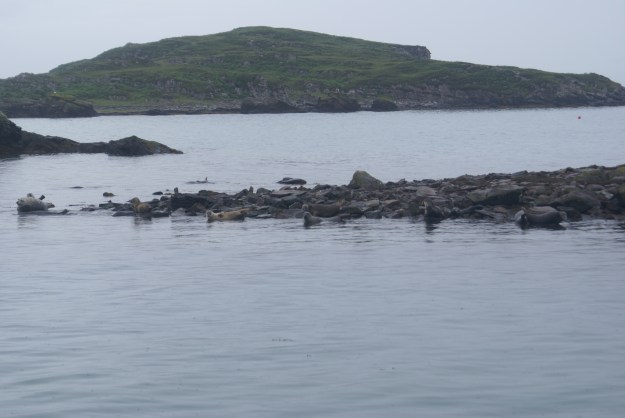
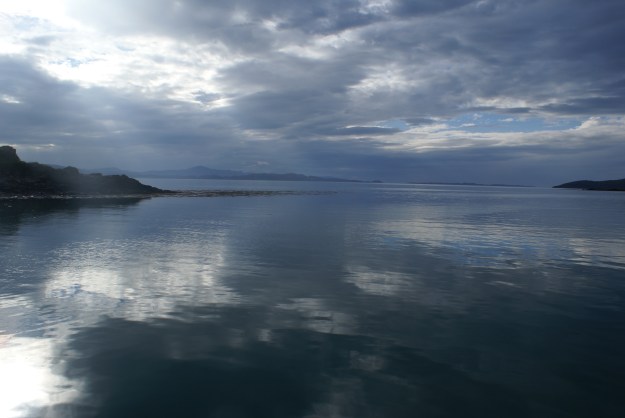
We re-anchored that evening in a quiet inlet just north of the Crowlins and just south of Applecross Bay where Joanna had camped. We were surrounded by a seal colony. I think what surprised us most was how noisy and restless they were. They burred, coughed, spluttered snorted very loudly to clear their nostrils after surfacing. They clearly like the sun and would clumsily hoist themselves up unto seaweed clad rocks to bask in the sun letting their whole bodies curl up like a parabolic reflector to send the rays back to where they had come from. When they got too hot – they would noisily splash back into the sea. They kept their distance from the boat. Occasionally a curious head would rise nearby to check us out. We ate on deck with the setting sun and the spurious noises of our new found friends.

SONY DSC

Our new found friends and noisy neighbours

SONY DSC

Our peaceful dawn before we heard the news about Brexit

We were were now out of internet and phone contact and we went to sleep that evening feeling optimistic that the vote that day would not be for Brexit. Next morning, still anxious about the Brexit vote, we suddenly remembered that we had a radio on board. Ros was waking up as Ian began to tune into Radio 1, the only station he could get. Ros will never forget the rude awakening, pop music blaring loudly followed by a rather jokey Radio 1 DJ announcing that the country had voted to leave the EU. Disbelief and depression followed and we remained glued to the radio, listening to David Cameron’s resignation as PM later that morning. We set sail for Tobermory leaving the seals behind but no longer feeling the joy that we had experienced the evening before. Later that day when we were in telephone reception again we had long conversations with Joanna and Andrew about Brexit. And when we finally reached Edinburgh on Saturday, Hugh and Skye were also keen to discuss Brexit. By then Skye was doing an excellent take-off of Nicola Sturgeon saying (about Scottish independence) “We will put it on the table….it is on the table”. Hugh was full of gloom about Scotland breaking away from England. And Percy as usual had his head in a book.

img_1875Sunset fro our anchorage in Muck harbour
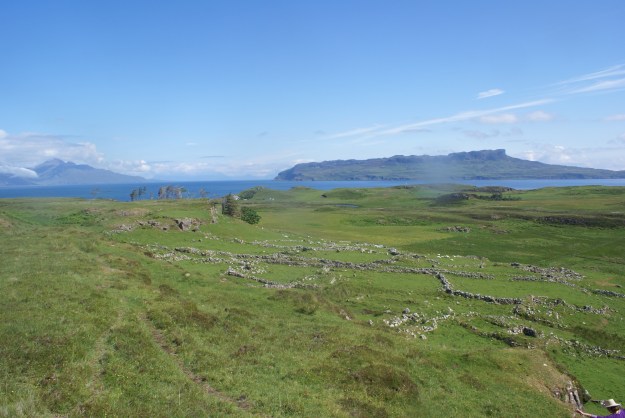
But before travelling to Edinburgh we had two more nights on Milo. The first was on the island of Muck, probably symbolic of the muck up that Cameron had made of the referendum – he should have never allowed anything other than at least 60:40 to lead to an exit. Muck is a pleasantly peaceful island owned by the MacEwen family. Jenny MacEwen, who we met briefly, owns a craft shop near the harbour and a café where we had a start-the-day coffee. We walked up to the top of the island, not very far, where there were impressive views across to the islands of Eigg anf Rhum. On the way back we passed through the ruins of an abandoned village – A’chille – apparently there had been as many as 300 people living on the island before the clearances in 1826 and now there were only 40.

SONY DSC

Milo on the pontoon in Muck harbour

SONY DSC

View across to the Isles of Rhum and Eigg from Muck

The next day we set sail for Tobermory. We were tossed about quite a bit by the rollers but had a good sail passed Ardnamurchan arriving in Tobermory with wind gusting force 5. Here we met our Dutch friends again from Kyleakin and joined them for a drink on their boat – they tried to cheer us up about Brexit but it was an uphill struggle. The next day I sailed Milo single handed to Lochaline while Ros took all our luggage round by car across the Fishnish/Lochaline ferry. Lochaline marina staff, Fiona and Chris were very friendly and it felt safe leaving Milo in their care – soon we were on our way to Edinburgh through more stunning scenery but from a different perspective.

Meeting our Dutch friends again in Tobermory

Inverie to Kyleakin, Skye

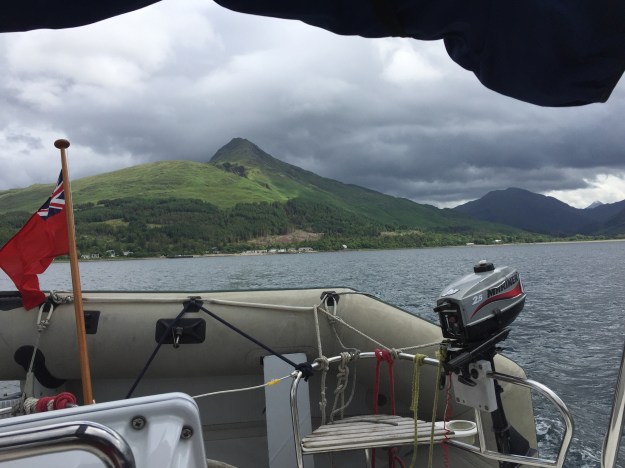
IMG_1781 Leaving Inverie and the Knoydart Peninsular
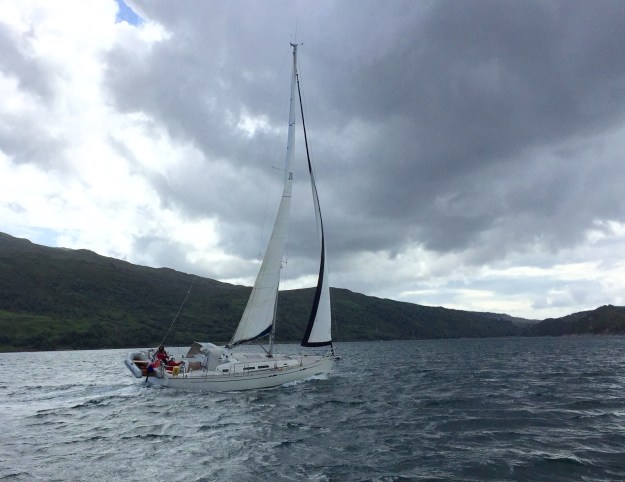
Today we broke our usual rule about not sailing in more than a force 4. The winds were from the south and we were going north so a force 4 gusting 5 would not be too bad. We put in a single reef to be on the safe side and made good progress up the Sound of Sleat passing through Kyle Rhea when the tidal flows were in our favour. During a spring tide the current through Kyle Rhea could reach 8 knots so in a yacht that has a maximum speed of 5 knots – it is important to get this right.

IMG_1794 (1)Being overtaken in the Sound of Sleat

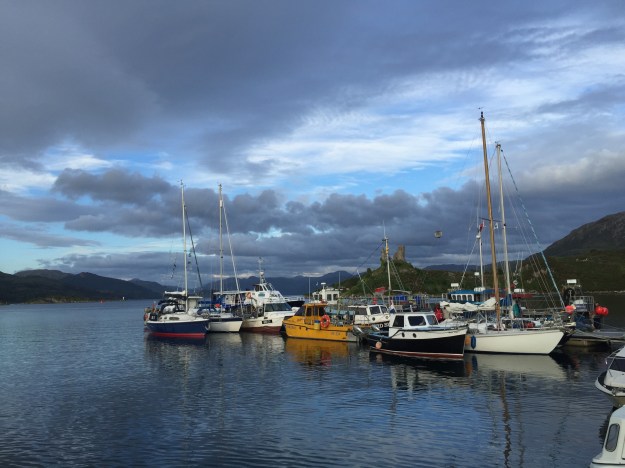
As a consequence we got to Kyleakin well before we had expected  and berthed in the only gap we found,  as all the spaces on the pontoon were taken over by fishing boats.

IMG_1801Rafted on the pontoon in Kyleakin with fishing boats predominating. Milo on the left, Isolde on the right.
Fortunately we were hailed from the pier by a fisherman who warned us that Atlantis, a glass bottomed boat, would be arriving any minute to offload passengers where we were now nicely tied up. Ooops .. a quick engine start and removal of the mooring wharfs and we just managed to leave as the Atlantis arrived, but where to go? Another Ian came to the rescue – he was moored on the other side of the pontoon and agreed that we could raft against his boat,  which was rafted in turn against a fishing boat. Although from Perth, he kept his boat in Kyleakin and was not planning to sail the next day.We were just starting to prepare our evening meal when another boat came alongside and asked if they could raft against us. They were a Dutch couple in a beautiful old “Contessa” like boat with a wooden mast and a non-furling jib. However, a local fishman thought they might go aground where they were and advised them to move further in and raft against another old boat. Ian and I helped them do this and we arranged to meet up later on Milo for a drink. Ian, keeping his boat moored in Kyleakin, was a great source of local information. He said the pontoon had originally been constructed for visiting yachts, but starting with a fisherman who had a health problem requesting a temporary berthing there, a slow take over by local fisherman began. Now you’d be lucky to get two single spaces for yachts. Also, there used to be visitors’ moorings, but now these had disappeared or been taken over for other uses. Ian advised us against going up the East coast of Skye and mooring in Portree as we had planned. He recommending instead the Crowlin Islands and Poll Domhain which were more remote (more in next blog). We learned about Calum’s Road – two and a half miles of road between Brochel Castle and Arnish on the Isle of Raasay built by Calum MacLeod singlehandedly using hand-tools to benefit the community and make it easier for his daughter Julia to return home from Skye where she had been sent away to school (listen to Calum’s Road by Colin MacDonald. BBC Radio 4 – Saturday Drama -Broadcast on Saturday, 5th October 2013). The Dutch couple, Bert & Lea, arrived with a huge bottle of Dutch gin, which you either drink on its own or with coka cola. I tried it on its own and to me it was a bit like a grappa. Like us they had sailed to Scotland from The Netherlands last year and wintered their boat just north of Oban. They had come across in 24 hours to Lowestoft, sailed up the East coast and crossed to the Western Isles via the Caledonian Canal. Bert’s father had bought their boat, Isolde, new in 1967 and it had been in the family since. I remember thinking – gosh that’s 2 years older than our Morris Minor and I was imagining an equivalent scenarios of us driving the Morris to Scotland instead of the Audi with journeys of 10 hours rather than 6.

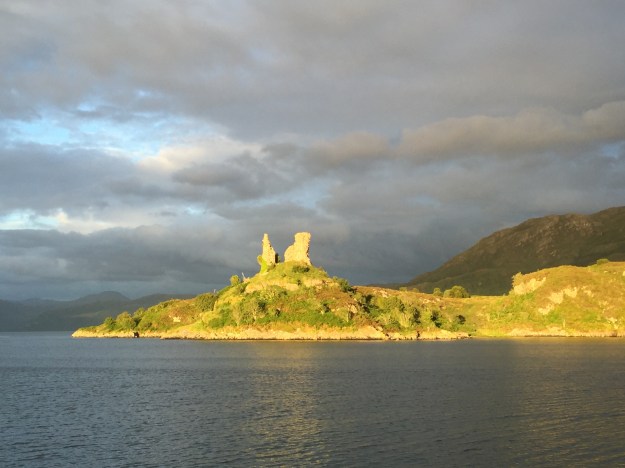
We heard stories about Moil castle and Saucy Mary. Moil castle, also known as Dunakin castle was the ancient seat of the Mackinnon clan. It was a fortress overseeing the strait of Kyle Akin between Skye and the mainland, through which all ships had to pass  to avoid the stormy passage of The Minch. Findanus, the 4th MacKinnon chief, brought Dunakin into the clan around the year 900 by marrying a Norse princess nicknamed ‘Saucy Mary’. Findanus and his bride ran a heavy chain across the sound and levied a toll on all shipping vessels.

IMG_1816Moil or Dunakin castle viewed from Kylekin harbour
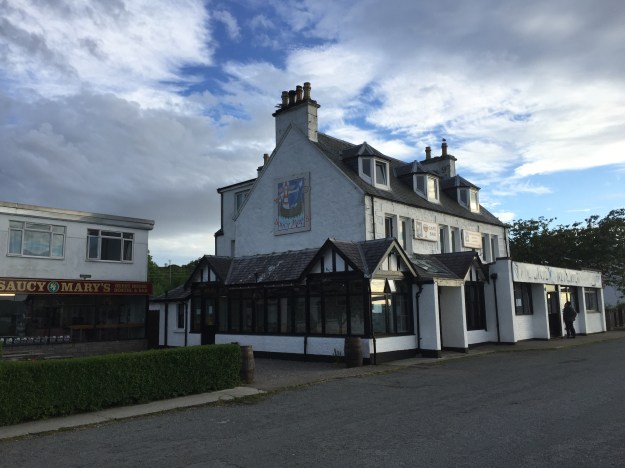
IMG_1806 The local pub is named after Saucy Mary and its facilities are used by the harbour authority for fishing and yachting people.
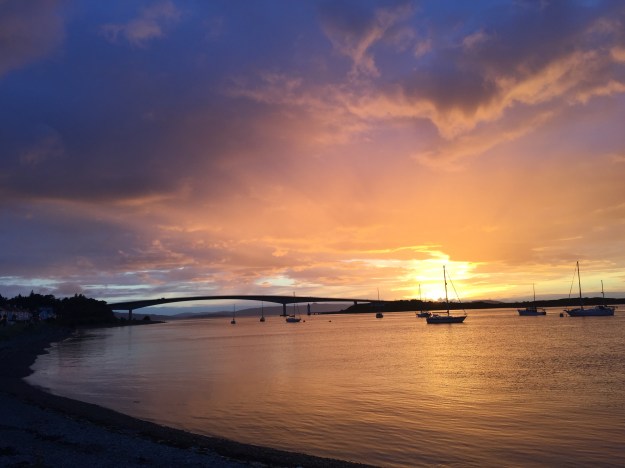
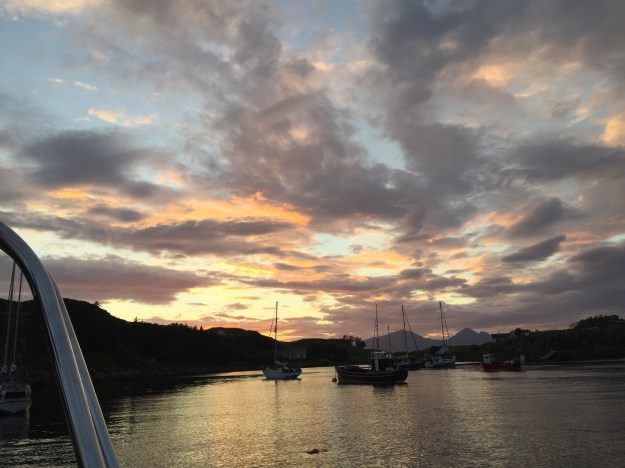
It was the evening of Wenesday 22nd June. There was a beautiful sunset over the bridge to Skye and with the EU referendum the next day – I hoped this would not symbolise the ending of our EU era.

IMG_1824Sunset from Kyleakin, Skye on the eve of the EU referendum
Mallaig to Inverie, Knoydart Peninsular

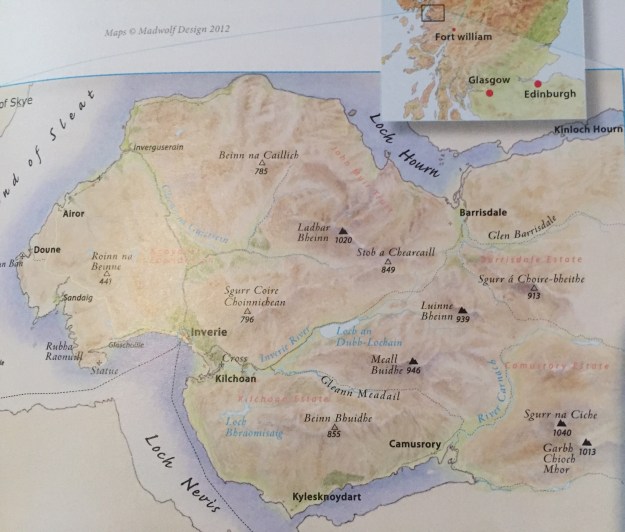
The Knoydart peninsular came highly recommended by Joanna & Dan who’d camped there 3 years earlier. It is on the mainland but cut off from the rest of Scotland by a range of high mountains and only accessible by boat or hiking over a mountain pass.

IMG_1762

Joanna had seen a basking shark from the ferry on the way to Inverie 3 years earlier, so Rosamund (below) was on the lookout during our whole passage from Mallaig to Inverie, sadly without success.

IMG_1742 Ros looking for basking sharks.

We picked up a “The Old Forge” mooring and later ate at the restaurant. After mooring we noticed a large boat drawing up to the pier – then a piper welcomed them ashore. But not many went ashore. Rosamund later learned from two Germany people she met that the boat “Lord of the Glens” was full of German tourist and they had started in Inverness for a cruise along the Caledonian Canal through Loch Ness to the Hebridean Islands of Mull, Skye, Iona and Eigg. They advertised a drink at the most remote pub in the British Isles at Inverie before crossing the sea to Skye and the picturesque town of Portree – that pub was of course “The Old Forge”.

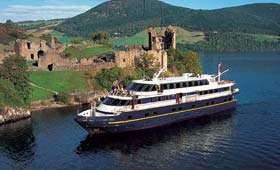
LordOfTheGlens The Lord of the Glens.

The Knoydart Foundation was established in 1997 to work on behalf of the community. The Foundation took over the management of 17,200 acres of peninsular land in 1999. They are now a charity with responsibilities including housing, a hydroelectric system, the visitor service, and the land/wild life habitat management. They also provide a ranger service. Knoydart is not connected to the national power grid and now has an independent green electricity supply serving all the properties in Inverie. Knoydart Renewables Ltd (a trading subsidiary of the Knoydart Foundation) is responsible for the hydro electric system fed by Loch Bhraomisaig on the slopes of Beinn Buidhe.

SONY DSC

The totem pole carved and erected by the local school children to reflect the history of Knoydart

On returning to Inverie the following morning, I had post cards to post at the Post Office (see below) – election day Thursday 23rd June was the next day and I could not tell how they would vote as there was a “Vote Remain” poster in the Post Office window but a “Vote Leave” poster in the window of a car drawn up outside. But I also had strict instructions to get some venison steaks from the local shop when it opened at 10am for us to enjoy that night – hopefully to enjoy the results as they came in and for Britain to remain in the EU.

IMG_1760 Vote remain in the post office window and vote leave in the car window.
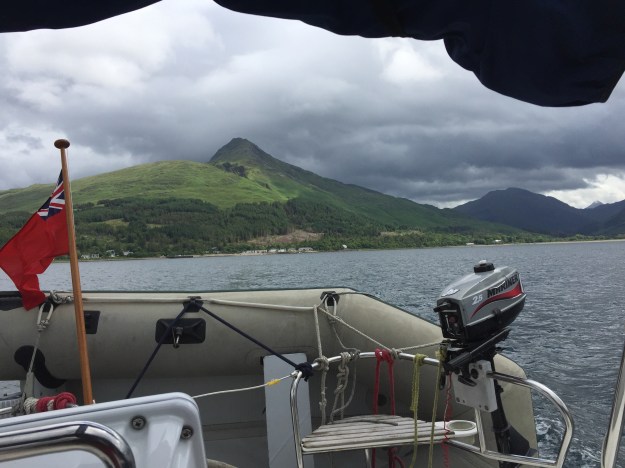
IMG_1781Leaving the magnificent vista of the Knoydart Peninsular