Arklow to Howth

Compared to our earlier passages the passage to Howth was relatively uneventful. We took advantage of the strength of the tide by timing our departure for 6:30am, about an hour after low tide to catch the force of the tidal streams going north. Unfortunately, instead of westerly winds they were more like northerly so we were forced to motor sail most of the way with just the main up. But we had 3 knots of tide at times so 5 knots became 8 knots and we raced towards Howth. On two occasions despite relatively light winds we came across overfalls. The first was Breaches Shoal which was marked on the chart, the second was between Greystones and Codling Bank and was not marked. As wind was against tide these were disproportionately rough and as we were pitching into the waves I was surprised at one point by the bow going under and the boat, despite the motor, coming almost to a halt. I noticed that the water became quite shallow over the shoal (of course) and then sloped steeply away into deep water resulting in these huge transitional waves.
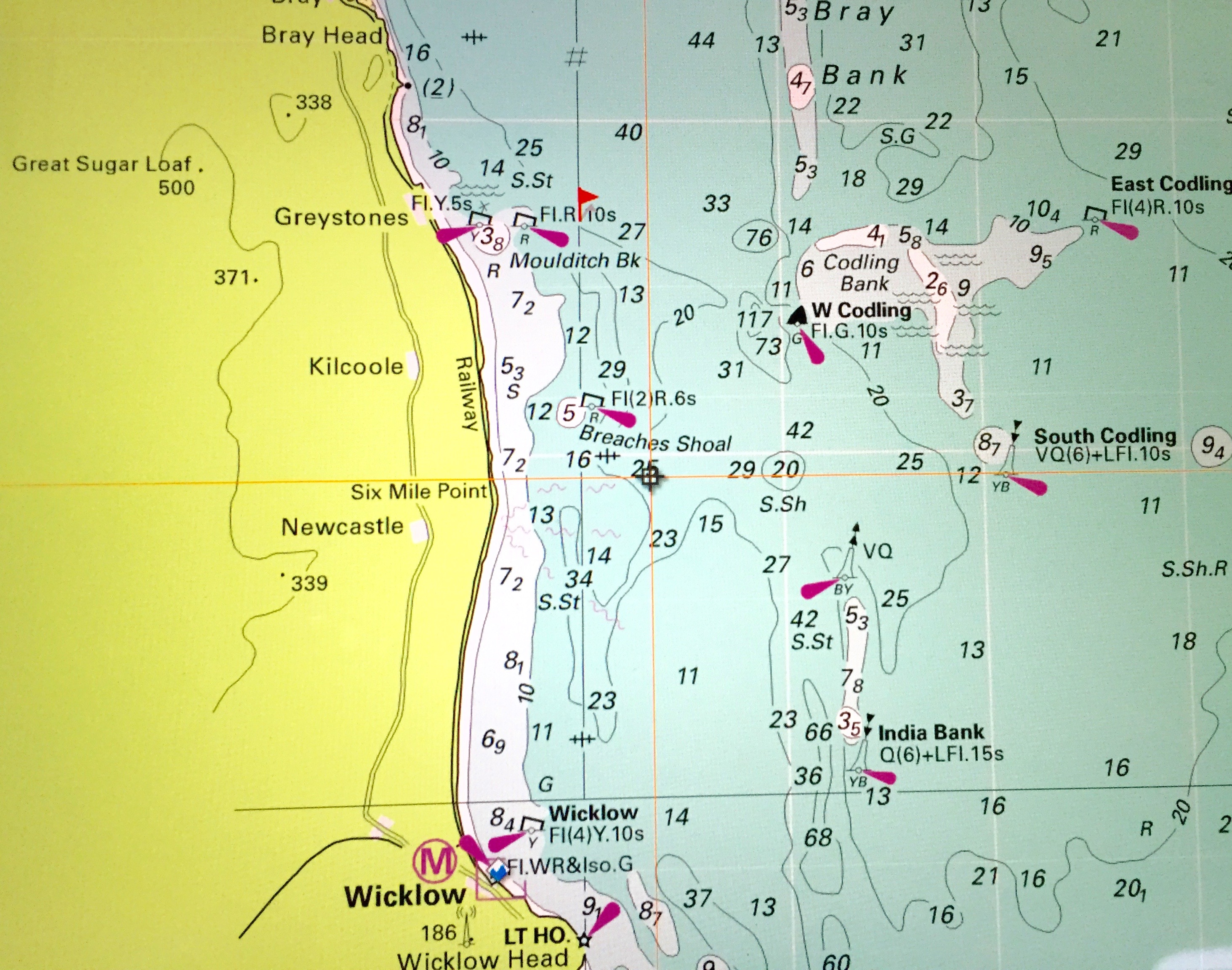
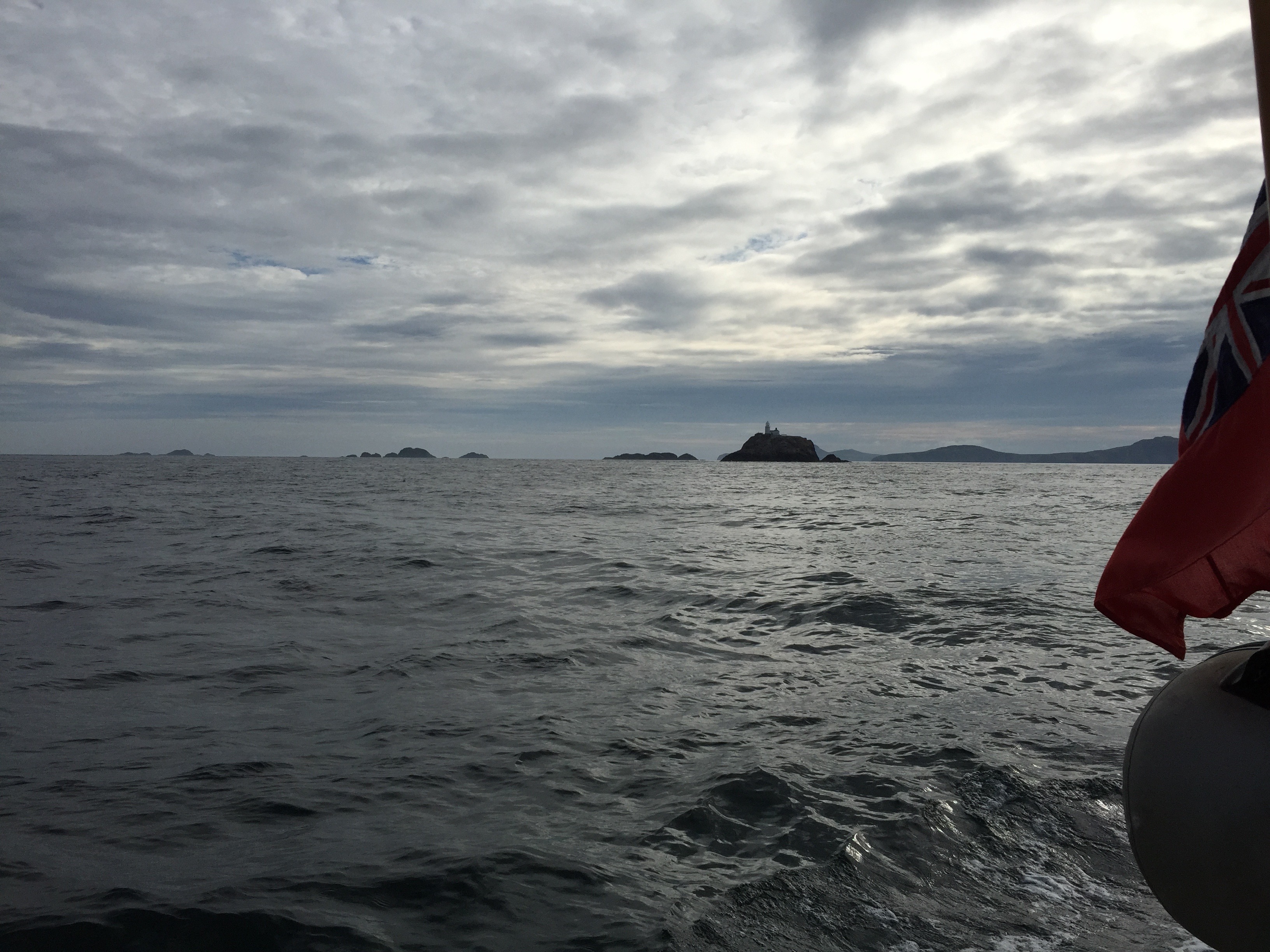
IMG_6852Note shoals north of Wicklow – Breaches Shoal (marked) and an unmarked one between Greystones and Codling Bank

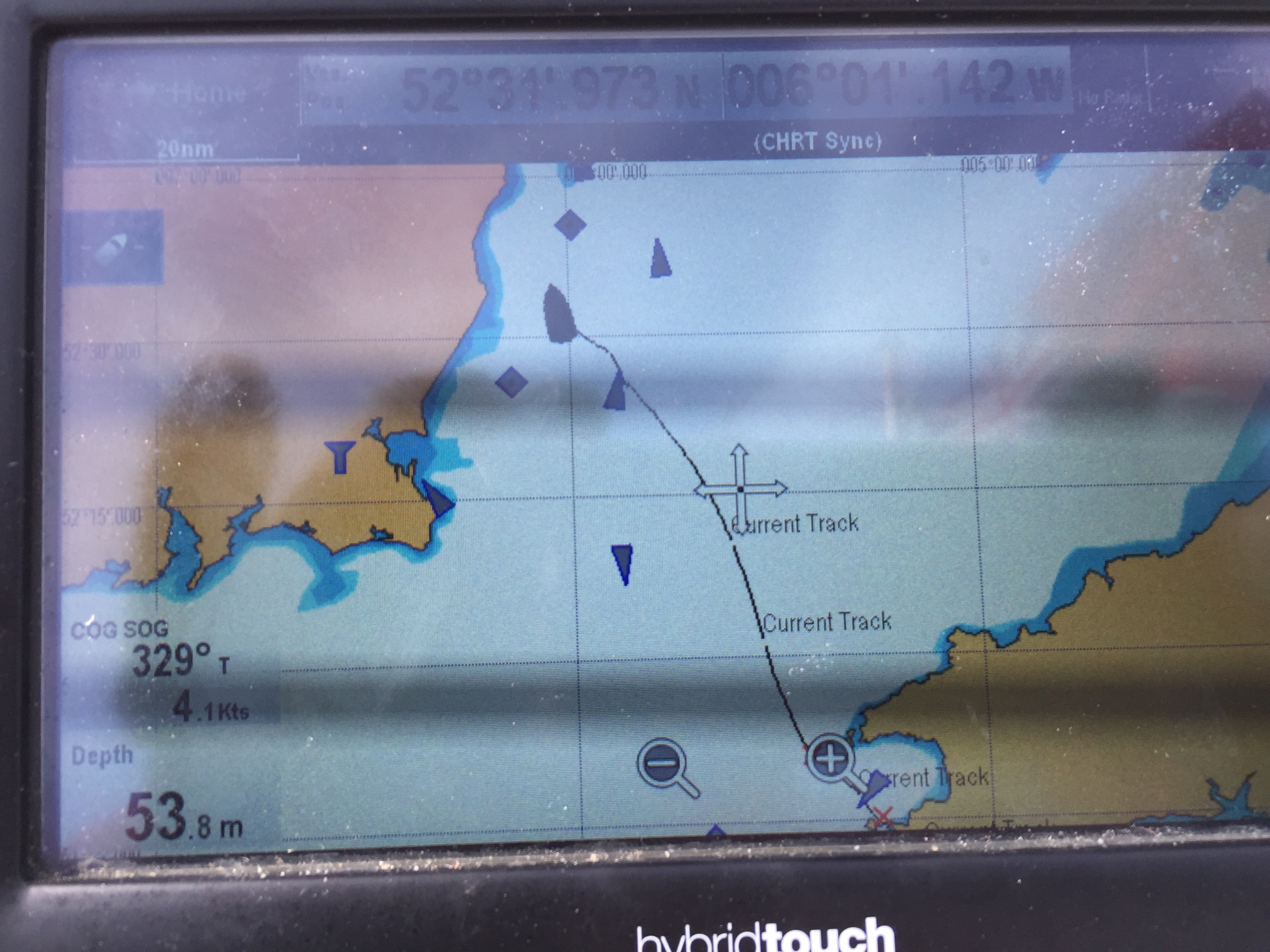
IMG_6868Marine Traffic chart showing our track from Arklow to Howth after it was first detected north of Wicklow.

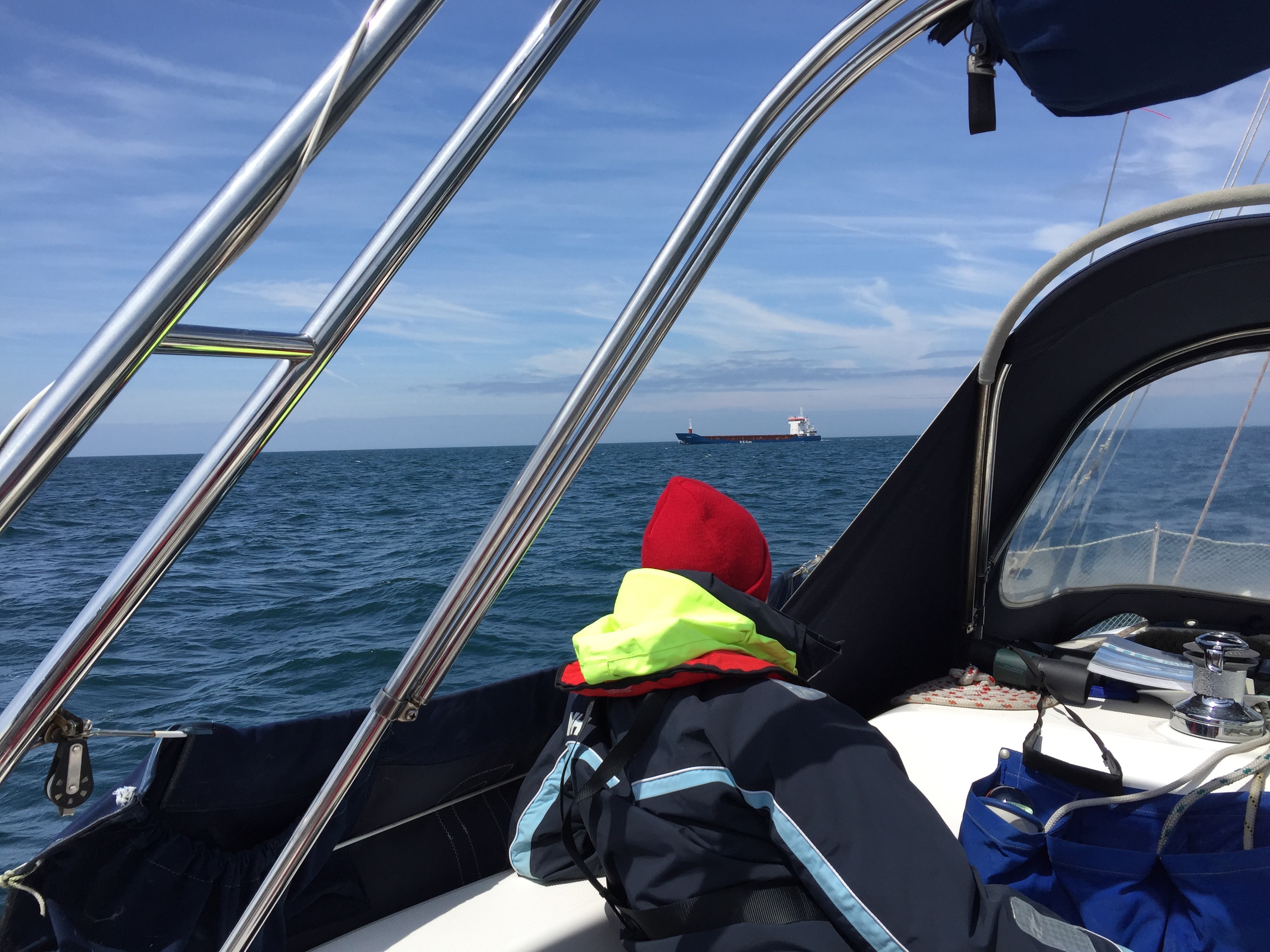
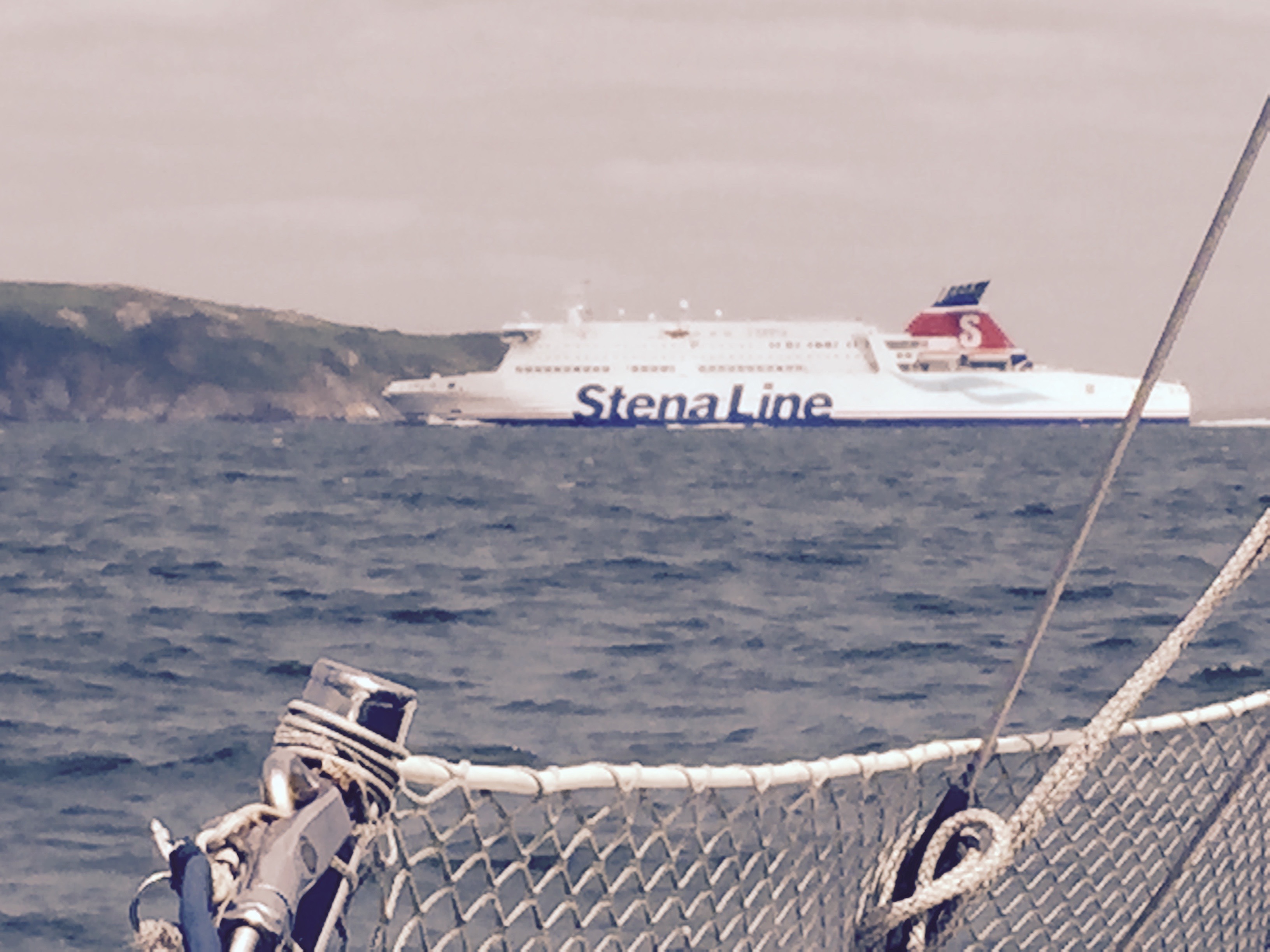
We had several near misses that looked threatening. One a huge tanker that looked as if it was going to run us down and the other the Stena Ferry probably from Angelsea. Both in the end cut in front of us to go to Dublin by about 0.7nm but nevertheless their size made it feel like a few hundred yards! The AIS of course did predict they’d miss by that margin but I took regular bearings in the old fashioned way just to check.
IMG_3526

The Stena Ferry reminded us of the time Rosamund & I took our bikes on the car to Angelsea and then came across on the Stena Ferry to Dublin. We cycled through Dublin to the railway station and took the train to Cork where we were met by Richard Beard who drove us to Lough Hyne near Baltimore where they have a most beautiful house on the Lough. We stayed there with him and Irene for a few days before cycling on round the South Westerly tip of Ireland. I remember talking to Irene about one of her outbuildings that was rather ruined. Richard had purchased a day boat and we had fun sailing round Baltimore bay. “Wouldn’t it be good if we had a boathouse” said Irene. I sketched something on a piece of paper and was amazed the next time we visited to see it not only built, but the boat in it and places to change and shower as well. It was no coincidence that several years later when Richard had given up sailing the boathouse became extra accommodation for the expanding family and friends.

Howth was everything our Irish sailing colleagues had promised. The House restaurant was also excellent. Rosamund and I both ate fresh crab and hake. The Howth Yacht marina was huge (300 berths) and extremely well equipped. There was also an excellent Marine Supply shop and chandlery nearby, so I took advantage of some free time to both refuel and calibrate the fuel tank. We had nearly run out of fuel on the last trip because I’d noticed that the fuel disappeared more quickly when near empty than when full – I later discovered that this was because most boat fuel tanks are triangular in shape in order to fit in the hull and fuel gauges do not compensate for this – my calibration showed that the 71 litre tank held only 28 litres in the bottom half of the tank and 43 litres in the top half.

At lunch time Rosamund and I left for Dublin on the Dart train. It was rather a culture shock to suddenly arrive in the centre of a busy city. We had different objectives for our visit – I wanted to focus on the waterfront, while Ros wanted to do some shopping. As we both wanted to visit Trinity College and go to see the book of Kells and have a Guinness afterwards – we ended up doing everything. The Guinness was a highlight as they were playing live music in the pub we chose in the Temple Bar area and for me the tall ship in the waterfront area was a highlight as it was the 90m training ship, the Cuauhtemoc (1,755 tons) from Mexico and was open to the public so I was able to see around it. I’m fascinated by these ships as my great-grandfather, Jean Canese, captained one like it in the late 19th century on voyages to New Zealand and back. The Cuauhtemoc was a modern version built in 1982.
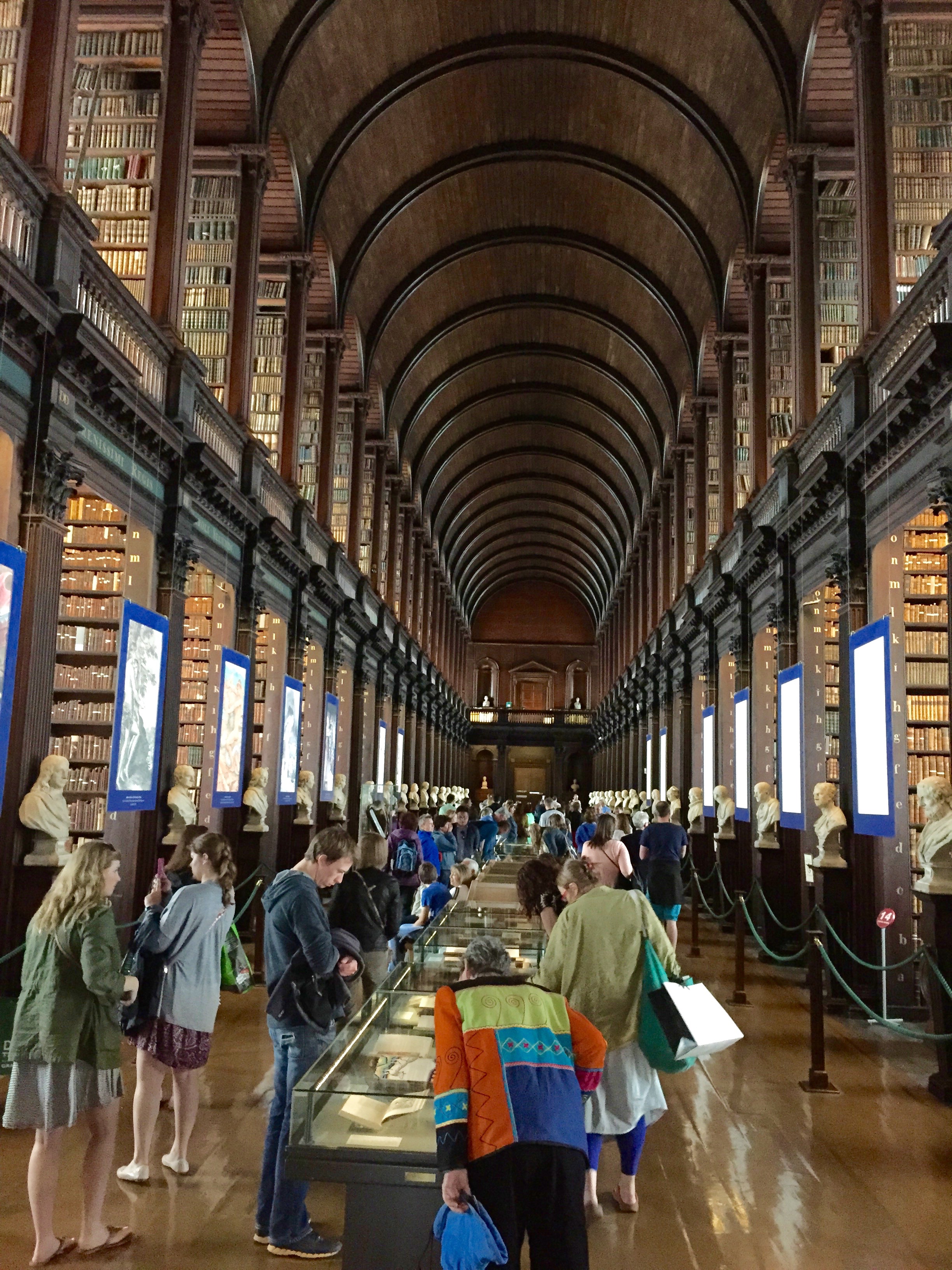
IMG_6877 The impressive vaulted library at Trinity College Dublin – we thought Percy would be at home here knowing his love of books – we visited the Book of Kells in another section of the library

IMG_3549 (1) IMG_6890The Mexican training ship Cuauhtemoc

Not sure what Joanna would have thought of the new architecture on the river front. The new exhibition centre was like a Guinness can tilted on its side – the swing bridge was more elegant but in contrast to all the other bridges.

IMG_6887The new exhibition centre – young boys in wetsuits were diving and somersaulting off the bridge (shown below) – much to the amazement of the crowds.

IMG_6906

It was a relief in a way to return to the peace and tranquility of the waterfront at Howth and we were pleased with our decision to eat again at The House.
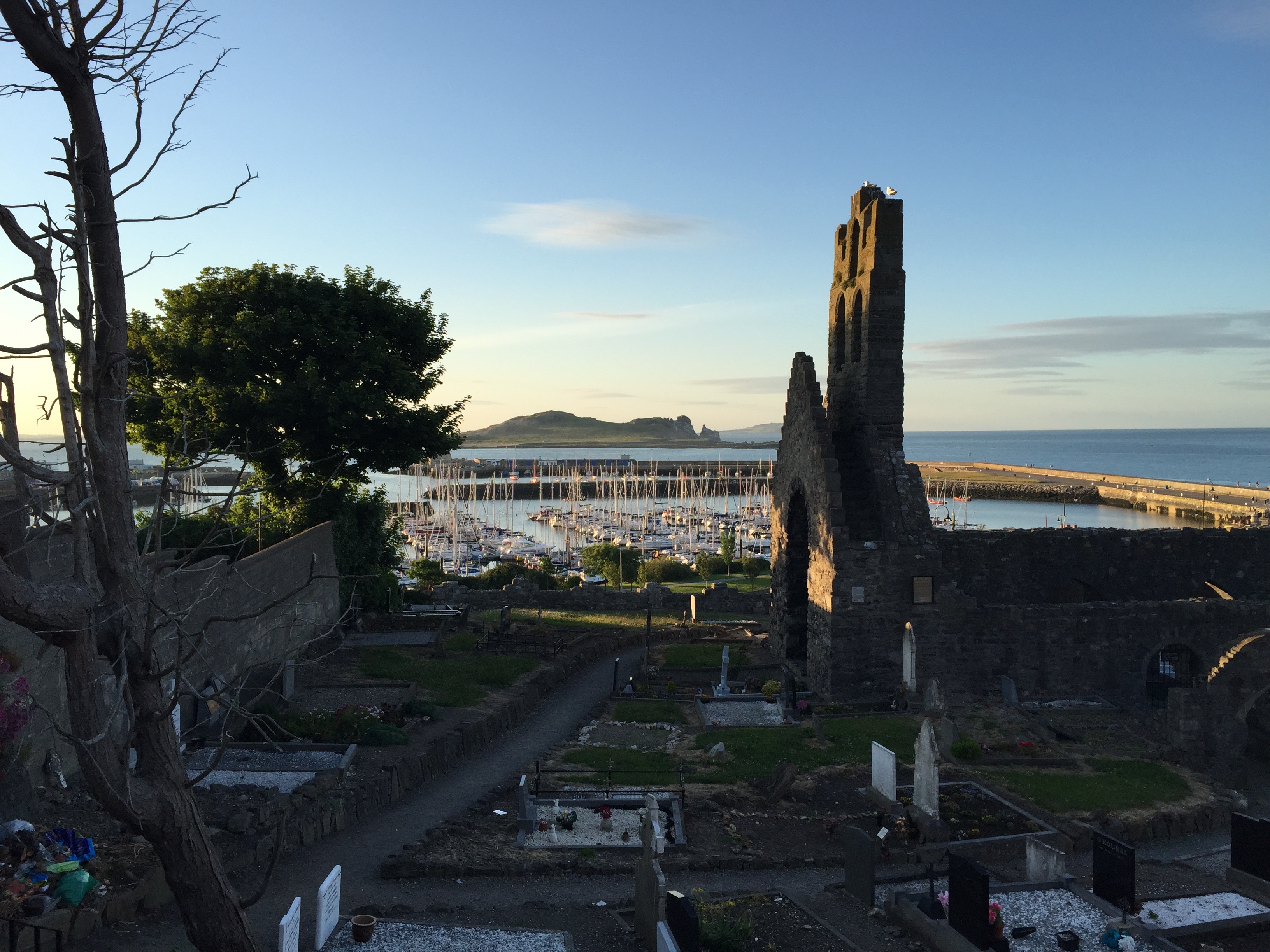
IMG_3539 View from Howth Cliff Walk

IMG_3545 (1)A heron walking on the seashore.  We also saw one on the pontoon and assumed it was responsible for all the crab debris scattered about

 

Crossing the Irish Sea – Dale to Arklow

Crossing the Irish sea had always been our waterloo. It had to be carefully planned, as Ros was adamant that she did not want to do a night sail. Initially we had thought about crossing to Rosslare or Wexford, but our chance meetings with sailors soon confirmed that Rosslare harbour was a passenger terminal and not yacht friendly and Wexford, though beautiful, had moving sandbanks at the entrance which could be quite hazardous to navigate, not what you want after a long crossing. So in the end, after reading a few books, we decided to bite the bullet and go straight from Dale to Arklow in one long day. We were fortunate with the tides as we could leave Dale at 5:30am one to two hours before high tide to get favourable tide flows through Jack Sound and then northerly tidal flows until about midday after which we had to put up with southerly tides until after 6pm when we had a tidal boost for our final approach.

It was an emotional moment sailing across the Marloes bay and one we could not savour in its entirety as the tide was high and its glorious sandy beaches were not visible. Nevertheless the coastline was majestic and passing through Jack Sound, where we’d often picnicked while observing the swirling streams below, was a magical moment.

IMG_3498Approaching Jack Sound.

Jack Sound is a treacherous stretch of water between the island of Skomer and Wooltrack Point on the mainland of Pembrokeshire. There are numerous reefs and a tidal race of up to 6 knots. It is famous as boats frequently used Jack Sound as a shortcut to avoid the 3 mile detour going round the outside of Skomer Island. One of the most popular wrecks is the Lucy that sank in 1967 in good condition with a cargo of calcium carbide. When we passed through the sea conditions were calm but we still had to navigate a three knot race and very lumpy and swirling currents. I was comforted by Kevin’s advice of the previous evening when he said – “keep to the middle and just let the boat go where it wants to go. The currents steer you round the obstacles!”

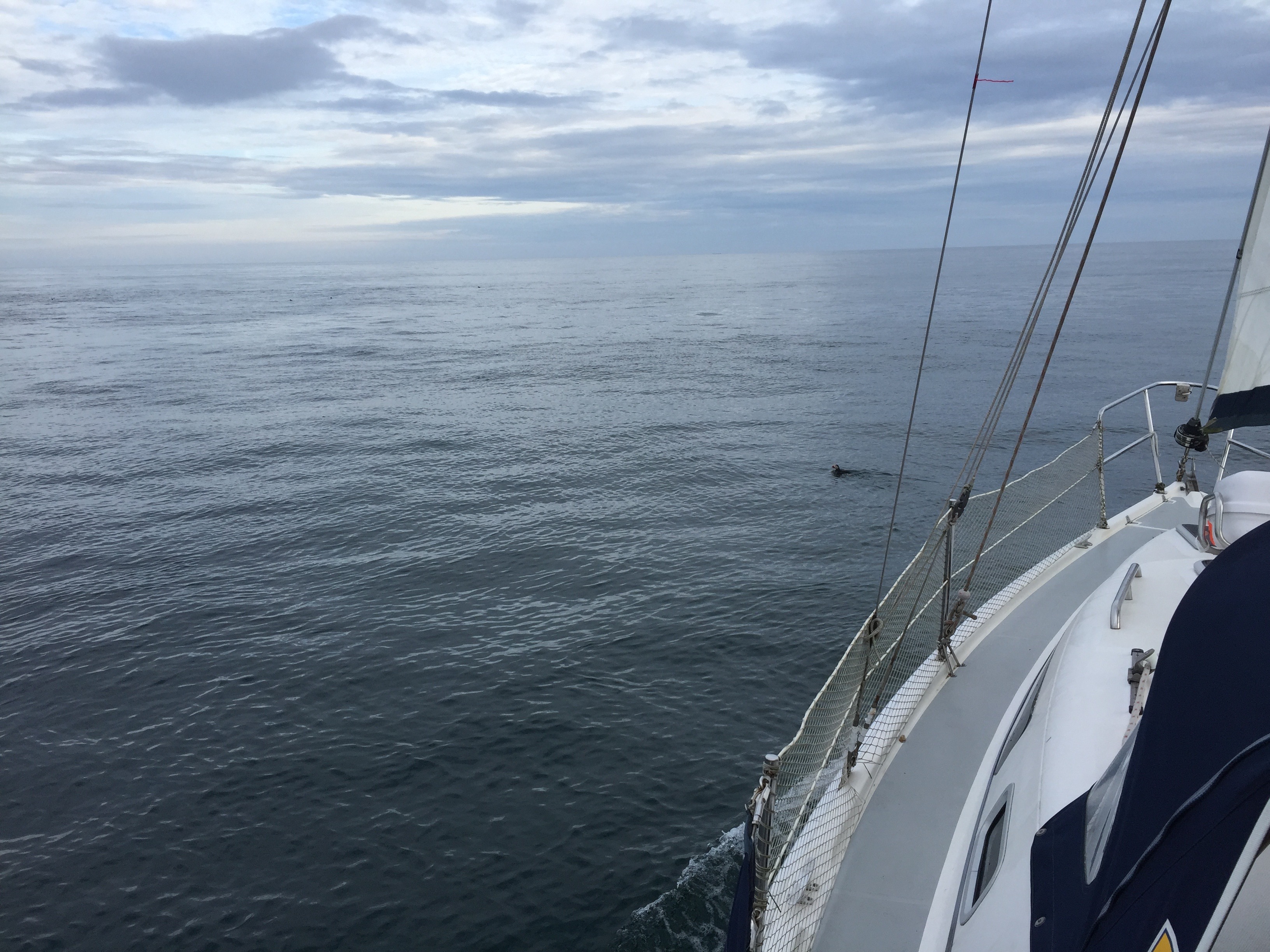
What was delightful as we emerged turbulently from Jack Sound was to see the many Puffins swimming and diving off shore quite close to the boat. There was also a dolphin (or possibly a porpoise) that surfaced just once but this time chose not to join us.

A Puffin in the water off the port bowA Puffin in the water off the port bow

The Automatic Identification System (AIS) was great as we crossed the Irish Sea as you could identify ships on a potential collision course even before you could see them and then slightly alter course to miss them. The AIS also tells them where you are – so both parties are on the lookout. This time I made sure I had my AIS switched on, but Andrew still complained that we disappeared shortly after leaving Bishop’s Rock off Pembrokeshire, causing both Andrew and Joanna to worry that we’d foundered on a rock. They were not reassured until much later that day when we came into mobile phone contact as we neared Ireland.

Leaving Wales and Bishop's Rock when our AIS tracking was lost

Leaving Wales and Bishop’s Rock when our AIS tracking was lost

AIS picking up shipping in the St Georges ChannelAIS picking up shipping in the St Georges Channel

Ros tracking a near miss

Ros tracking a near miss

We arrive in Arklow just over 13 hours after leaving Dale, tired but happy to be in Ireland.

Milo just berthed on the outer pontoon in Arklow Marina.

Milo just berthed on the outer pontoon in Arklow Marina.

We took the next day off and in walking around Arklow I was stuck by how many shops were closed down or for rent. The people were extremely friendly and helpful and I managed to get a number of small jobs done on the boat. We met sailors from Dun Laoghaire on the pontoon and later joined them for a drink at the sailing club. This crew were heading for Brittany via the Scilly Isles, sailing  overnight with an hour on the helm and two hours off. They told us how good Howth Marina was north of Dublin and that “The House” restaurant was a must – valuable information which we took advantage of later. Earlier we had met Derek and Norman from Portsmouth who were returning from Scotland. Derek, who’d sailed round Britain several times enthused us both with sailing in the Western Isles of Scotland. He had lived for a time north west of Glasgow and told us that he never tired of sailing in the Firth of Clyde with its links with Loch Fyne and the East & West Kyles and then proceeded to tell us all the best places to visit. We went to bed that night very excited about our impending travels in Scotland.


Dale – our half-way destination

We were very happy to have reached Dale. We have camped on the Marloes peninsular in Pembrokeshire since the 1960s  and the late May bank holiday had become a ritual camping week with the Roddy family, the children, the grand children and many other friends. It was our starting to sail three years ago that broke this ritual for us and voyaging to Dale by sea was a symbolic return to a part of the country we loved.

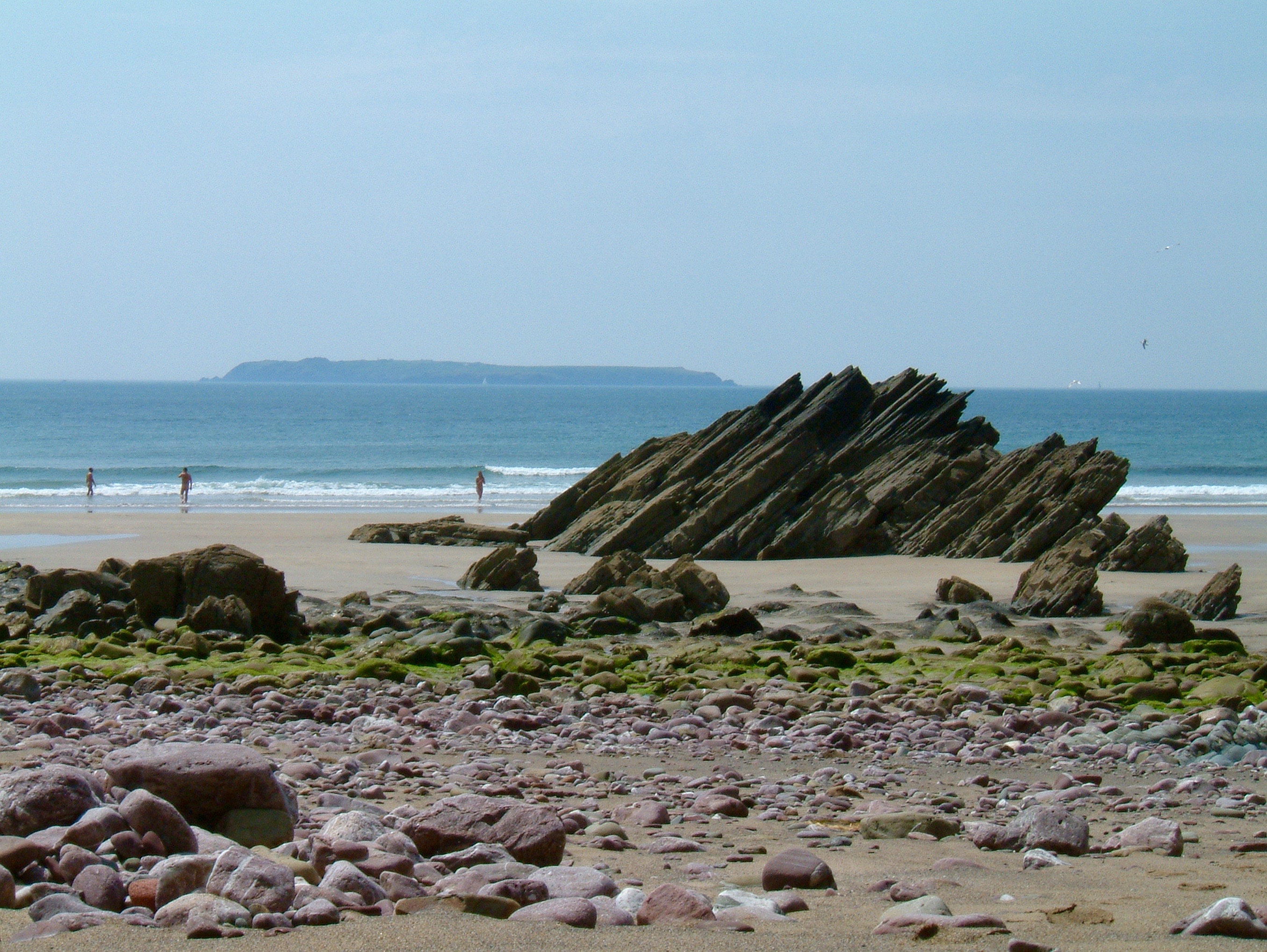
DSCF1726 (1)The Marloes red beach looking out toward Skokholm Island.  Skomer is just out of site on the right.

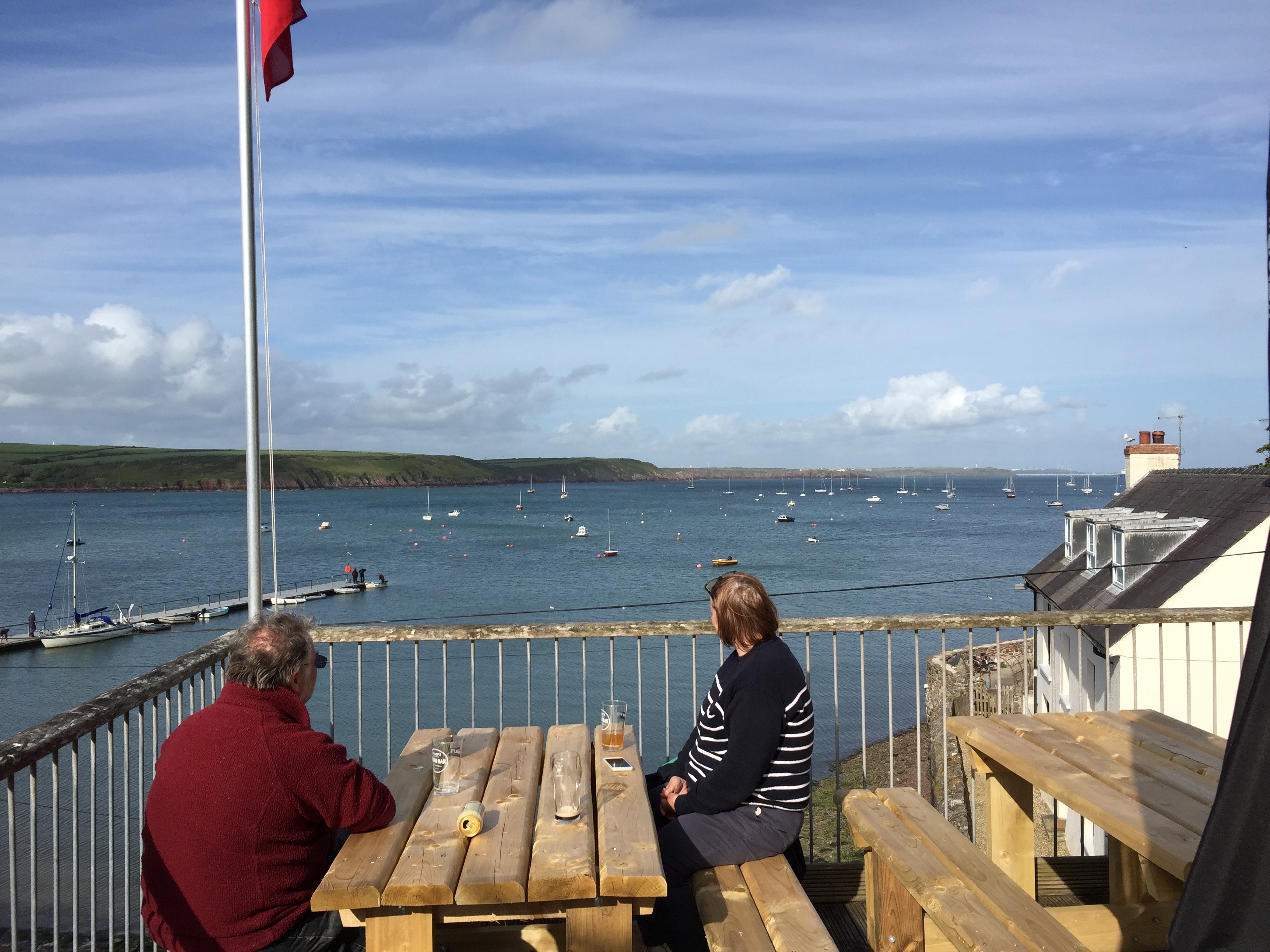
We motored ashore in our tender to meet Kevin Rogers at the Dale Sailing Club – we had a drink on the roof terrace overlooking the bay.

IMG_6510Dale Sailing Club with the new “The Moorings” restaurant

IMG_6493 Looking out from Dale Sailing Club terrace – Ros with Kevin Rogers who had lent us his mooring while his yacht was being repaired.

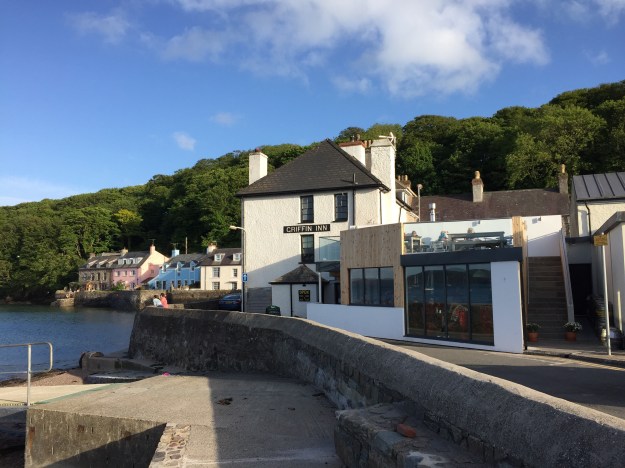
 Earlier we had passed one of our favourite pubs, the Griffin. Many a year we had spent camping on the Marloes peninsular using the Griffin as a meeting point for a drink afterwards – sitting out on the wall in the evening sun while the children played on the beach. We were horrified to see that new owners had built a modern annex as a restaurant and terrace, which jarred with the beautiful row of stone houses and destroyed the view from the harbour.

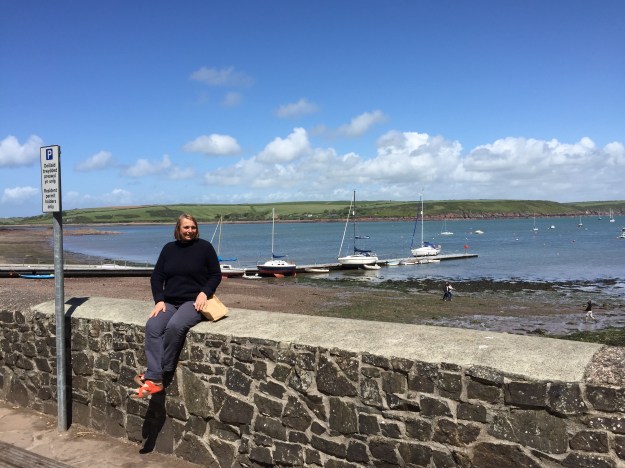
IMG_6511Ros on the wall near the Griffin 
IMG_6496 The Griffin with the new extension in the foreground

But all was not lost as you could still sit on the wall and enjoy a pint as long as you kept your eyes firmly seaward. And the good news is that Paul Garnish and his wife who used to run the Griffin are now running “The Moorings”, a restaurant at Dale Sailing club. We had a very enjoyable meal there of freshly caught fish.

Next day we were to return to Bristol for a week and Kevin once more came to our aid, borrowing a friend’s fishing boat to transport us and all our luggage to the pontoon.

IMG_6507Kevin at the helm of his friend’s fishing boat transporting us and our luggage to the pontoon. Milo is in the background on his mooring.

He promised us a better solution a week later when we were due to return and he was true to his word. He took his own tender out to Milo and brought her single handed into the pontoon to welcome us in the evening sun on our return from Bristol.

IMG_6799  Kevin bring Milo alongside the pontoon at Dale to greet us on our return from our week away.

After a meal at the Moorings with Kevin and Tina we retired early. The next day would be our long anticipated passage across the Irish Sea.

Through the firing zone

The last and only time I’d sailed across the Bristol Channel was on one of my RYA training runs nearly 30 years ago. We were heaved-to and boarded by the customs and excise with machine guns. They had suspected us as being drug runners from South America as they had no record of our passage plan from the local coastguard. Tim, our trainer, spoke first and clearly his Welsh accent put them at their ease. “Oh bugger” he said “I forgot to register our passage plan – sorry chaps, would you like a cup of coffee?” – and there we were in the middle of the Bristol Channel sipping coffee and exchanging tales with the now relaxed assault crew of the nearby Naval Vessel hovering on the horizon. We learned how they had been shot at several times during assaults and had often seen crew off-loading drugs into the sea to avoid prosecution by being caught in possession.

But I was relaxed, this would not happen this time – I’d reported my passage plan to Falmouth coastguard, switched on the AIS and satnav and was heading on a straight bearing toward Milford Haven inlet. The weather was sunny and bright – what could possibly go wrong. While we were happily sailing on a beam reach, I noticed after a few hours that there were some somber looking clouds and storms emerging from the west. The winds got stronger and suddenly a squall came along with heavy rain and the wind suddenly veered to the NW (ie on the nose) and I had to take down the jib and motor sail for a while as the winds were gusting to force 5 and the sea was becoming quite choppy. But the storm passed and the wind settled back into the west and we were sailing once again with stronger winds toward Milford Haven, when I got a text from Andrew asking why my AIS was switched off. Earlier, I had said to Ros, “this is not like the English Channel, I can’t see any ships on my AIS (not realising it was switched off). We then worked out what had happened. I’d heard the main VHF above the chart table making quite a hissing sound so I asked Ros to switch it off.  But she switched off the main VHF switch on the control panel, which switched off both the VHF and the AIS. I then switched the main VHF switch on and the AIS system clicked into action and suddenly I could see shipping everywhere on the screen. So we had just crossed the Bristol Channel playing a form of Russian Roulette. Luckily the visibility was good and we had not been mown down.

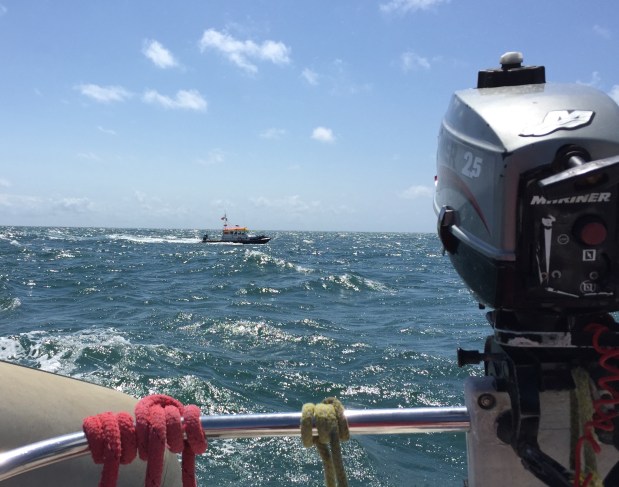
As we got within an hour or so of Milford Haven and were back within sight of land, Ros said that there was a boat on the port bow – it seemed to be coming toward us. Then she said, “it is coming toward us very fast, I think it’s going to ram us”. Sure enough – it came alongside about 50m off and I could see some writing on the side “Range Patrol” – the vessel was called the “Smit Penally”.

IMG_6485

I turned the VHF handset onto the emergency channel 16. “Smit Penally, Smit Penally, this is Milo, this is Milo, over”; “Milo, this is Smit Penally. Move to channel 08, channel 08, over”. I switched to channel 08 wondering what was coming next. “Smit Penally, Smit Penally, this is Milo, this is Milo on channel 08, over”; “Milo, may I ask you what port you are heading for? Over”. “Smit Penally, this is Milo, we’re heading for Dale in Milford Haven over”. “Milo, this is Smit Penally, you’ve headed into the military firing zone during a firing exercise and we have had to halt firing while you are here. I’d like you to head 270 for 3 nautical miles immediately until you clear the zone. Over”. “Milo to Smit Penally, copy that, apologies.” There was then a mild panic on board as we were sailing on a close reach on a course of 327. Heading to 270 would turn us directly into wind – a direction we just could not sail in. So we had to furl the jib, which was not easy in the strong wind, tighten the main and start the motor before heading due west on 270. Smit Penally shadowed us close behind escorting us the whole way until we were out of the firing zone. It then advised us that we could then head on a course 330 into Milford Haven.

IMG_6489 (1)

Milo’s track on AIS showing where we were intercepted by the Range Patrol and had to change course by heading west to get out of the firing zone as quickly as possible so that they could resume firing.

By then the weather was getting fierce, at least force 5 and the sea state quite rough, although oddly the sun was starting to break through – it seemed to be clearing up. As the waves entered the bottle neck of Milford Haven they got even higher, so I kept Milo on motor and main making up to 8 knots on occasion with the tide. It was  a huge relief when we rounded to the lee of the Dale Fort headland. We’d been offered the use of mooring D27G by Kevin Rogers of Dale Sailing Club while his boat was out of the water. We picked up the mooring and then had a well-deserved cup of tea and a late lunch to celebrate the completion of the first half of our journey to Scotland.   It’s hard to believe that Pembrokeshire is half way to Scotland, but we have now travelled 290 nm through the water on a voyage that will reach 600nm as we get to Holy Island off the Isle of Arran in the Firth of Clyde, Scotland.

Dolphins again on the way to Lundy

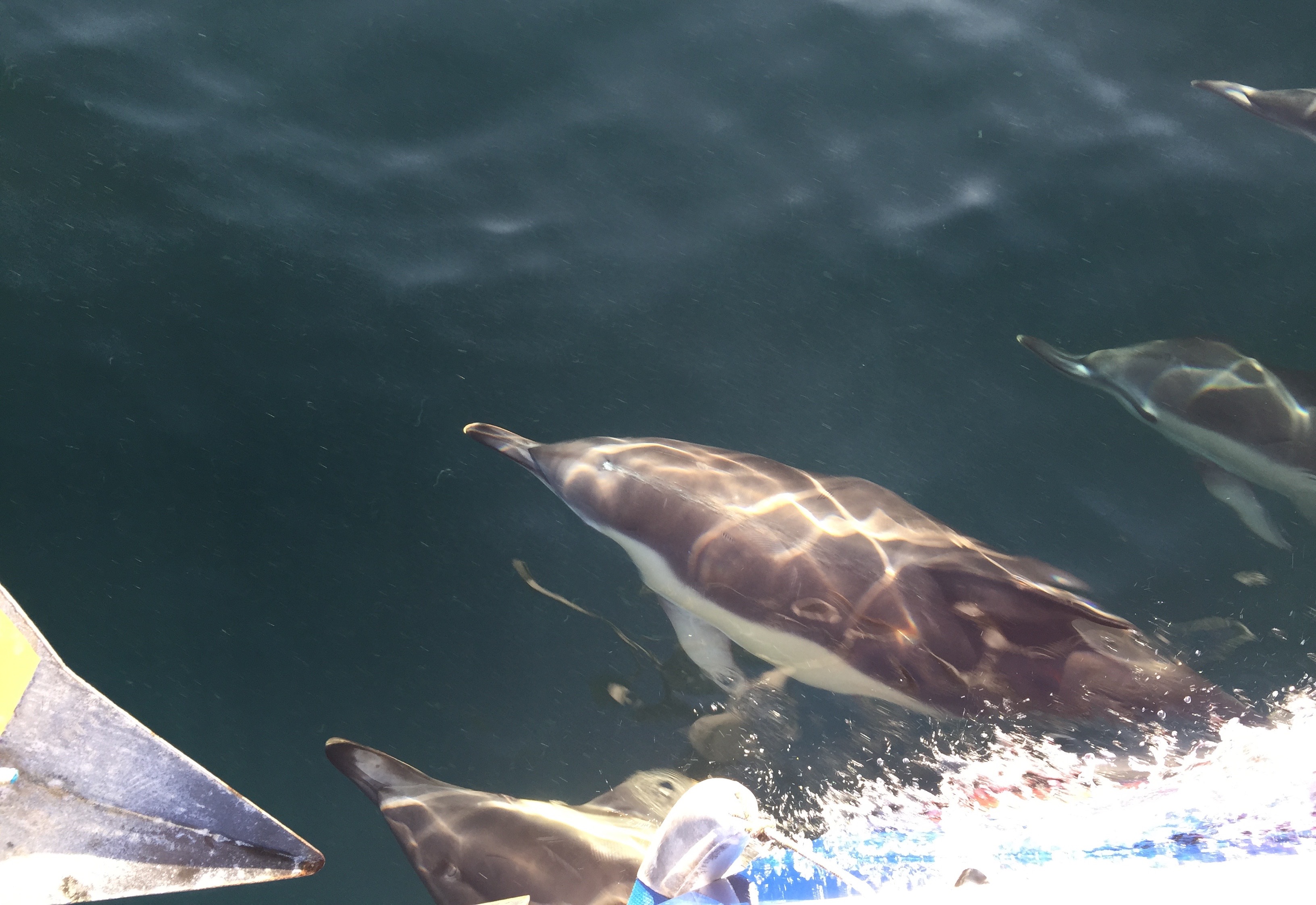
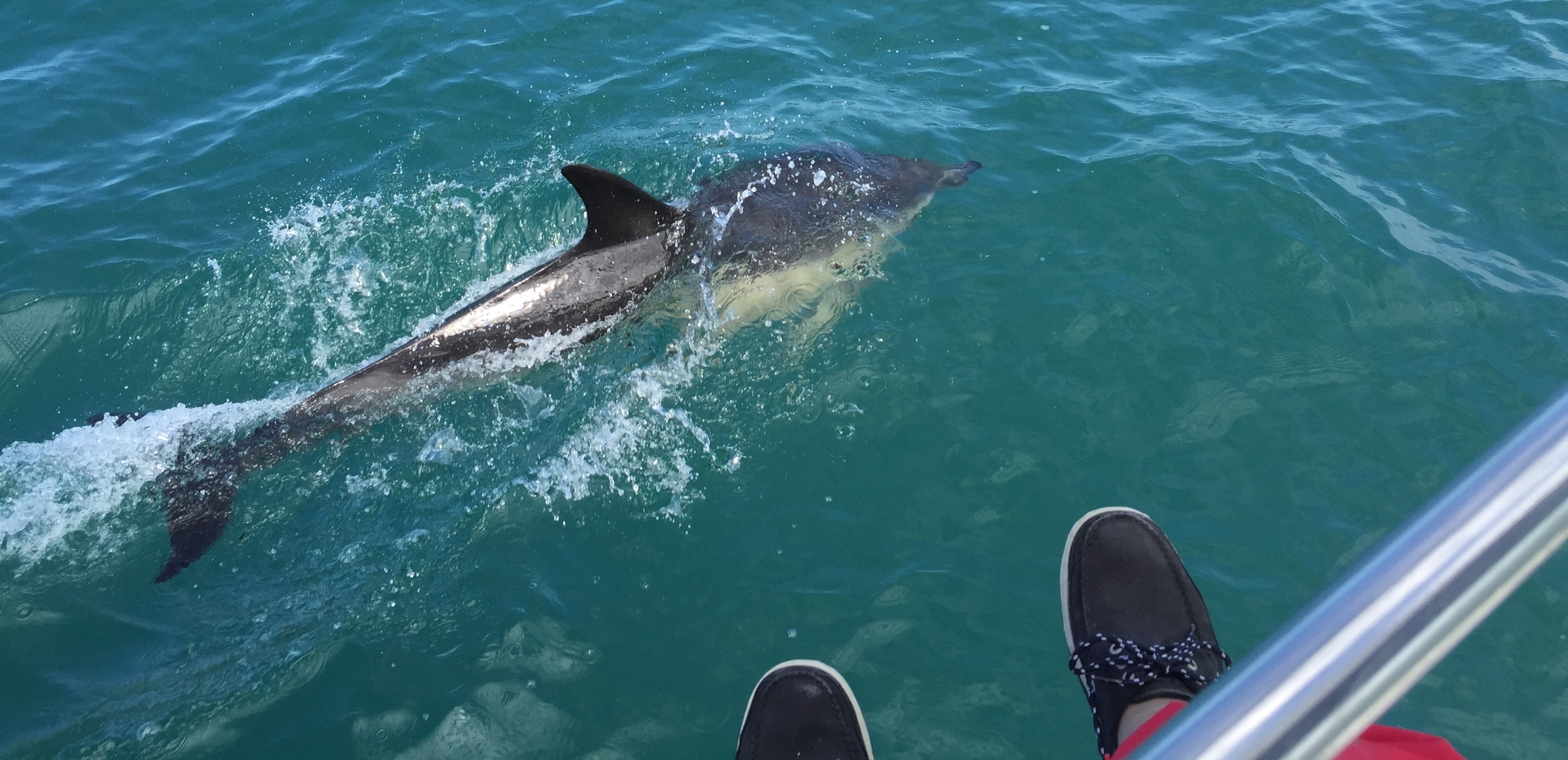
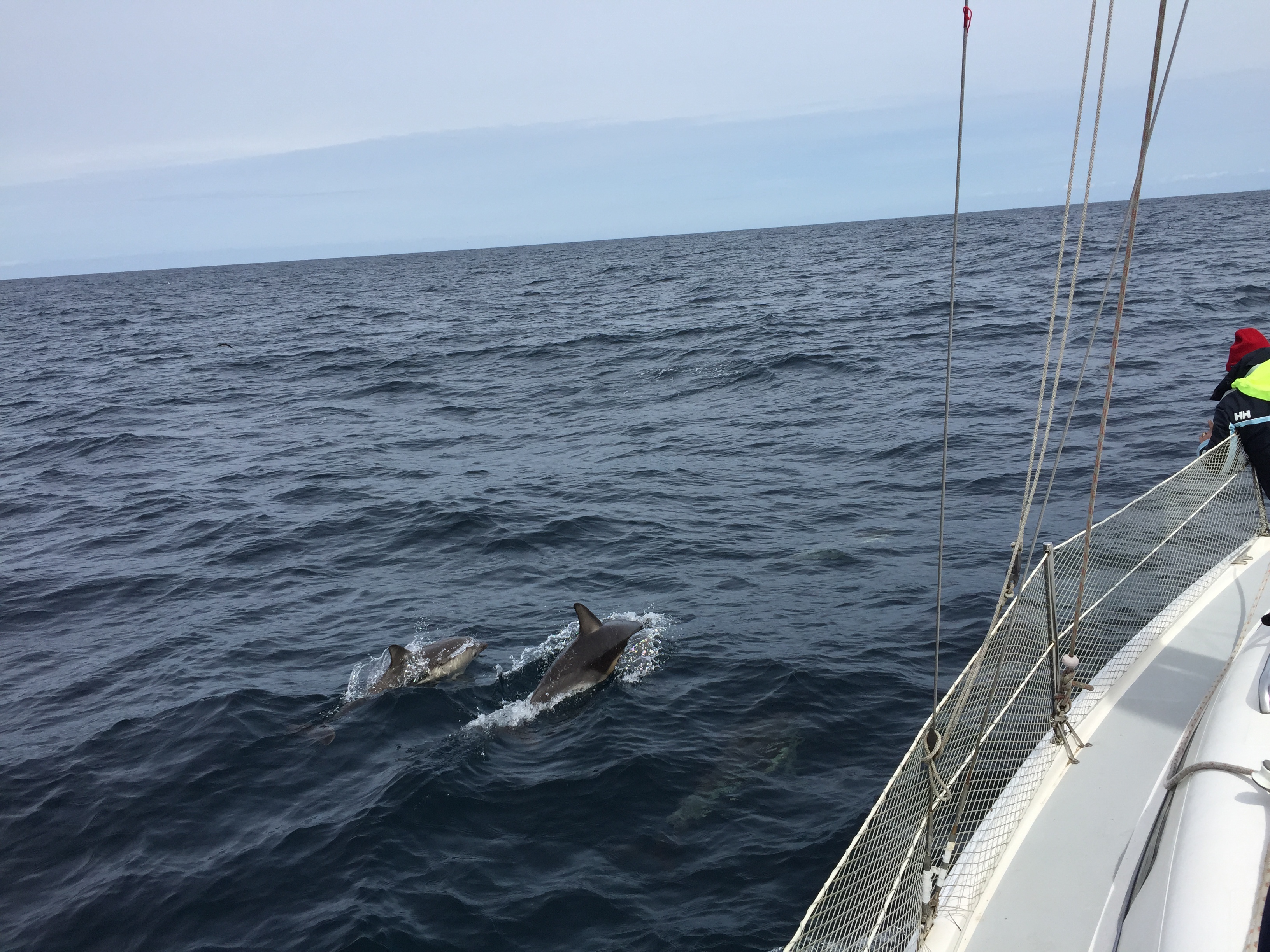
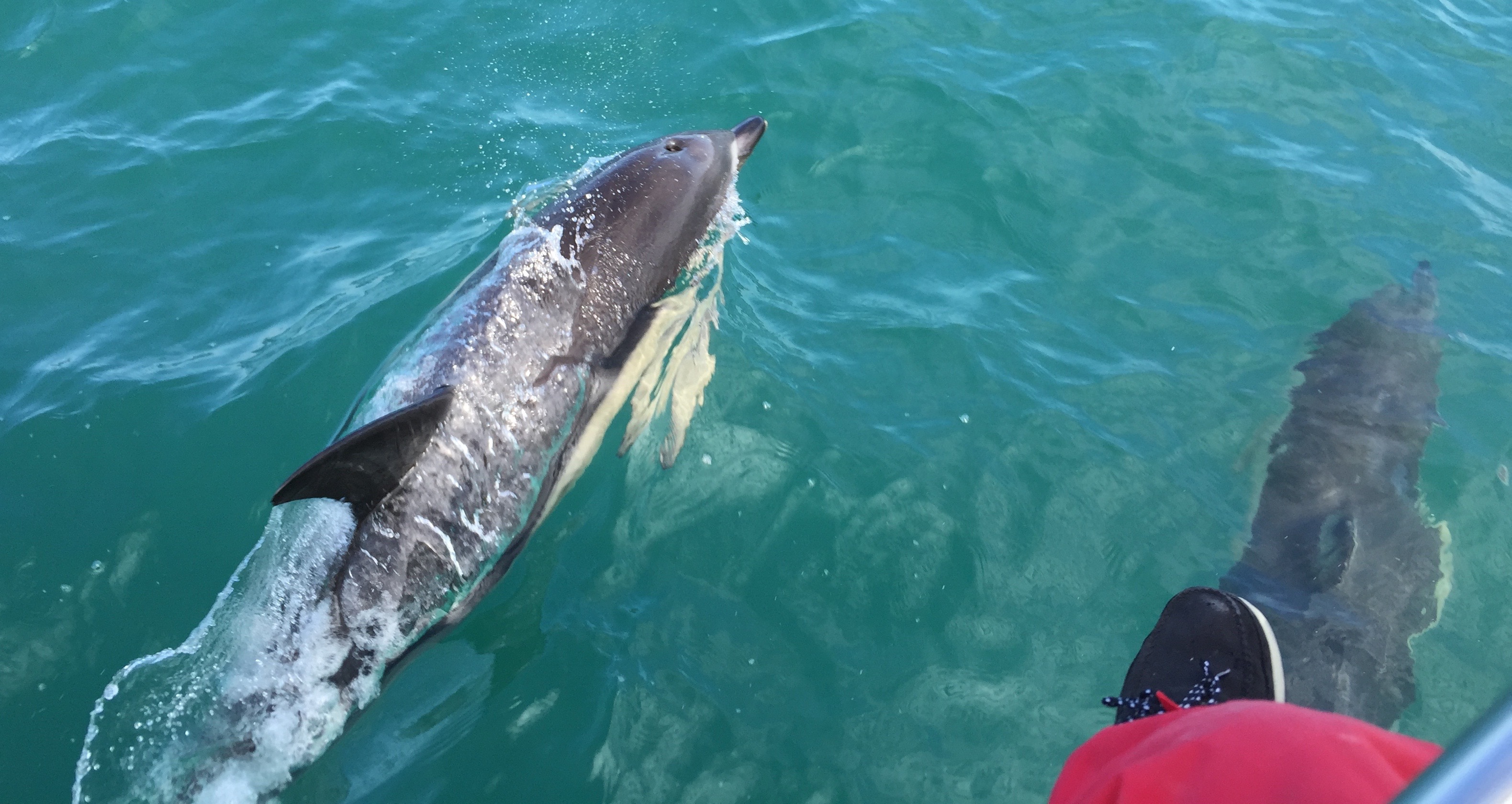
Milo must have a beautiful bottom. Admittedly she has been recently painted with a blue-grey under belly by Amanda Wright but clearly the dolphins love it because they came back to the boat again today, not once, not twice but three times. Again they grouped in threes or fours under the bow of the boat and in the picture below I saw at least five grouped to the right.  How many were to the left I don’t know.

IMG_6335 (1)

I went up to the pulpit and was there for ages taking videos and pictures. I was convinced they were surfacing close to my feet to communicate with me. You could hear their high pitched squealing noise.

IMG_6416 (1)

It was easier to capture their playful nature with video than with still photography. I eventually began to recognise when they were surface for air. They swam up to the surface and jumped in a shallow parabolic arch to breath through their blow hole but also look you in the eye.

IMG_6437

I had devised a theory that they were attracted to the wake that the propeller makes, as it was very aerated. Also, because we were motor sailing, we were doing at least 6 knots which was a speed they could race against. However, on the second occasion they joined us we were sailing and only going about 3.4 knots. This time they stayed with us for much longer – not just in the bow wake of the boat, but also criss-crossing around and across the boat – also wizzing forward and turning to race back – jumping along the way. We later learned from a seasoned sailor that they like surfing on the bow wave of a boat.

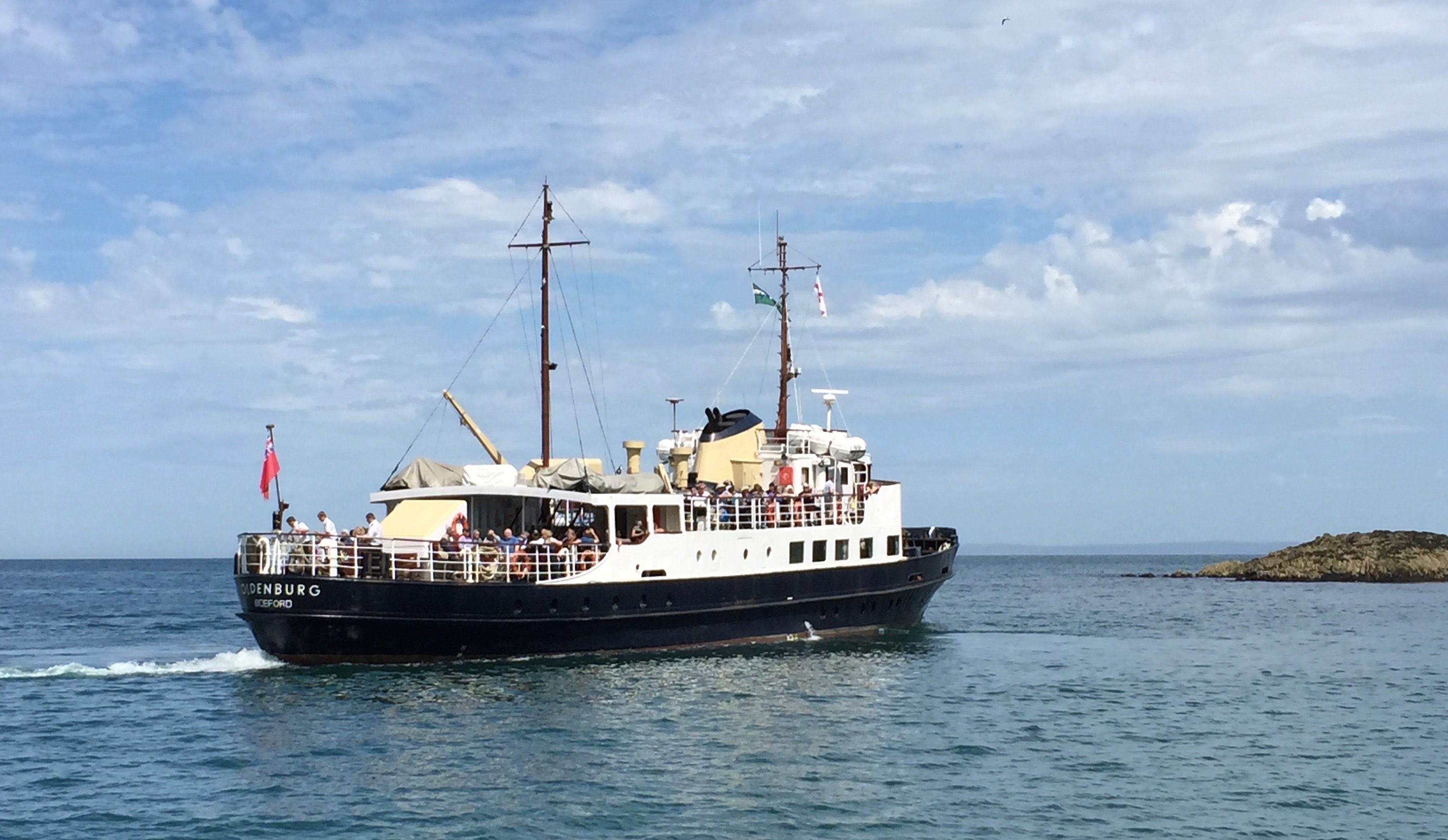
Finally we arrived at the island of Lundy in the early afternoon just in time to see the Lundy ferry Oldenberg leave.

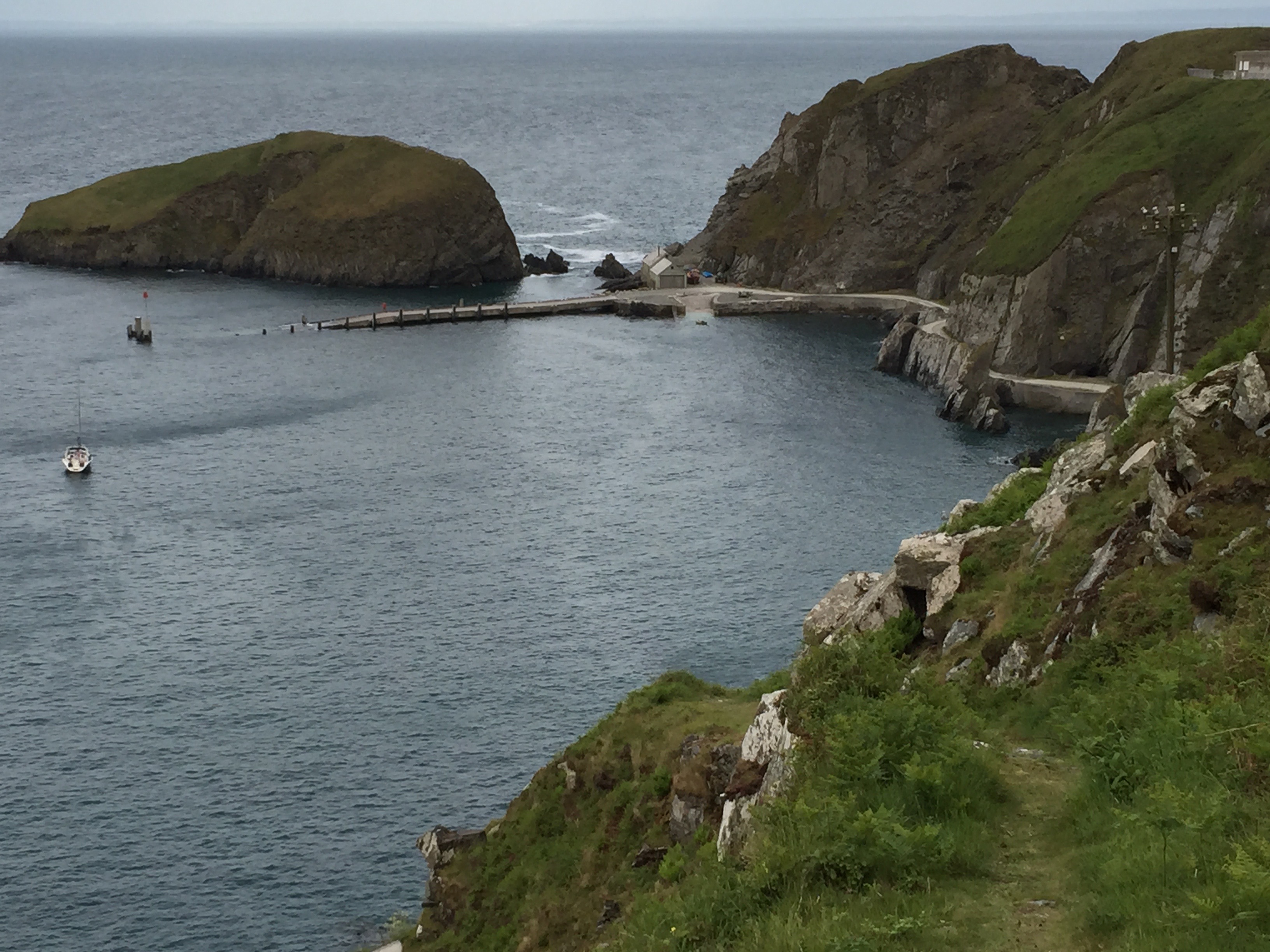
IMG_6450We anchored and took bearings of three landmarks to fix our position and motored the dinghy ashore. I asked a young woman who was filling Oxygen bottles in an old hut on the shore if I could borrow one of their old ropes to tie up the dinghy. Its normal mooring wharf  was too short for the spring tides which I’d estimated would rise another 5m while we took the walk to the pub. It turned out she was the local warden and the ropes lying there were ones that had washed up on the shoreline. We left Milo moored in the bay and started the long winding walk up to the small village at the top passing a very interesting manor house along the way, which we later learned was Millcombe House administered by the Landmark Trust (http://www.landmarktrust.org.uk/search-and-book/properties/millcombe-house-13591).

IMG_6478

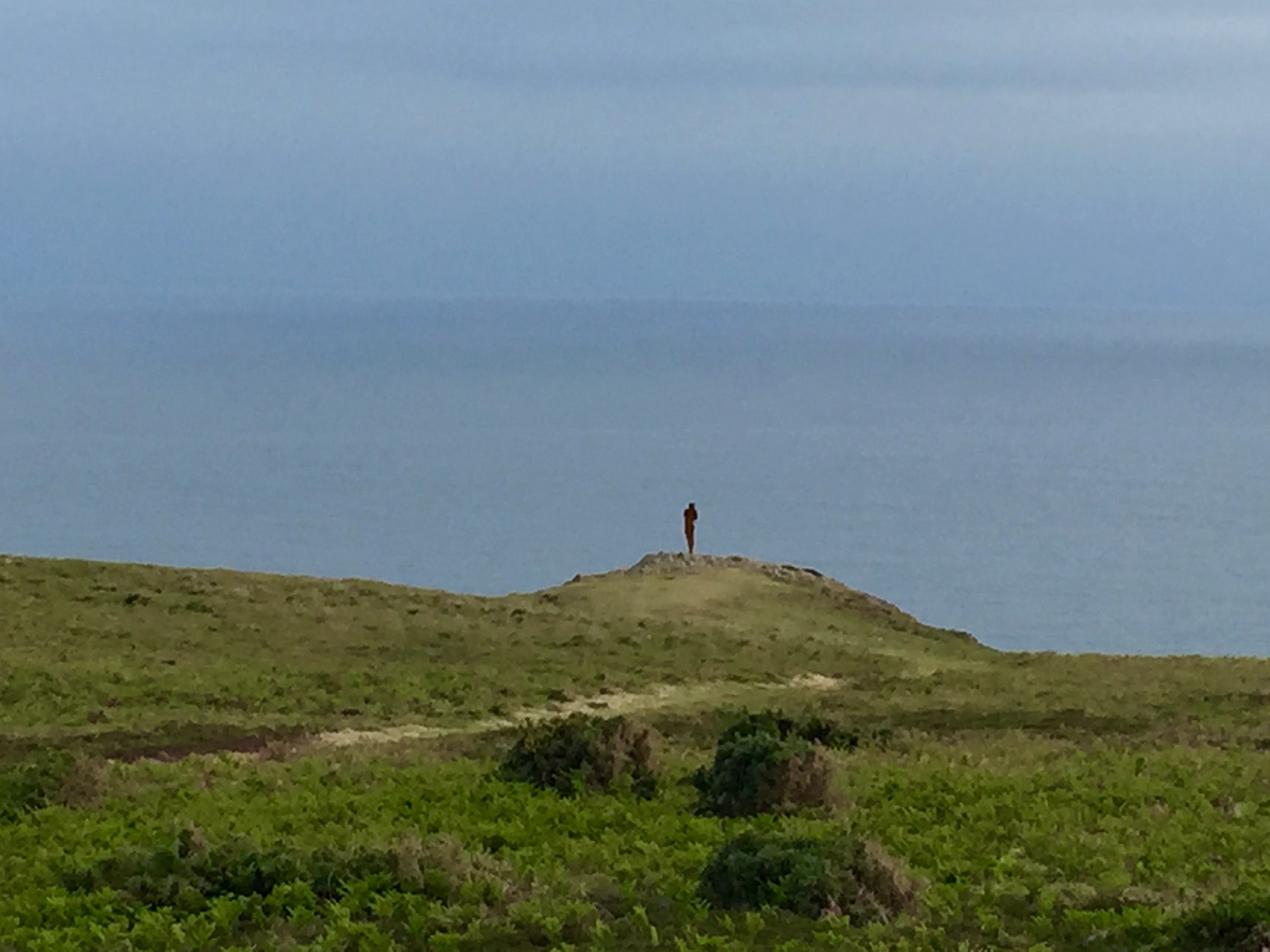
We ate at the Marisco Tavern and studied the chart of shipwrecks on the wall by the bar – a sobering moment when we thought that the next morning we’d have to navigate through the overfalls at the NE end of the island. After a visit to the church which doubled as a geological museum, we went for a short walk to see the Antony Gormley sculpture on the distant southern shoreline before we started our descent to the bay by a different route and our return to Milo

IMG_6471 (1)In fact when we eventually got back to the boat that evening, the wind had been blowing from the NE for a while and there was a swell in the bay making Milo rock and roll. It was much worse than being at sea in a gale. At least at sea the wind keeps the boat listed one way and you pitch through the waves. Here it was pitching both ways, which was nauseating – literally. We were worried our anchor would drag and leave us blown against the rocks in the night, so I set out a back up kedge anchor just in case and arranged for Ros and I to have 3 hourly watches each throughout the night. I took the first watch and kept taking bearings of my landmarks. The spring tide came up remarkably high rising 7.2 metres and covered the landing stage.

As our anchor was only 20m long and I’d anchored at low tide in 2m – I only had a ratio of 2:1 of length to depth – normally it is recommended to have 3:1. I was in the middle of these complicated calculations as something to do on my watch, when I suddenly realised I had technology on board to fix my position within +5m – my GPS. I switched it on, waited for a while for it to find enough satellites and, hey-presto, a fix. It was within metres of where I’d first moored – why was I worrying? It was near the end of my watch but I decided, after padding the crockery with matting to stop it rattling around, not to wake Ros for her watch, got ready for bed and slept really soundly until 6am. We woke to sunshine in an idyllic spot, but somehow the traumas of the night had brought a more sinister aspect and it had lost some of its romance, so it was agreed “to get the hell out of here”.

IMG_6484


Weathering the storm

The reason we started so early on Saturday 30th was that we wanted to get to a really safe haven before the storms started. These were not just storms, they were extremely strong, more than gale force storms, gusting 9 & 10 on the Beaufort scale. Padstow has an inner port with a tidal gate, which is only open at high water+2 hours. Once you are in, it is like a lock up – you can’t get out. So you and your fellow sailors frequent the local restaurants, pubs and shops and exchange stories.

IMG_6304  IMG_6305IMG_6306IMG_6307

Padstow tidal barrier opening  

That’s how we met Geoff and Jerry. Geoff is rafted next to us in a classic 1977 35ft Nicholson and Jerry is outside him in a classic 32ft Contessa. Both are returning from Gulf’sWeek, a classic boats rally, 11-17 May, in the Gulf of Morbihan in Britanny, but the weather had been so bad that they had already been away from their home port in Portishead for a month. Both had lost their crews, not to a misfortune, but to pressure to get home. So they were both lone sailing but had each other and radio contact to tide them over.

Yesterday Geoff invited us round for coffee. What a delight it was entering his cabin – just like a 1970’s sitting room – we felt immediately at home. We exchanged stories on our recent passages from Falmouth – we had both come from the same port and we asked them if they’d previously experienced a storm like the one due that night – when out came this amazing survival story from Geoff.

IMG_6264

Geoff and Jerry aboad Fly, a 1977 35ft Nicholson Classic 

It had been 8 years ago, about the same time of year, in the estuary of the same port, -Padstow. A storm had blown up from nowhere and Geoff (lone sailing in his 37ft Ohlson called Fly) had missed the tidal gate and was dropping anchor in a sheltered part of the estuary in a heavy swell. He saw the lifeboat go out and take four people off the yacht Cawesande that was in trouble further out and had seen it towed back into port. They then came out to his yacht while he was securing the kedge anchor – circling him many times making it difficult for him to balance in the wash. They persuaded him he needed rescuing and in the process of trying to come alongside they rammed his yacht broadside , stoving in the whole side. Geoff was on the same side waitinIMG_6269g to be rescued and the collision did not just pitch him into the water, but also injured him quite badly. He ultimately had to be airlifted by helicopter to hospital (Geoff was full of praise for the helicopter crew) but was furious two years later when he saw the blue plaque on the north harbour wall bearing the entry, “2007, 25 JUN YACHT FLY ONE LIFE SAVED’. “The cheek of it” he said, “I was coping, I didn’t want to be rescued, they insisted and then nearly killed me!!” Sadly as he had not finished securing the anchor properly, the yacht drifted onto the rocks in the night and was an insurance write-off. It was after this that he saw the Nicholson in very poor state in Glasgow, bought it and has reconditioned it to its proud state today. As an ex-aeronautics engineer, Geoff just loves the free ride that you get with sailing – using aerofoil technology to get you to where you want to go. Prior to the incident in Padstow estuary, Geoff had sailed Fly solo non-stop from the Azores on one single tack for 8 days covering 1200nm – using a self made wind vane steerage control system.
We learned that both Geoff and Jerry had worked together at British Aerospace in the 60’s. Ros mentioned that she’d worked there in 1968 for a year as a computer programmer and it turned out that Jerry had working in the same building at the same time and they had colleagues in common.

Another yacht in the harbour is Jacomina. We had met Lena, one of the crew, in Falmouth and learned that they’d sailed non-stop from La Coruna in Spain in four days. When Jacomina arrived in Padstow, we met John Eacott the skipper and could see that they were flying a huge promotional flag with www.floodtide.eu in large letters. From March to August 2015 Jacomina (and Floodtide) journey around UK and Europe making sonification performances of many tidal waterways in conjunction with local musicians and arts organisations. Jacomina set sail from Antwerp in Belgium, visiting northern France and Britanny before crossing the Bay of Biscay to Northern Spain. This was followed by the 500 mile passage from La Coruna to Padstow. From Padstow they plan to go to Wales and then arrive in Bristol for Bristol Big Green Week  (www.biggreenweek.com) from 14th to 20th June 2015. They invite performers, musicians, artists and scientist to join them on different legs of the journey and rendezvous with local musicians for concerts at weekends. For anyone interested in joining them read their blog on www.floodtide.eu.

Lyme Regis to Padstow

Rosamund and I have at last set off on our trip from our home port in Lyme Regis to Scotland. We plan to do the trip in two stages with a stop off in Milford Haven and a week at home.IMG_5804

We set off from Lyme on Sunday 24th May after a fantastic effort to get Milo ready to sail by the local boat builder HJ Mears & Son, the local marine engineer Rob Perry Marine and of course the harbour masters Graham Foreshore and Mike Higgs who lifted her out and in again and left her on the pontoon for us to be ready to leave on any tide. Milo’s rudder had been damaged in the recent gales and emergency repairs were necessary just before we left.


IMG_6075

What I like about sailing, apart from the usual challenges of weather navigation, tides and current, is the unexpected. After some quite tedious motor sailing against the wind to first get to Salcombe, then Falmouth and then Newlyn, we look a bus and train to St Ives as it was too windy to sail. We discovered the Barbara Hepworth museum there which was an absolute gem – set up in the house that she had lived in, it was like a time-warp from the 1970’s – everything had been left as it was in her workshop the day she died – her tools and the sculpting she had been working on. Very inspiring – I must try some woodcarving when I return from our Scotland trip.

IMG_6059The next day we headed for Padstow with an ambitious plan of arriving by high tide at 4pm in order to get into the inner harbour. We had to get up by 3am and leave at 4am in order to achieve this and cover the 64nm involved. The winds were light (3 to 4) so we motor sailed the whole way, but then at 1:15pm – the unexpected happened – a whole school of Dolphins chose to adopt and play with us. I went to the pulpit and two were swimming literally underneath me one to the left and one to the right of the bow as if they were guiding us along. Ros and I then changed places and she occupied the pulpit sending FaceTime images to the grandchildren! There must have been about 12-15 in total – they would race, dive, surface, one baby one jumped clean out of the water – others criss-crossed the boat and each other. We had a thoroughly entertaining 45 minutes until 2pm when we reached our waypoint off Padstow – they seemed to be having such fun and I’m sure they could see us – some did victory rolls flashing their white bellies. They guided us well into Padstow. Ros was glued to the pulpit and when I came up behind her she said “who is sailing the boat?”, to which I replied “she’s sailing herself” (thank heaven for the Autohelm).

IMG_6207IMG_6139 IMG_6237 IMG_6245

We are now safely moored against the Quay in Padstow inner harbour, having arrived earlier than expected at 3pm. We’ll have to wait here three days now for storms to pass.