Gigha and the Fairy Islands

It rained heavily in the night with a persistent southerly wind.  We had berthed on the windward side on the Gigha pontoon so we had creaking and groaning noises all night including flapping from the main halyard that we’d forgotten to re-position.

After a lazy start, welcome wake-up showers and a relaxed coffee and bacon butties at the Boathouse, we hired bicycles from the shop/garage/post office at the top of the hill and set off for Ardminish House Gardens.

Ardminish House Gardens

The vast expanse of mostly wooded gardens was overgrown and unkempt, but rather wild and wonderful. We enjoyed a long meandering walk through the gardens, circumnavigating the large house (which is for sale). Ros was looking for ideas for replanting borders in the even more unkempt gardens of our family home in Branscombe. We had read that we could buy ice cream at the house, which we couldn’t quite believe as we had seen no one around. But yes, delicious ice cream, made on the island, was for sale and we sat for a while enjoying our ice creams and imagining what it might be like to live on Gigha.

IMG_2871

Ardminish House for sale

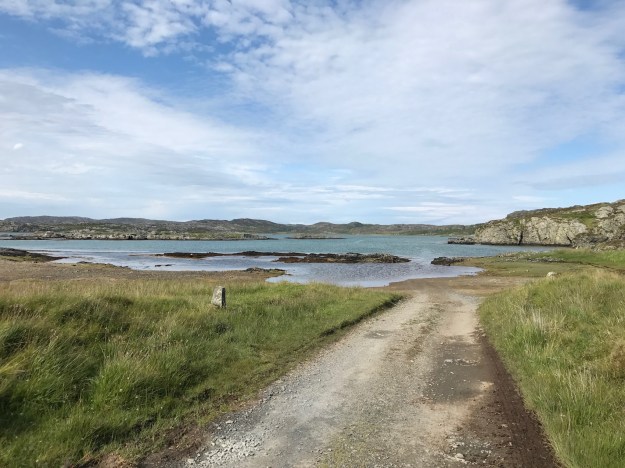
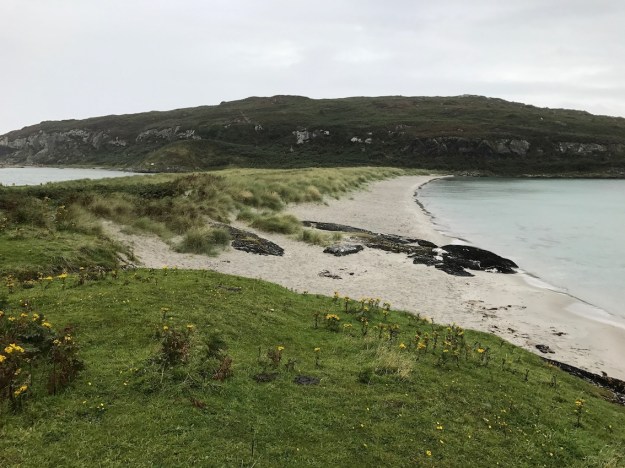
While Ros returned to Milo for a read, Ian cycled to Twin Beaches on the north western side of the island.  The island is about 9-mile-long north to south and a mile and a half wide.  The beauty of Twin Beaches was not just the lovely sandy beaches but the potential anchorages both north and south offered for any wind conditions.  To get to the beaches by foot or by bike was tricky as there had been heavy rain overnight and there were muddy flooded sections of the footpath.  Ian had to abandon the bike at one point in the heather and do the final bit on foot and enjoyed a secluded wild swim in the rain in turquoise waters with one yacht moored in the northern bay.
IMG_2876

Twin Beaches – the one on the right faces north

The next morning before bacon butties (again) at the Boathouse, Ian had determined to fill up with water and fuel.  This involved getting out the green folding luggage wheelie that he had bought over from the States more than thirty years ago and had hardly ever used until today.  Two trips to the butler’s sinks at the back of the restaurant to collect 2×25 litres of water for the fresh water tank.  Two trips up the hill to the garage to collect 25 litres of red diesel (1x15L + 2x5L).  Enough to get by with until we reach Crinan.

IMG_2885

Arran with his catch

Met Arran and Carra again – we’d chatted the day before. They were on holiday nearby and were living a “Swallows and Amazons” type existence sailing, exploring and fishing.  Today Arran had been out fishing and had caught several mackerel.  He offered us some for our evening meal. Then he said that he had a smoker and would smoke them and bring some back to us if we were still here later that day.  Unfortunately, we left on the noon tide with a following wind to motor sail to the Fairy Islands. There were already two yachts moored in our planned secluded anchorage, but being a bilge keel boat we could sneak into the corner in shallow water nearer the shore.  It was extremely sheltered, quiet and the peace was only disturbed by the occasional grunt from the seals on the rocks nearby.
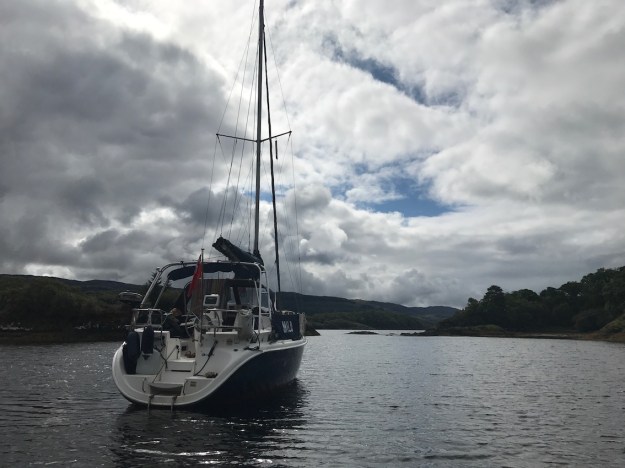
IMG_2925

Anchored in the Fairy Islands with the seal rocks in the distance

Next day we had a very relaxed morning, left alone in the bay.  We had swims off the boat and the water felt warm enough to swim around it. We later took the tender to explore the islands to the north.  We passed another seal rock where the seals were of two minds whether to wobble off their rocks or not.  In the end, all bar one stayed to watch us go by.  We found a forestry track and had a short walk, passing signs of ancient harbours for logging boats to pull in.
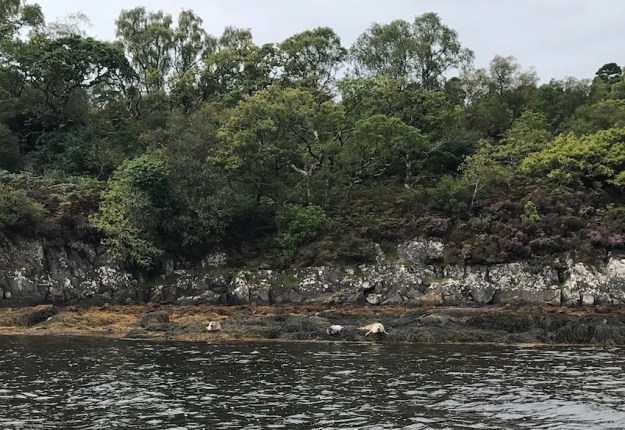
IMG_2934

More seals on the rocks nearby

Returning to the boat we then raised anchor and motored round to Tayvallich, picked up their inner visitor’s mooring and took the tender in to shop and walk to the Tayvallich Inn, where we had a delightful seafood meal – their scallops were great.

IMG_2962

Perfect reflections in Tayvallich Harbour
From Jura to Islay

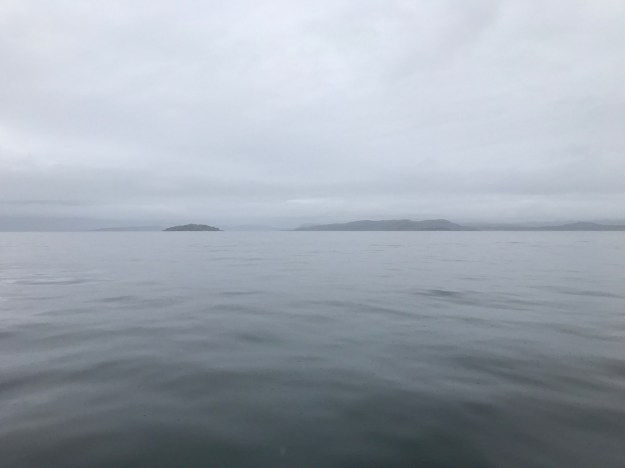
It was a damp, grey, misty morning. Ian made porridge and toast and marmalade before reading one of our Round Britain Sailing books, while waiting for Ros to wake up.  Despite the persistent rain the Russian crews in the 5 yachts surrounding us ferried crews back and forth between boats – possibly a complicated Russian breakfast ritual.  We had intended to leave at 7:30 to catch the tides, but there was no wind.  By 9am Ian was bored of waiting for Ros to wake and decided to go it alone.  He got the boat ship shape – put things away, washed up and started the engine.  This woke Ros up– who gamely said she’d be ready to leave, but he had already slipped our mooring and was leaving the harbour before she appeared on deck.

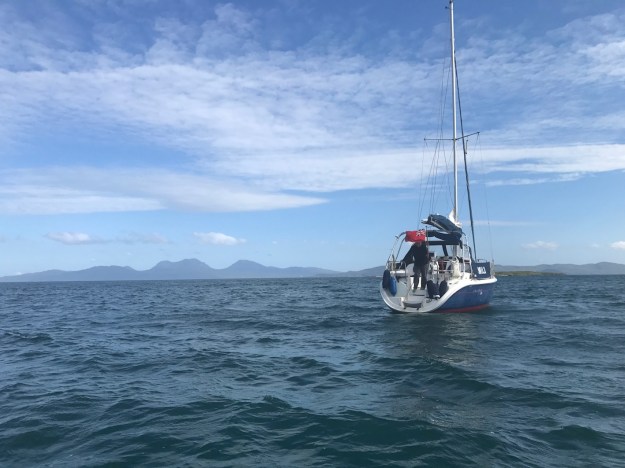
True Blue, our mooring neighbour had left just before us – heading south.  As we left the harbour she was hardly visible in the mist but gave us a useful heading – she was all we could see until two porpoises passes us by travelling north. As we reached the open sea the wind freshened and we had some lively sailing on a port reach before the winds completely disappeared and we had to start the engine to motor sail – just as well, as when we reached Ardmore point there were massive overfalls.  The waves were so large that Ian was soon feeling sick.  Fortunately, the wind returned and with full sail and the engine revving away we could battle through these enormous waves.  Poor Milo, she was lurching this way and that.  We heard the entire contents of the galley go crashing to the floor as we rolled heavily to starboard.  Another time her bow went at least two feet under a huge wave which swept up the deck like a tsunami and nearly washed over the sprayhood, instead deflecting sideways and coming round the side into the cockpit soaking Ros who was sitting on the port side. We had to endure this for at least 20 minutes before we could bear away round the headland giving us a better lead into the waves, which were by now moderating.  There was also better visibility and a narrow brighter strip of light along the horizon suggesting better weather further south, but we never reached it.  A Caledonian MacBrayne Ferry showed us the way into Port Ellen harbour – I’d planned to sail between two of the islands, but, as it was rough and windy, caution won the day and we kept well clear of these islands and took the ferry way in.  We had to keep full sail into the shelter of the bay which involved a few hairy jibes on the way in.

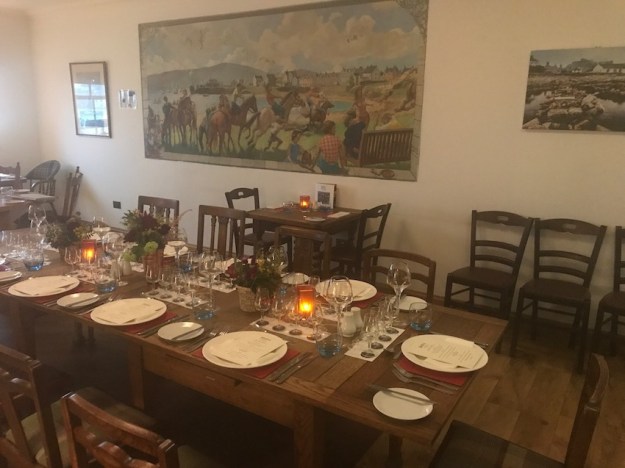
We eventually berthed at midday in Port Ellen and Ros had soon booked us an evening meal at the local Islay Hotel, which had been full but chose to take us early at 5:30 if we could finish by 7:30pm.  When we arrived we could see why.  The table next to ours had 9-10 places each lovingly arranged with 4 hooded glasses of whiskey plus wine and water glasses. We learned later that this was an outing of the staff of Ardbeg Distillery who were celebrating the launch of a new whiskey.  Talking to the staff as they arrived we learned again of the three distilleries to the North of Port Ellen, and that only Ardbeg had a restaurant.

IMG_2774Table set at the Islay Hotel for the party from Ardbeg Distillery

After a lazy breakfast on board, we went ashore to find Jim of Islay Cycles – we were told it was behind the church, but we could not find his shop.  We telephoned and he gave us directions saying he’d meet us halfway – which he did and I was grateful for that, because it was not a shop at all but the back garden of his house on a modern estate. “This is the Hebrides” said Jim, when I told him I was looking for a shop, “ye have to make a living in any way ye can”.  He’d told me on the phone that he had an electric bike and Ros had said quite firmly to me that “she did not need an electric bike”, but when she saw it was a Raleigh/Bosch just like her new one at home, she was delighted as if it was her own bike magically transported to Islay, so off we set to visit the three distilleries along the recently opened new cycle path NE of Port Ellen.

Clockwise from top left: arriving at the Lagavulin Distillery, the Laphroaig Distillery, the Ardbeg Distillery and Ros passing the signpost near the Ardbeg Distillery which has the Corryvrecken 30 miles, Kildalton Cross 6 miles, Jigeadail 3 miles, Ardbeg 1/4 of a mile and a sign pointing upwards –  Supernova 12m light years
 There must be a lot of money in whiskey – the buildings are so beautiful and well maintained. We soon reached Ardbeg, had a coffee in the restaurant and learned that we were too late for the morning tours and the afternoon tours did not finish until 4pm when we’d planned to set sail for Gigha. So we decided to head on to that secluded beach Jim had mentioned and return for lunch and a table tasting.

IMG_2795

Ros by the distillery at Ardbeg

The beach was amazing, the water was completely brown, so much so that your feet turn immediate orange as soon as you enter the water – the sand on the beach collected dark veins of peat between ridges of sand emphasising the beauty of the patterns.

The water at the beach at Ardilistry Bay was incredibly peaty – as you waded in your feet went orange and the sand had peat lined ridges

Returning to Ardbeg Distillery we had a lovely lunch followed by the tasting.  Ros tried a 10-year-old Ardbeg while Ian could not resist the Corryvrekken.  We bought a bottle of the 10 year Ardbeg. The Corryvrekkan was much peatier, which was to Ian’s taste, but also much more expensive.
The tasting of 10 year old Ardbeg by Ros and the Corryvreckan by Ian

Ros returned to Milo in time for sailing at 4:00pm across to Gigha – a four-hour trip, but Ian, determined to see the beaches on the west coast cycled further.  It tool longer  than he had anticipated and combined with trying to rescue a sheep which had strayed onto the road, he was late back.

Laggan Bay beaches NW of Port Ellen 

By 5.15 we were underway – Ros was worried it would be dark by the time we arrived and had checked that sunset was 8:50, but with a projected time of arrival at 9pm – we should be alright.  Heavy rainstorms threatened but by the time we’d reached Gigha and taken a zig-zaggy shortcut between the Islands of Gigha and Carra we were well on schedule and even had a glimpse of a sunset.

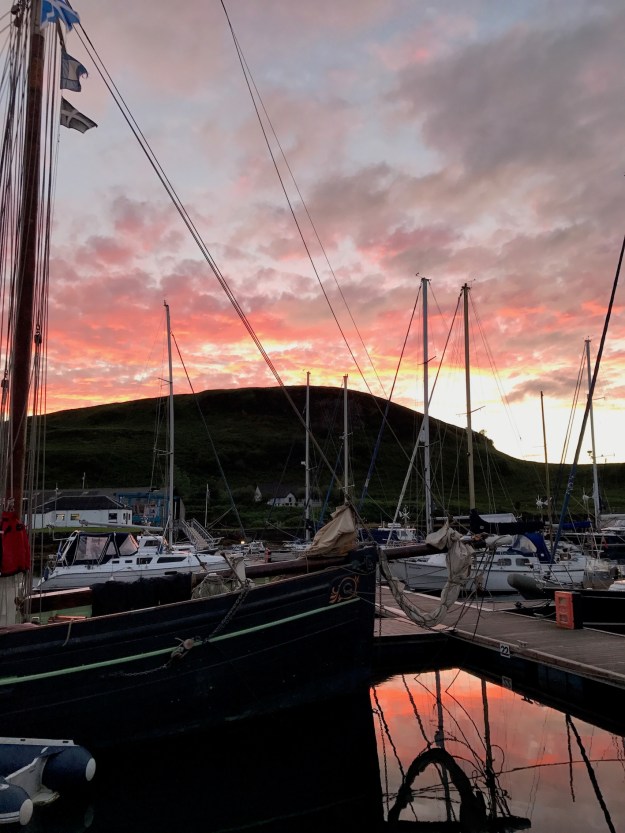
Leaving Islay late and arriving at Gigha as the sun was setting

We berthed on the south side of the pontoon at Ardminish Bay.  Unfortunately, there was no water or electricity and fuel was at the garage at the top of the hill, but to offset that the bay was beautiful and the Boathouse Restaurant very welcoming with the prospect of bacon butties and good coffee for breakfast and whole lobster the following evening.


Oban to Crinan and on to Jura

So much has happened since we were last on Milo. We have spent two fantastic weeks at Eastcotte in Branscombe with all the grandchildren – finished and even slept in the treehouse.  Ros fully retired at the end of July and experienced the delights of the Edinburgh Festival with Hugh, Percy and Skye while Ian commuted to Brunel from Edinburgh to complete his final month at Brunel before retiring himself.

Andrew kindly drove us to Oban on a windy blustery day.  The Marina river taxi dropped us off at Milo on her mooring and we found her warm, dry and welcoming as the evening sun came out for us.IMG_2718

Leaving The Isle of Kerrera, Oban

On this trip we had decided to head south to explore Jura, Islay and the west coast of the Mull of Kintyre.  The next day we had a lazy start.  Ian worked out the tides too late to take advantage of them, but there was no wind so we slowly motored south while checking the tides through the Corryvreckan and the Dorus Mor.  Pure luck had us arriving at Dorus Mor as the tide changed, directly pushing us through at a real pace amid the swirling waters.

IMG_2722

Passing the Corryvreckan with Jura in the distance

We picked up a mooring outside the entrance to the Crinan canal and  had a lovely meal on deck serenaded by the setting sun – warm, sunny and no wind – an unusual combination in Scotland – we felt privileged.

IMG_2733

Sunset over Crinan with the sun looking remarkably like Saturn!

Next day we left early and with the wind in the SE were determined to sail all the way to Jura.  We started well and were soon able to turn the engine off and sail on a port reach between 6-7 knots with the tide, but after an hour the winds started to die to almost nothing – we managed 4 nautical miles in the next hour and a half.  Our water speed was hardly a knot, the tide must have accounted for the rest, but it was peaceful and the water was calm, so we were able to both see and hear all the wildlife around us.  We observed colonies of Razorbills, Kittiwakes and Guillemots.

Route from Oban to Craighouse and Kittiwakes by Milo when wind dropped

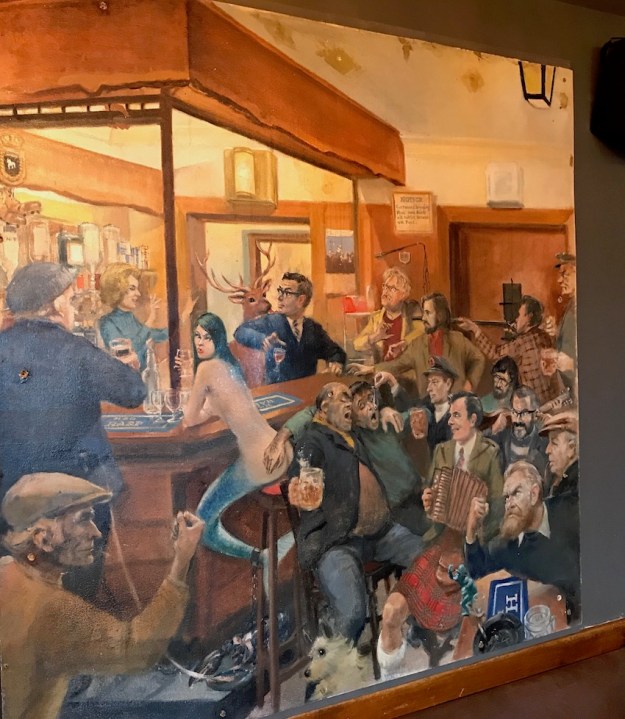
This peace was disrupted when the Chart Recorder started to cut out, with the message that the battery was low. We started the motor to charge the batteries and were OK for a while, but as we were running out of tide time we motor sailed the last few nautical miles before picking up a mooring in Craighouse. We took the dinghy ashore to the Jura hotel where we had a coffee in the bar and sat in the window with a view over the bay, charging our computers.  There was a distinctive painting in the bar of a mermaid on a barstool sipping a whiskey. In the painting none of the beer drinkers or musicians were taking any notice of her.

IMG_2763

The mermaid at the bar in the Jura Hotel with Scots drinkers taking no notice.

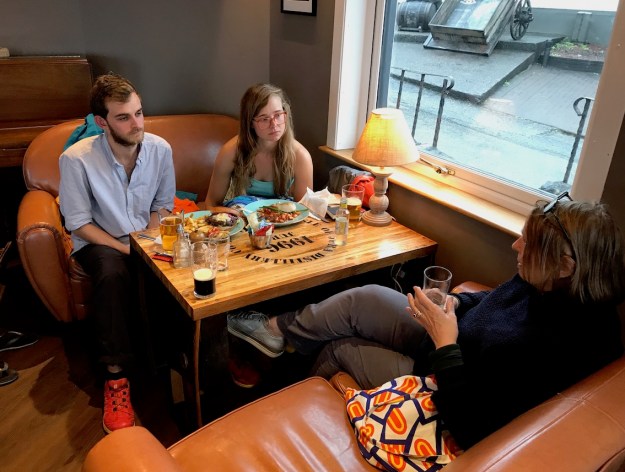
Ian then went for a shower in the block adjacent to the hotel.  Someone was already in one of the showers, but their kit was everywhere outside and the dryer in the same room was whirring away.  Ian was just getting organised for his shower when “excuse me, can you open the door of the dryer when it is still going and then start it again?”.  He opened his shower and there in the doorway of her shower was a mermaid – or so he first thought without his glasses on – a long wavey haired lass clutching some clothes to hide her modesty, explaining that her towel was in the dryer.  “Have mine”, he said gallantly, but she preferred her own, so he opened the door of the dryer and was directed to an orange wrap. Problem solved.  After his shower he discovered that the Mermaid was Eleanor, a cyclist, not a sailor, who with Harrison her boyfriend had cycled from Glasgow and this was her first shower for a week – “wonderful” she said.  Later we met them in the bar and discovered that they were medics having a short career break.  Both had studied and met in Southampton, Eleanor was interested in becoming a paediatrician and Harrison an anaesthetist. They talked about their cycling experiences across Europe, they really love cycling.  They told us about the new cycle path linking three distilleries north of Port Ellen on Islay, the beautiful sandy beaches there and the bird sanctuary peninsular in the Southern part of the Island.

IMG_2764

Eleanor, Harrison and Ros in deep conversation about education in the Jura Hotel

Ian had to wait quite a while to buy his round – there was a group of sailors ahead of him.  “Where have you sailed from” he asked.  “Russia” they replied, “err.. not all the way of course – we flew some of the way.  It turned out there was a very large group of them who had charted 5 yachts from Largs.  They were all part of some sailing association and raised red runners up their forestays.  They were a lively crew.

We returned to Milo for dinner, a scrumptious dish of sausages and cannellini beans.  Early, while in the pub, Ian had popped across to the Port Ellen Distilery shop and bought a bottle of Jura Superstition Malt whiskey that went down extremely well  after the meal.

IMG_2775

Ian enjoying his Jura Superstition aboard Milo after a sumptuous meal by Ros

Many Shades of Grey

Sunday 9th July was our day to return to Oban. It felt too cold for a sea swim but Ros washed on deck with rainwater collected overnight. We had decided to leave Milo in Oban Marina on the island of Kerrera for the next few weeks, before returning to Scotland in August.

IMG_1874

The many shades of grey

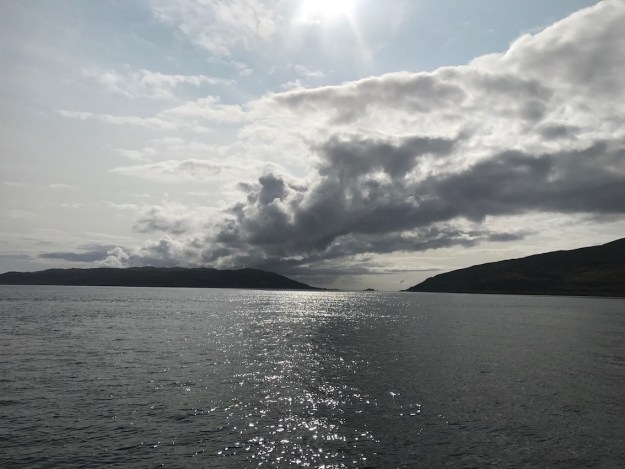
We set out at noon on the flood tide knowing the weather would be poor. As we left the shelter of the bay, there was a slight breeze – Force 3-4 at the most, so we set full sail, but kept the motor on at low revs to keep the speed up when the wind dropped. It was overcast, dull, drizzly wet and grey – many shades of grey. Later the wind disappeared completely and the sea became like a mill pond. With the helm set to Autohelm, both Ros and I were reading our novels most of the time, but when the wind dropped, we furled the Jib giving a clear view to the north and as the weather seemed to brighten toward the NW, the result was an amazing multitude of greys which were reflected in the calm sea. By the time we arrived in Oban, the sky was blue in the north west and we were treated to a lovely sunset.

IMG_1892

Sunset on the Isle of Kerrera, Oban

We berthed at the Oban Marina on the Isle of Kerrera while Oban bathed in the evening sunlight. We berthed next to a 46 ft Cornish Pilot Cutter. Later talking to the crew we discovered they were between trips and were picking up 6 new guests the next day. Their boat was a reproduction built in 2003 (1 year younger than Milo) of an Isles of a 1841 Scilly Pilot Cutter (1 year after our house in Bristol was built). Both Ros and Ian agreed that they’d like to have a trip on her one day – she’s based in Falmouth (www.classic-sailing.co.uk/agnes-pilot-cutter)

IMG_1894

After beginning to get Milo ship-shape we took the ferry over to Oban. Ros spent time in Waterstones choosing some books for our next sailing trip and the journey home. We had both enjoyed Julian Barnes’s The Sense of an Ending and so bought “The Lemon Table”, the latest Margaret Drabble “The Dark Flood Rises” and the latest Ann Cleeves Shetland series. We like to imagine sailing on to the Shetland isles next year, after sailing to the Orkneys. We will both be fully retired and should be able to wait for fair winds.

The reproduction Isles of Scilly 1841 Pilot Cutter built in 2003


Ros on the ferry from the Marina to Oban Quay, the new short-term stay marina (still under construction) in the town and the CalMac ferry arriving from Mull

That evening we ate dinner at EE-Usk ( phonetic for the gaelic word for fish). Ian chose scallops followed by langoustines and Ros mussels followed by fish and chips. An excellent restaurant, overlooking the new short stay marina.

Ros’s nth fish and chips and Ian’s Langoustines at EE-Usk

While Ros was in Waterstones Ian walked up to McCaigs Tower via Jacob’s Ladder, a steep 144 step staircase.  John Stuart McCaig had initiated the project in 1897 to keep the out-of-work stonemasons in Oban busy.  No-one knew why it was modelled on a Roman amphitheatre, but it makes an impressive sight on the hill as you approach Oban and has magnificent views from its parapet.

Views from Jacob’s Ladder and McCaig’s Tower.  The views on the right show the Oban Marina on Kerrera Island in the foreground with the Munros of Mull in the distance

Tuesday July 11th was our day to return to Bristol. We felt as if we had been away for weeks but it was only 7 days since we had arrived from Edinburgh. We realise how much we enjoy the remote anchorages with the hills rising up in the distance. Ros loves swimming in the sea and after reading about how good cold water is for the immune system she is determined to take the plunge as often as possible. We are already thinking about our return in August and whether we can explore Jura and Islay. Ros wants to sail to Fingal’s cave on Staffa and the Treshnish isles off the West coast of Mull. We sometimes fantasise about a bigger boat. Our aft cabin is very cramped and there is no head room for Ian who sleeps on the right hand-side. He has to climb over Ros to get in and out and surely we are going to become too old and too stiff for all this rigmarole or maybe it keeps us young. Ian had seen a slightly bigger Hunter Legend 326 at the Oban Marina and asked the owner if we could look around her. It was a relief for Ros to discover that an additional 3 feet didn’t offer much advantage to the fore and aft cabins and overall the design, wood quality and ergonomics didn’t seem as good as our Hunter Legend 306. Ian recalled Paul Santry, the original owner of Milo telling him that Milo was the showboat at the 2001 London Boatshow and was therefore built to a very high spec and has all the extras – comparing these too boats – it would appear he was right.

Waiting on deck for the ferry; the ferry arriving and Milo’s mooring for the next month
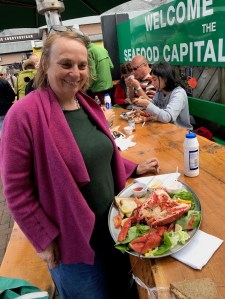
We took Milo from the pontoon to a mooring where we would leave her for a few weeks and were picked up with our luggage by the ferry that took us to Oban. We had time before the train to try the seafood just near the Caledonian Macbrayne ferry stop – “Welcome to the Oban Seafood Capital”. Ros ate a whole lobster and Ian a crab sandwich, both were delicious.

IMG_1950

Ros’s whole Lobster – and that’s only a light lunch

A very friendly 80 year old Scottish lady from St Andrews and her husband were sitting opposite us eating scallops. She chatted away about the golf course in St Andrews, about how Edinburgh is too posh for her (although her granddaughter would like to go to University there), the awfulness of the Grenfell Tower fire and what might happen when the Queen dies. Ros who is sometimes rather anti-social rather enjoyed the conversation. The lady said that she had been married for 61 years and that all the 10 couples who they knew when they were first married are all now dead. Her son had said to her – “We’ll buy you a holiday for your 60th anniversary, where would you like to go?”. “Australia” she said. “You should have seen his face” she said, “before she said “just kidding”!”. Their chosen holiday was the bus trip they were now on to the Western Isles. “We haven’t had an argument in all those 60 years” was their parting comment. Her husband, who rarely spoke, adding: “just a lot of lively discussions!” We liked that. Our 49 years of marriage (on July 13th) is punctuated by ‘lively discussions”.

IMG_1896

Always be aware though that there may be something lurking under the surface.  This wreck was revealed at the entrance to Oban Marina at low tide.  At high tide only a thin stake is visible in an otherwise clear approach – so beware.

A day trip to Oronsay

We both finished our novels (Days Without End by Sebastian Barry and Birdcage Walk by Helen Dunsmore) before bracing ourselves for a swim in the sea.

IMG_1825

The Paps of Colonsay and Jura

We tried not to be put off by the sea temperature recorded on the boat as 13.3 C.  We did not leave for Oronsay until after noon when the tides favoured the southerly trip.  We left the shelter of our anchorage with the winds on the nose.  We were not in a hurry and we tacked under full sail towards Islay in the far distance.  The profile of the Paps of Jura – were on our Port bow.  Islay gave us a good heading while tacking as the wind and waves were variable and we were by now feeling the full swell of the Altantic.

Anchor’s away before our tack toward the Paps of Jura – a long tack when Ros managed to finish another book

As we were towing the dinghy (not recommended when sailing) we stayed on the starboard tack further than we needed to.  Perhaps this was as well because when we did eventually tack toward Oronsay we realised that we had both wind and tide pushing us sideways from our intended destination.

IMG_1831

After our tack when heading for Oronsay looking back at the Paps of Jura

Having satellite navigation really helps when sailing into these rocky anchorages, but when it re-boots when you start the engine there is a period of panic – are you heading for a submerged rock or not? That minute or so before the screen returns seems endless.  The Oronsay anchorage on its eastern shore is approached between two rocky outreaches –  there are then submerged rocks to be circumnavigated.  Eventually we were able to anchor in 5m of water over sand – just in time for lunch.  Ian had been reading a book on Oronsay and wanted to go ashore – Ros preferred to stay aboard and finish her book “The Sense of an Ending” by Julian Barnes.  Here’s Ian’s account of his trip ashore:

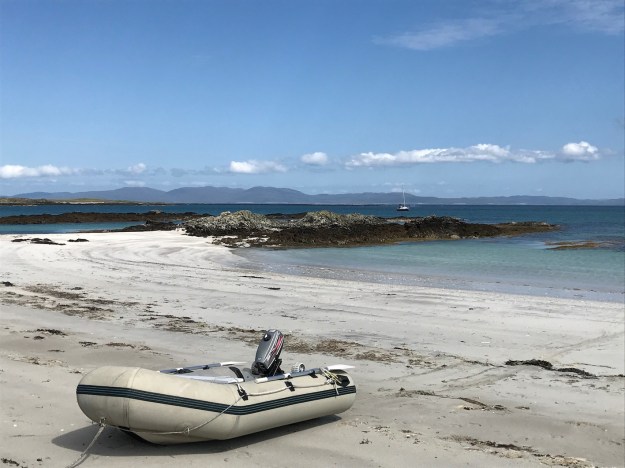
“I headed upwind on the motor of the dinghy and beached on a lovely white sandy beach strewn with razorbill shells. I dragged the dinghy at least 100m up the beach to be safe from the rising tide.

IMG_1833

The dinghy dragged 100m up the beach as the tide was rising – Milo in the far distance.

I’d landed not far from what is now called seal cottage, a ruin that used to be the old coal store – apparently small puffer steam ships beached there to unload the coal for the island.

IMG_1835

The ruins of the Coal Store now called Seal Cottage

Further on the beach was the boathouse, mentioned in the anchorage book but not in the history of the island.  It had been modernised as a holiday cottage (I presume) as the curved entrance was now a picture window and the decor inside more suited to someone on a writing retreat.  Perhaps in its heyday there was a water channel up to and under the arch, but no longer – it was sand dunes for at least 100m before the sea.

The boat house with its arched window.  The sand in the foreground must have been a water channel once.  The view through the arched window shows the inside – note the old bath on its side in the bedroom beyond.

“I headed inland and as I reached the brow of the hill I could see Oronsay farm and the ruins of the Priory ahead in the distance.  But the track veered to the right – a quick check of the Ordinance Survey showed that this was the right way to avoid marshlands ahead.  Oystercatchers swooped overhead noisily trying to distract me from their nests, but by keeping to the track, I felt sure I would not encroach.  It was a long roundabout walk to the priory but I eventually got there.  I was greeted by wild screeches which quite alarmed me in this isolated place – was someone being murdered? – until I saw two male peacocks with their splendid plumage climbing a fire escape at one of the cottages.

IMG_1847

The Abbey had no roof, but all the walls appeared firm, despite the warning notices. There were the remains of a beautiful cloister and the McNeill mortuary chapel.

I only saw one person going from the farm house to one of a group of three or four cottages – we waved but he did not stop to talk – his track suit had something about conservation on the back – so I assume it was the warden’s cottage.  I half expected him to come up and talk to me to tell me I’d left it too late to cross the causeway – but he didn’t.  Oronsay is cut off by the high tide.  At low tide you can cross a long causeway from Colonsay, even by car if you take the right route.  I’d read in “Lonely Colonsay” by Kevin Byrne that if you attempt the crossing by car you must put it in first gear and not stop – never go in reverse and follow the proposed dog-leg route exactly.  If you did get stuck – the advice was, “don’t worry – stand on the roof of your car, the tide only rises – 2-3m at the most so you will not drown”.  The prospect of my car being completely submerged in salt water would worry me even if there weret no risk of drowning.  Rather than go straight back to the boat, I wanted to explore this causeway – it was approaching high tide so I knew I would not see it as a sandy stretch, but I wanted to imagine what it would be like – I crested the hill and there before me was a cacophony of rocks and inlets and it was hard to imagine how it would dry out – fortunately I had the Ordnance Survey and was able to work it out.  Also, in the distance looking NW I could make out Ardskenish House where our friend Daphne said she stayed as a young girl.  I walked right to the end of the track to see it disappear into the water.  It must have then gone through a narrow entrance between two rocks – there was no other way – so I could only imagine small vehicles coming to Oronsay – but I only saw one – a land rover at the cottages.  On returning to Seal Cottage and the Dinghy, I saw a lone Swan or Heron – I think it was a Swan, but I could not understand why it was inland, unless it was attracted by the buckets of food put out by the farmers or the ranger.

IMG_1855

View to the North to Colonsay from Oronsay showing the road which at low tide crosses a sandy causeway

Returning to the Dinghy, barely safe as the tide was lapping behind it, I found I’d forgotten to switch off the fuel and I could not start the motor– I rowed half way to Milo before trying again, no choke and full throttle assuming the engine was flooded – this time it worked and I was able to speed my way back to an anxious Rosamund.

IMG_1861

An anxious Rosamund waiting to take my painter.

I’d been gone a long time and she’d been wondering what to do if I’d had a heart attack – how do you send out a May Day, how do you even operate the VHF?  After raising the anchor with Ros on the helm – we headed east – there was a cross wind and my favourite Aussie hat blew off.  Man overboard – Ros needed the practice  — this could have been me overboard.  She turned perfectly.  I saw the hat but unfortunately by the time I got the boat hook out it had sunk. That’s the second hat I’ve lost at sea, but now that my hair is growing back I can go bareheaded for a while before I buy another one.

We returned to our safe anchorage at Loch Stoasnaig – there were two French boats at anchor, but they were probably heading south and leaving early on the ebb tide, whereas we had the prospect of a lie-in as the flood tide to take us back up the Firth of Lorn would not start until after noon.

IMG_1863

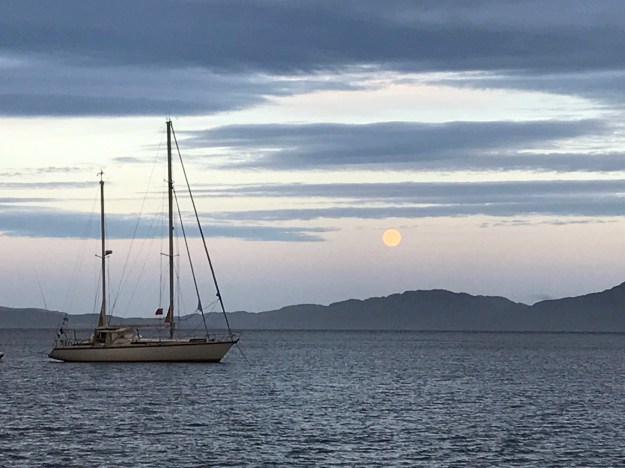
The rise of the full moon in the NE over Jura

Crossing the Firth of Lorn to Colonsay

We rose at 5.30 to prepare to set sail for Colonsay. Our friend Daphne had spent six weeks every summer there as a young girl and still returns as often as possible. When the old laird Donald Strachcona was dying in 1958 he had given Daphne’s mother the old farmhouse Ardskenish for her lifetime. With four days before we returned to Bristol, sailing to Colonsay was just the challenge we needed.   We set off in a thick mist and soon the promised rains set in.  It was cold and wet.  Ian set a course on the Autohelm and sheltered under the sprayhood while Ros stayed below reading.  When we reached our waypoint in the middle of the Firth of Lorn we put up the sails. NW force 3-4 winds were predicted so we hoisted a full mainsail.  The course to Colonsay put us on a beam reach with the wind blowing from the starboard side at right angles to the hull.  This is the fastest sailing position and we soon had the engine off and were reaching 6.5 knots (albeit with actual winds being higher than predicted at Force 4 gusting 5 to 6), whereas with the engine alone we were barely achieving 4 knots into the wind and waves.

Ros on the helm approaching Colonsay while Ian has 40 winked holding on to his nifty rope method of stopping the boom banging with the Atlantic swell.

But after an hour and a half of fantastic sailing, the wind suddenly disappeared and we had to put the engine on again. Where had it gone?  This was not predicted either.  After half an hour on the engine, the wind returned slowly and we motor sailed for the next two hours.  We were then able to turn the engine off at last and sail again (it’s so peaceful when it is sail-only) but the wind had veered WSW and so we were nearer tacking than reaching.  By the time we reached Colonsay the sun had started to greet us – we hoped this was a good omen as the next day promised to be sunny.

IMG_1893

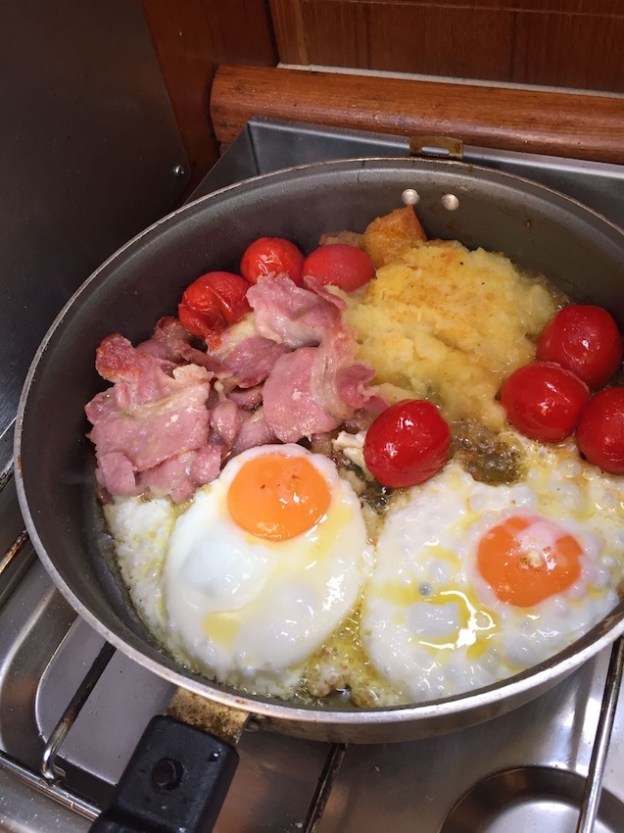
Taking advice from Warlow’s Scottish Anchorages we decided to anchor in Loch Stoasnaig, a sandy bay just South of Scalasaig where the Caledonian MacBride ferry lands. Fortified by a huge fry-up and forty-winks on deck  we decided to take the tender ashore and walk to Scalasaig. We followed the shore line, startling some oyster catchers who circled and shrieked above us. Being careful not to trample the wild flowers underfoot we just about managed to find a sheep’s track to Scalasaig. We had read about the book shop and in the distance seeing “OPEN” on the book shop’s wall, quickened our pace to arrive before 5.30.  We chatted to the bookshop owner and learned that the bookshop is linked to the publishing House of Lochar on the Isle of Colonsay. Ian was delighted to buy the ordnance survey map of Colonsay and Oronsay and a book “Lonely Colonsay” written by Kevin Byrne (who turned out to be the husband of the lady in the bookshop). Ros bought the last novel written by Neil Gunn, “The Other  Landscape”. Both books were published by the House of Lochar.

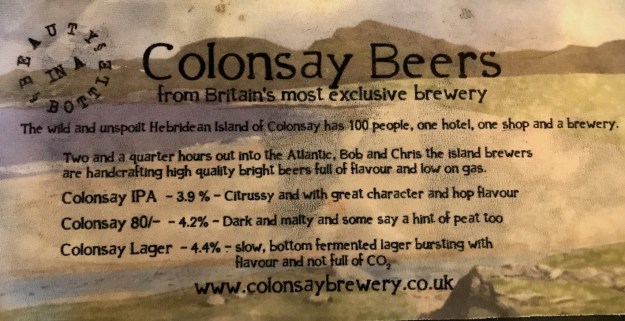
From the bookshop we strolled across to the Pantry café to study the menu and then decided to walk up the hill to see what the Colonsay Hotel had to offer. We had a drink in the bar where Ian sampled the local beer.

IMG_1814

The local beers

We managed to book a table by the window for dinner and enjoyed a magnificent view over the water and watching the 7.00 Caledonian Macbray ferry landing.  Earlier Ian had order Langoustines as a starter, but had to change to herring pate when told they were coming over fresh from Oban on the ferry.  He was very envious of the table next to us when a plateful of delicious looking Langoustines arrived while we were enjoying our desert.  When we’d walked the road to the hotel, we’d met no cars and many walkers, so were amused when we saw the cars leave the ferry turning this isolated and normally deserted road into a slow moving nose-tail traffic jam – the number of cars surprised us but it was Saturday and maybe this was the change over time for holiday cottages.

IMG_1815

View from our restaurant window with the ferry approaching.  Later cars filled the empty road seen in the distance.

We walked back to the boat over the top of the hill, following a track from the Ordnance Survey map , but even this petered out and we had to follow sheep tracks for the last bit, but at least we could see the boat  anchored in the bay and faithfully waiting for us.

IMG_1821

We were beginning to feel the magic of Colonsay and decided that next day we would sail to Oronsay and explore what Daphne called her favourite strip of water in the world

Off in a Boat

We had read about the beauty of Loch Etive in “Off in a Boat” by Neil Gunn.

“The head of the loch is a wonderland of mountains. In front of us two Shepherds of Etive lifted their heads into the haze. To our right Ben Straw, with Stob an Duibe Ruaidh before it and many peaks behind.” P 308.

But when we visited Dunstaffnage in September last year we were too fearful of sailing under the Connel Bridge and over the Falls of Lora. This year we were more confident and before we left Milo at Dunstaffnage several weeks ago we had taken a trip up Loch Etive with Chris Jackson in “Etive Explorer”. That day had been grey, cold and misty and we had seen little of the wonders of Loch Etive, but importantly Ian had learned from the skipper Chris how to navigate the falls and the low hanging electricity cables further into the loch past Bonawe.

IMG_1707 copy

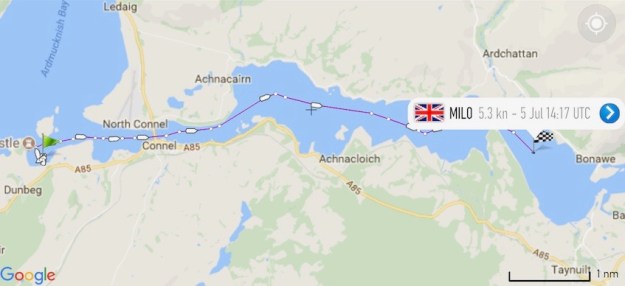
With the sun breaking through the clouds we set sail on the flood tide just after 2.00 p.m. and comfortably navigated the falls which were churning around us. We were almost alone on the loch apart from a few fishing boats. In the 1930s when Neil Gunn sailed into the loch he wrote about a passenger boat chugging up the loch every day, but in 2017 there were no other tourists to be seen.  Beautiful. We needed this sunny tranquil day with just enough wind to sail slowly up the loch with only the sound of lapping water and the local bird life. We anchored at the head of the loch and ate on deck for the first time this year.

IMG_1710-1

The Head of Loch Etive is a wonderland of mountains – Neil Gunn

Ian expressed a desire to climb the local Munro the next day, but Ros was not keen  for him to do this  because he did not have the right gear.  That night there was torrential rain and we felt cosy in our aft cabin.

IMG_1722

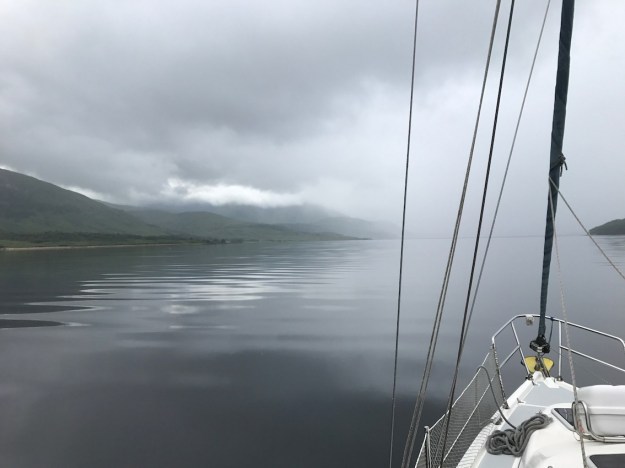
The calm after the storm of the night before

We were woken next morning to a new sound; the night of rain had resulted in streams of water cascading down the mountainside. The mist had descended overnight but we were enjoying the stillness and remoteness of the upper reaches of Loch Etive.  We both swam in the loch, very cold but refreshing.

IMG_1727

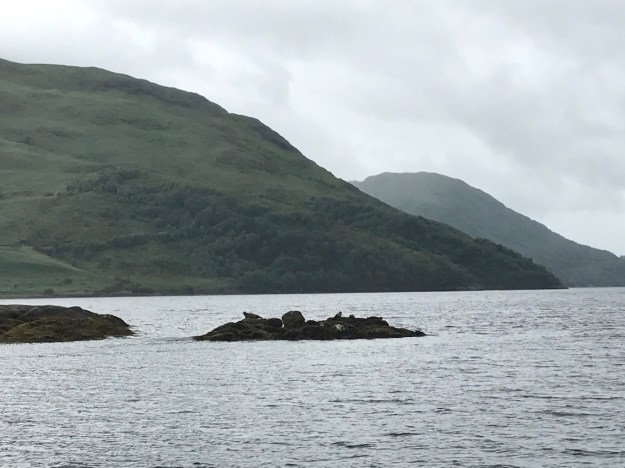
Seal Rock

Later, we motored slowly past seal rock, chuckling as the seals slid off into the sea as we approached. We had read about the village of Taynuilt in “Off in a Boat” and decided to moor there while we waited for the ebb tide that would allow us to pass back through the Falls of Lora.  We took the tender ashore and walked into the sleepy village, passed the station that we had travelled through several times on our journeys from Oban to Glasgow. There was something attractive about a remote anchorage that could be reached by train and foot. By 4.40 the tea rooms were already shut and the butcher had cleared away all of his meat, but the general stores were good for stocking up on milk, water, bread and rice pudding. And surprisingly, the post office still had one Guardian left.

The approach to Connel Bridge on the ebb tide with Milo’s mast just slipping under with less than a metre to spare


Fort William to Oban: The Falls of Lorna at Dunstaffnage

Leaving the Caledonian Canal, we had a very cold, wet and windy motor into the prevailing south westerlies, as well as a few overfalls, to get to Ballachulish Marina.

Nine months earlier we’d  rendezvoused there with Andrew and the boys (https://milosails.com/2016/09/).  That weekend in September 2016 there had been even more severe weather than this one, with gale force winds as well as rain.  This time we were expecting it to clear by evening so that we could walk to the Leroch restaurant and then be greeted by a lovely sunset on our return to Milo.

Meal at the Leroch and the sunset at Ballachulish Marina

We left early the next day to sail on to Dunstaffnage Marina.  This was another cold, hairy, rainy and “on-the-nose” windy trip, but this time we hugged the coast and used the Isle of Shuna as a shield from the wind and to keep the wave height down.  Two times we headed SE and could sail on the Jib for some time, increasing our speed to over 6kn when we’d hardly managed 4kn against the wind with only the motor.

Sheltering under the spray hood, setting waypoints with the iPad – the course hugged the coast and sheltered behind islands to keep the wave height down

Dunstaffnage Marina has a difficult approach as you must enter between an island and the mainland into a narrow channel and the whole marina is subjected to a large diameter 1-2kn whirlpool which can make berthing difficult.  The plan had been to sail under Connel Bridge the next day, past the Falls of Lorna, but we found that the “Etive Explorer” could be hired for the day for private trips, so we thought it prudent to do this and get as much experience from the experts before trying for ourselves when we return at the beginning of July.

IMG_1411

Etive Explorer for trip round Loch Etive – www.etiveboattrips.co.uk

The approach to Loch Etive (pronounced “Etiff”) is under the Connel Bridge, which only has a clearance of 14m (our mast height is 12m).  Just 100m beyond the bridge most of the width of the “bottleneck” entrance is straddled by a rocky ledge that is covered at high tide.  A tidal swing of 4m at Oban will be less than 2m inside the Loch.  There are slacks (where the levels are the same), but these are about 3 hours different from the normal high and low tides at Oban and the timing can vary considerably due to atmospheric pressure changes and wind strength – in other words the more inside information you can get the better.  These differences in water levels create high flows, eddies and whirlpools either side of the falls.  Chris Jackson, the skipper of the Etive Explorer, showed us how to approach Connel Bridge and aim for a small red mark on the right-hand side of the bridge – although the overall channel was wide, any diversion from this narrow track could result in you going on the rocks of Lorna; he then showed us how to negotiate through the Kilmaronag Narrows – Chris pointed out a faint line in the water marking the line of the underwater spit.  Further on we passed Ardchatten House, off which there was another shoal called “Ardchatten Shoal”.

Top right: The Falls of Lorna in Spring Tide floods from the Connel Bridge; Top right: canoeists enjoying the falls: Right Centre: view higher up the Loch of Glen Noe; Bottom: Lorna falls as we passed during a Neap Tide.

Bonawe used to have a ferry crossing until the 1930s, but only the ruins could now be seen – there was an active quarry beyond Bonawe and a listed jetty or pier on the southern shore which used to be used for loading locally quarried iron ore in the Crimean War.  There were several buoys that could be picked up on this southern side of the Loch, and it was possible to catch a train from Taynuilt to Glasgow,  just 0.5km inland.

Further up the loch beyond Bonawe, there was another hazard.   Power lines spanned the Loch hanging in a catenary that only had a 13m clearance at its centre.  After that it was, as they say, plain sailing and the views would have been stunning if the weather was clearer.  We went on for lunch to “Seal Rock” where there was a colony of seals basking in the seaweed looking like floating washed up bloated bodies.

IMG_1389

Seal Rock and view toward the top of Loch Etive

We returned to Dunstaffnage Marina after lunch passing two superyachts on the way in – one called “Catalina” and the other “Song of the Sea”.  Catalina (a huge 44m x 10m beam yacht) had missed the marked channel coming into the marina a few days earlier and crossed what Chris called “the trots” passing through the buoyed area.  Inevitably it got a mooring chain wrapped around its propeller stalling the engine.  The marina staff had to come out in their launches to carry lines ashore – apparently, it was quite a spectacle and when divers eventually freed their prop and they could moor they fortunately found no serious damage only the loss of their rope cutter. “Song of the Sea”, although she was smaller (34m, 7.4m beam), was a much more elegant yacht.

The Super Yachts – Song of the Sea on the left and Catalina, the one whose prop got tangled up in a mooring chain, on the right

We spent the afternoon getting packed and getting Milo ready for our departure.  While at the marina we noticed a number of ducks with their ducklings – these were Eider Ducks traditionally used for eiderdown with their distinctively shaped beaks.

IMG_1410 (1)IMG_1410

Eider Ducks and their chicks in the Marina

On the return train journey to Glasgow Central, we had fleeting views of Loch Etive to begin with and the second stop was at Taynuilt Station near Bonawe – we look forward to returning in two weeks time to take Milo under the Connel Bridge.  There was a heat wave when we landed in Bristol – after the cold and rain of Scotland, it was very welcome – we had a bar-b-que on the roof – we only hope this weather will reach Scotland when we next go north.


Fort Augustus to Fort William – the final stretch of the Caledonian Canal

Our main problem was the weather – it was still “low” after “low” after “low” and we were travelling SW into the nose of the wind – the sails were having a real rest. The main highlights of this last section of the Caledonian canal were “going over the top”, returning once more to the Corriegour Lodge Hotel on Loch Lochy and the next day descending the eight locks of Neptune’s staircase.

The top section of the canal through Loch Oich is quiet, serene and wooded – we were following a Danish crew aboard Aurora, a new 36ft Luffe, and Ros started chatting to them in the locks and we agreed to lead them to the jetty at the Corriegour Lodge Hotel as we had told them that the food there was good.  Would there be enough depth by the jetty for them to berth?


This slideshow requires JavaScript.

Passing through Loch Oich and then the canal leading to Loch Lochy

 We agreed to berth first.  We nearly went aground ourselves and found that we had to pull Milo back to the end of the jetty, before we had more than 0.7m under our keel – enough for them to berth in.  We radioed them to come in carefully and we’d take their ropes to slow them down before they went aground.  This worked well – with them projecting about 2m from the end of the jetty.  We walked up to the hotel together, and, over pre-dinner drinks in the lounge discussed with the patron, Christian, the possible lengthening of the jetty for fin-keel yachts.  She was very keen to encourage more boating people to come to her hotel and encouraged me to email later with suggestions and some ideas on the yachting/boating terminology she would need.  The Danes, over the meal tried to encourage us to sail across the North Sea next year to visit Denmark – who knows – we could be tempted, if Ros would consider night sailing.

Milo berthed with Aurora at the rickety jetty of the Corriegour Lodge Hotel, the walk through the woods for the evening meal, the view from the dining room and of the dessert.

 The Danes left early, but we stayed on the Jetty until lunchtime as it was pouring with rain.  In fact, the rain hardly stopped all day, so again we motored head-to-wind (and rain) to pick up the canal again and managed to get to the top of Neptune’s Staircase by late afternoon and arranged our descent for 8am the next morning.  We’d forgotten how isolated the staircase was – the nearest shop was over a mile away, so we battened down and ate a lovely meal on board of Lamb steaks we’d bought at the butchers in Fort Augustus, followed by Ambrosia Creamed Rice with Mrs Bridges Scottish Raspberry Preserve.

Descending the staircase, the next morning was much more efficient and quicker than when we had come up.  We were following a much larger yacht called Maxi Cosi and at first I thought we’d encountered mysterious aliens and was about to call in “the Doctor” when Ros realised they were like bee keeper’s hoods that the crew were wearing to keep off the midges.  It was then that I realised that my head was a bit itchy and perhaps, despite wearing a hat – I’d been midged around the edges. As we progressed down the locks Ros walked Milo down from above while I tended to the rear warp and the engine.

This slideshow requires JavaScript.

Ros walking Milo down Neptune’s Staircase following the “beekeepers” on Maxi Cosi – toward the bottom we were drawing quite a crowd

When we eventually arrived at the sea lock we berthed outside for a while to prepare ourselves for sea sailing once again and getting kitted up to sail once more into wind and rain, but this time against waves and tides as well.

IMG_1311

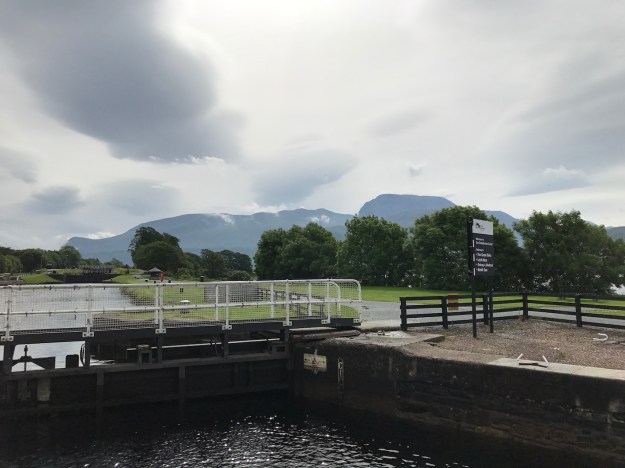
Final view of Ben Nevis from the sea loch as we left the Caledonian Canal.


Sailing through Loch Ness – Temple Quay to Fort Augustus

They say that Scotland only has about three “Highs” per summer, and by “Highs” we mean a period of high pressure where the sun is shining most of the time.  We were lucky to experience one of them last year, but now, perhaps because of the election, and the loss of seats by the SNP, Scotland is experiencing a series of “Lows”.  It’s teasing weather – the sailer’s windfinder app seems to be the most reliable – it predicted sunshine this morning at 7am and sure enough, we awoke to sunshine and made an early start to visit Urquhart Castle.  Ian had tried to walk there the evening before, but gave up, as there were no coastal paths and the road was busy with traffic, which spoilt the feeling of isolation and remoteness you get when on a boat.

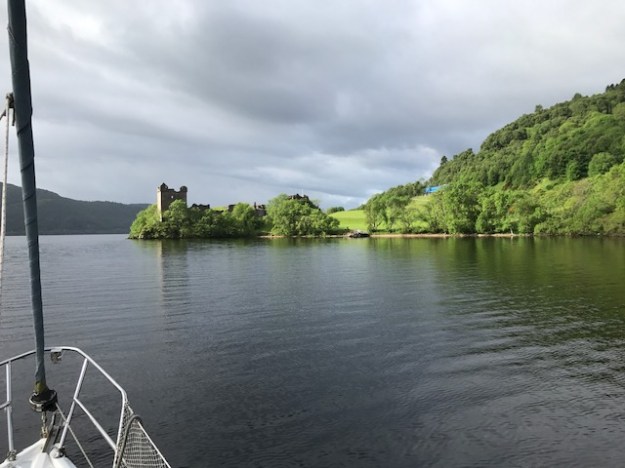
Urquhart Castle looked impressive from the Loch.  It was once one of Scotland’s largest castles, it saw great conflict during its 500 years as a medieval fortress. Control of the castle passed back and forth between the Scots and English during the Wars of Independence. The power struggles continued, as the Lords of the Isles regularly raided both castle and glen up until the 1500s.

The last of the government troops garrisoned there during the Jacobite Risings blew up the castle when they left. Urquhart’s iconic ruins remain, offering glimpses into medieval times and the lives of its noble residents.

IMG_1179

Urquhart castle from Loch Ness

Sun turned to cloud and then turned to rain as our dress turned from jeans to full wets and eventually bluff and hood. Ros, when we started, tried a bit of sunbathing while listening to the “Andrew Marr” show – the ongoing politics were still intriguing us.

No sailing yet – the light wind was again from the south west exactly “on the nose” so we set the autohelm to track toward the canal entrance at Fort Augustus and both put our feet up – there was not much traffic on the Loch and we did not see any monsters. While Ros “Andrew Marr’d”, I whipped a few ropes and wharfs to prevent them fraying.

IMG_1193

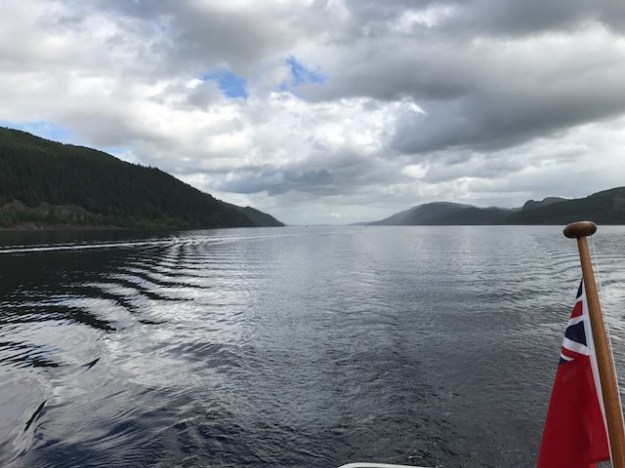
Motoring head-into-wind SW down Loch Ness

Radioing through to Fort Augustus Lock we were told we were ahead of 3 cabin cruisers and that we should berth on the pontoon to wait for them and then they’d let us through.  But after we’d berthed the lock keepers (there were two of them) told us they had a problem – the top lock hydraulics had failed and they had a number of boats “stuck” in the top lock, so first they had to get them down, then get an engineer to fix the broken pipe and then we’d be on our way – which is why, for a change, the twins, Skye and Vyvyan got post cards and we were able to send letters to other friends in the old-fashioned way. Eventually after a three hour wait and time to provision, post letters/postcards and have lunch we were told we could go.  The lock keeper though was a bit like a film producer trying to stage manage the entrance to the lock.  First the large yacht on the starboard side followed by the cruiser in front of us and then the large cruiser behind us on the port side followed by us behind her.

What was amazing in Fort Augustus was that the raising of four boats through the four locks in the staircase was like theatre in the round.  There were crowds of people surrounding the locks and taking pictures from atop the lock gates. Even prior to departing we felt like pop stars for Chinese tourists, holding their hands boat-to-shore for their pictures to be taken for their folks back home.

Proceeding up the Fort Augustus staircase lock in the rain – Ros distinctive in her yellow

Finally, we berthed on a pontoon at the top of the Fort August staircase locks – planning to relax rather than rush – visit the butcher and wine merchant the next day and set off with a well provisioned boat – ready for anything.  Great meal again on the boat with the rain beating intermittently on the roof making us feel warm and secure – not quite strong and stable, but near enough, and much more sustainable!