
The last and only time I’d sailed across the Bristol Channel was on one of my RYA training runs nearly 30 years ago. We were heaved-to and boarded by the customs and excise with machine guns. They had suspected us as being drug runners from South America as they had no record of our passage plan from the local coastguard. Tim, our trainer, spoke first and clearly his Welsh accent put them at their ease. “Oh bugger” he said “I forgot to register our passage plan – sorry chaps, would you like a cup of coffee?” – and there we were in the middle of the Bristol Channel sipping coffee and exchanging tales with the now relaxed assault crew of the nearby Naval Vessel hovering on the horizon. We learned how they had been shot at several times during assaults and had often seen crew off-loading drugs into the sea to avoid prosecution by being caught in possession.
But I was relaxed, this would not happen this time – I’d reported my passage plan to Falmouth coastguard, switched on the AIS and satnav and was heading on a straight bearing toward Milford Haven inlet. The weather was sunny and bright – what could possibly go wrong. While we were happily sailing on a beam reach, I noticed after a few hours that there were some somber looking clouds and storms emerging from the west. The winds got stronger and suddenly a squall came along with heavy rain and the wind suddenly veered to the NW (ie on the nose) and I had to take down the jib and motor sail for a while as the winds were gusting to force 5 and the sea was becoming quite choppy. But the storm passed and the wind settled back into the west and we were sailing once again with stronger winds toward Milford Haven, when I got a text from Andrew asking why my AIS was switched off. Earlier, I had said to Ros, “this is not like the English Channel, I can’t see any ships on my AIS (not realising it was switched off). We then worked out what had happened. I’d heard the main VHF above the chart table making quite a hissing sound so I asked Ros to switch it off. But she switched off the main VHF switch on the control panel, which switched off both the VHF and the AIS. I then switched the main VHF switch on and the AIS system clicked into action and suddenly I could see shipping everywhere on the screen. So we had just crossed the Bristol Channel playing a form of Russian Roulette. Luckily the visibility was good and we had not been mown down.
As we got within an hour or so of Milford Haven and were back within sight of land, Ros said that there was a boat on the port bow – it seemed to be coming toward us. Then she said, “it is coming toward us very fast, I think it’s going to ram us”. Sure enough – it came alongside about 50m off and I could see some writing on the side “Range Patrol” – the vessel was called the “Smit Penally”.
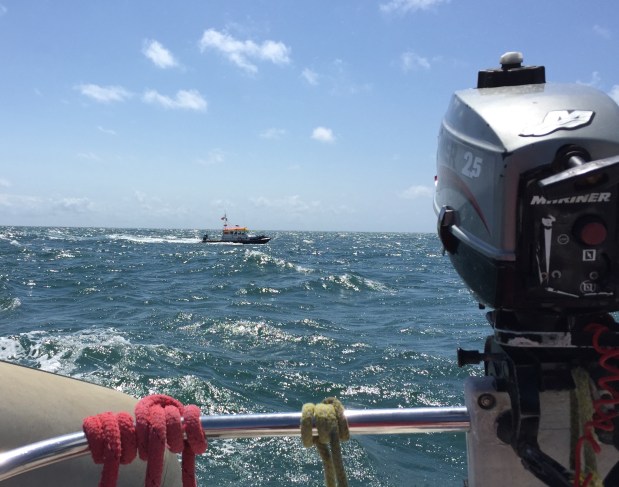
I turned the VHF handset onto the emergency channel 16. “Smit Penally, Smit Penally, this is Milo, this is Milo, over”; “Milo, this is Smit Penally. Move to channel 08, channel 08, over”. I switched to channel 08 wondering what was coming next. “Smit Penally, Smit Penally, this is Milo, this is Milo on channel 08, over”; “Milo, may I ask you what port you are heading for? Over”. “Smit Penally, this is Milo, we’re heading for Dale in Milford Haven over”. “Milo, this is Smit Penally, you’ve headed into the military firing zone during a firing exercise and we have had to halt firing while you are here. I’d like you to head 270 for 3 nautical miles immediately until you clear the zone. Over”. “Milo to Smit Penally, copy that, apologies.” There was then a mild panic on board as we were sailing on a close reach on a course of 327. Heading to 270 would turn us directly into wind – a direction we just could not sail in. So we had to furl the jib, which was not easy in the strong wind, tighten the main and start the motor before heading due west on 270. Smit Penally shadowed us close behind escorting us the whole way until we were out of the firing zone. It then advised us that we could then head on a course 330 into Milford Haven.

Milo’s track on AIS showing where we were intercepted by the Range Patrol and had to change course by heading west to get out of the firing zone as quickly as possible so that they could resume firing.
By then the weather was getting fierce, at least force 5 and the sea state quite rough, although oddly the sun was starting to break through – it seemed to be clearing up. As the waves entered the bottle neck of Milford Haven they got even higher, so I kept Milo on motor and main making up to 8 knots on occasion with the tide. It was a huge relief when we rounded to the lee of the Dale Fort headland. We’d been offered the use of mooring D27G by Kevin Rogers of Dale Sailing Club while his boat was out of the water. We picked up the mooring and then had a well-deserved cup of tea and a late lunch to celebrate the completion of the first half of our journey to Scotland. It’s hard to believe that Pembrokeshire is half way to Scotland, but we have now travelled 290 nm through the water on a voyage that will reach 600nm as we get to Holy Island off the Isle of Arran in the Firth of Clyde, Scotland.





 milosails