There was no end to our milo sailing blog last season and there has been no beginning this season. The reason was that our son Andrew with his wife Rebecca were negotiating to buy a bothy/cottage, called Pheasantry Cottage, in Tighnabruaich on the west side of the Kyles of Bute. We’d contacted the Tighnabruaich boatyard to see if it was possible to take Milo out of the water and leave her there for the winter. At the time the boatyard was full. But by the time we sailed into Tighnabruaich and had taken up one of their moorings, we were told that someone was not returning to the boatyard so a space had become available. Ros returned the next day to Bristol on the early bus to Dunoon, while Ian stayed with Milo.
Finding a window of opportunity to take the boat out of the water was not easy as both wind and tide had to be right – Ian MacCloud from the boatyard was pessimistic about the boat coming out that day so IanS contented himself with a good English breakfast at Biologica, booking a room for the following night, visiting the post office to get a local explorer map and the do-it-yourself shop to get essential supplies for repairs. It turned out that the taxi driver of Tam’s Taxis was also the proprietor of the local DIY store – a useful contact and a font of knowledge.

Pheasantry Cottage as advertised by the estate agent
After spending the day cleaning the boat and doing repairs and refurbishments – replacing some of the lights for LEDs to save power, Ian was just getting ready to cook his evening meal and then bed down for the night, when at 5:45pm there was a knock on the hull – it was Ian MacCloud ready to take the boat out – a window of opportunity had arrived. Looking toward the shore, the cradle was already deep in the water – waiting. “All you have to do”, IanM explained, while he secured his small boat to the hull of Milo, “is release the mooring and I’ll do the rest”. Sure enough – he manoeuvred Milo backwards into the cradle and then somehow from his boat managed to lift Milo out of the water. I later learned that he had devised a system of strings to operate the controls remotely – ingenious – so that he could take boats in and out of the water on his own with no help. Once secure in the cradle, he mounted the controls and did a three-point-turn in the small harbour space and took Milo out of the water, bow first, and within half an hour she was high and dry and left dangling in the cradle. IanM then busied himself spray cleaning her bottom and getting all the barnacles off. “We’ll leave her there for the night and put her in the boatyard in the morning,” he said as he prepared to leave. “But I was planning to stay the night on Milo!!” IanS said. “That’s OK, I’ve levelled her off so you’ll be OK – see you in the morning” and he was gone. What follows is IanS’s account of the next day.
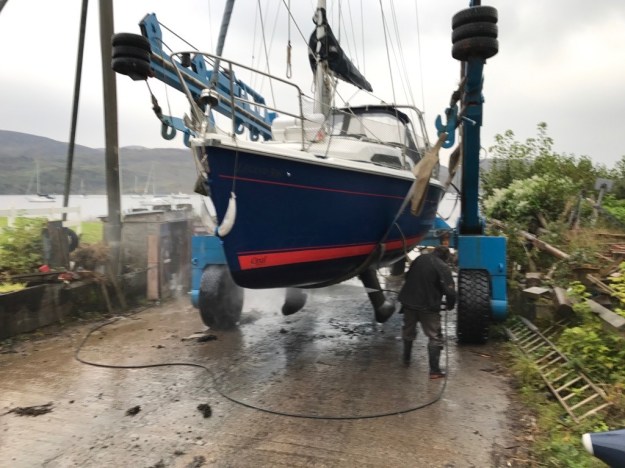
Ian MacCloud pressure washing Milo’s hull while she’s still in the cradle. IanS slept on the boat while it was still in the cradle.
“I woke early. I had not been expecting the boat to come out until much later in the day and was not due to stay the night at Biologica until the end of the day, so I had an early breakfast and set off to explore the route to Pheasantry Cottage and beyond.
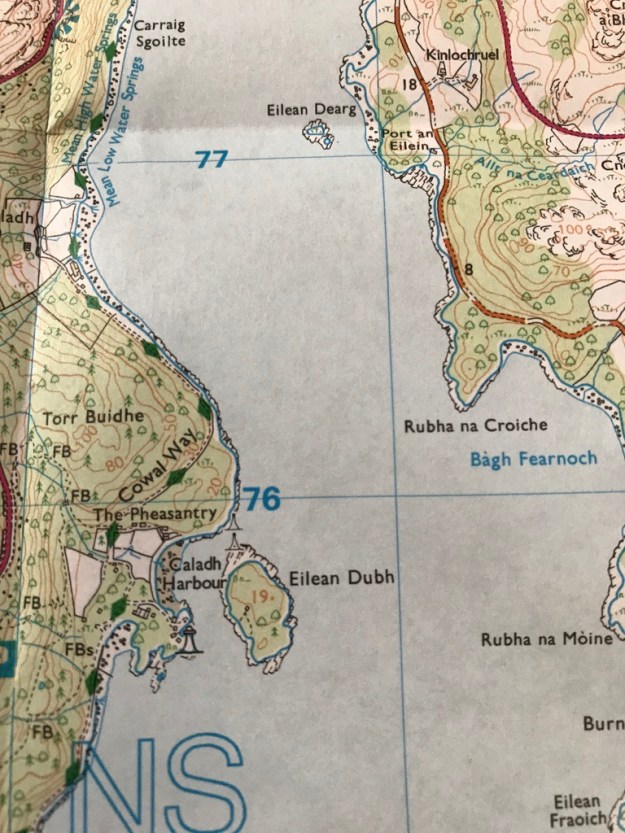
There are three houses NW of Caladh Harbour and Pheasantry Cottage is the middle one. To the south of Caladh Harbour there is a small jetty in a long curved bay indicated by a thin line perpendicular to the shore – this was the landing stage for Glen Caladh Castle. To the North of Pheasantry Cottage is Glen Caladh Farm with Eileen Dearg opposite – this island is a potential “Wild Cat Island” for the grandchildren and far enough away to be an adventure.
The Pheasantry is an area on the map near Caladh harbour where Andrew and Rebecca were negotiating to buy their bothy/cottage which as it happened is also called “Pheasantry Cottage”. It was at least two miles off road to the north of the boatyard. Apparently this costal route was created in 1897 for Queen Victoria’s Diamond Jubilee. Before this, access was only by sea. The route wound its way along the coast, sometimes close to the sea, at other times climbing steeply nearly 100m through the woods to circumnavigate a large promontory. Nearing my destination I came across the notice board below concerning Glen Caladh Castle which used to be there.

The Glen Caladh notice board 100m from Pheasantry Cottage. It was hard to read as it was so dirty so there are some extracts below.
Some extracts: “The setting must always have been idyllic and secluded and it is no surprise that in 1867 the estate was snapped up by wealthy engineer George Stephenson, nephew of the railway pioneer, who set about making significant improvements – the designs for the magnificent house pictured below were entirely Stevenson’s own, as were those for the estate buildings some of which are still occupied today. (We believe the bothy part of Pheasantry Cottage was one of those buildings). During the Great War the big house was used as a convalescent home for wounded officers. Then in World War II it was taken over by the Royal Navy, who named it HMS James Cook. In the run-up to D-day, Caladh became a training centre for the new wonder of radar technology.
Although at the end of the war the house was no longer required by the armed services, the Ministry of Works refused to hand it back. Inevitably, the empty property developed extensive dry rot and in 1958 was demolished in a weekend exercise by the Territorial Army. Many of the stones were used in the retaining wall opposite the Tighnabruaich book shops”.
Today, there is hardly any trace of the old castle as it is overgrown with trees and shrubbery, but if you look carefully there are amazing things to find.
Andrew had asked me to look out for a link to the main road which could be a potential short cut to the cottage. At one point I found a track to the left, steeply climbing the hill alongside a lively stream. At 100m elevation I came across hill cottage another bothy that was probably part of the Glen Caladh Castle estate. Unfortunately the track turned into a single track path about 200m before it met the main road at 130m elevation, despite being a track on the ordinance survey map. So there was no short cut for Andrew.

Hillside Cottage 100m above sea level.
I then discovered their cottage, Pheasantry – not quite as idyllic as the estate agent’s picture suggested, but was in a fantastic location in a group of three cottages, with a generous rambling rocky garden rising up into the hillside and down to Caladh Harbour.
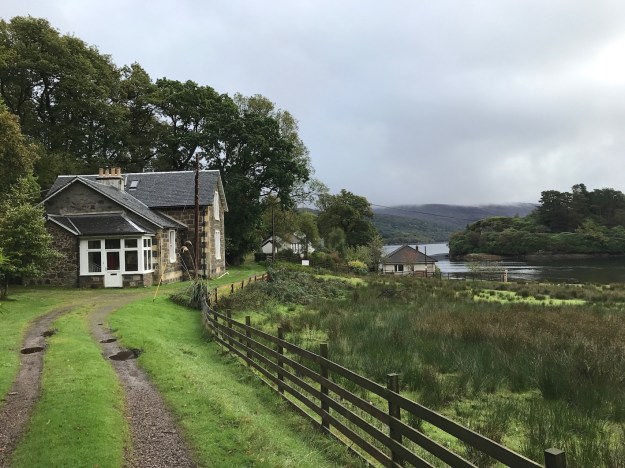
Here are the three cottages. Pheasantry Cottage is the white one in the middle. Part of Caladh Harbour anchorage is on the right with the tree lined north side of Eileen Dubh (Black Island) visible beyond.
I walked on a further mile or two to Glen Caladh Farm and then came back via a secluded coastal path, which gave me a view of the cottage from the sea. When I eventually arrived back at the boatyard around lunch time, Ian MacCloud had moved Milo to her final location and there she was standing on her bilge keel with her stern propped up by a barrel.”
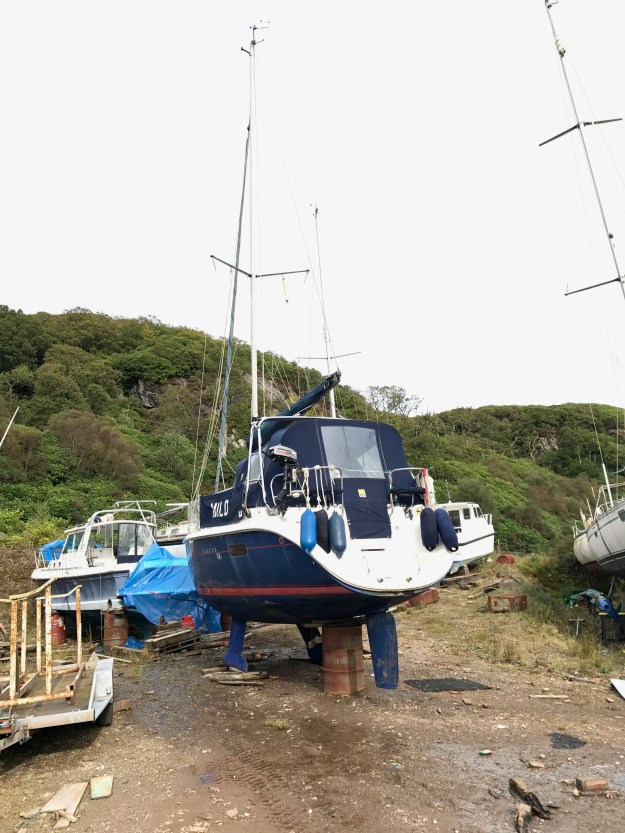
Milo’s final resting place for the winter of 2017/18
“Oh there you are” said IanM, “I thought you were still asleep on the boat!”
We did not like to write this final blog, as we thought the sale might fall through, but it did eventually happen in early February 2018.
In 2018, our plan was to sail to the Orkneys around the Cape of Wrath. However things don’t always go to plan. In March 2018 Ros was diagnosed with endometrial cancer and she learned that she would need to have a hysterectomy, followed by 4 and a half months of chemotherapy. We returned to Pheasantry for Easter 2018, to celebrate Andrew’s 44thbirthday and Rosamund would not return again until September, after her treatment had finished.
Clockwise from top left: Our friendly robin; Easter bunnies for lunch at Portavadie; Rosamund, Hugh, Skye and Percy re-enacting Charlie and the chocolate factory; painted Easter eggs (thank you Becky); marjong at Pheasantry and Andrew’s 44th birthday cake
Unfortunately, the boatyard is small and Milo was boxed in by many other boats (last in first out principal). Ian came up in June for three days to put the boat in and coincided with Andrew and the twins bringing Milo2 (their newly acquired Miracle dinghy) to Pheasantry. There was a grand meeting of the Milos near Caladh harbour before Milo1 was returned to her mooring off the boatyard for the summer.

Milo1 meets Milo2 at the southern entrance of Caladh Harbour. It is Andrew and Hugh sailing Milo2 (Mirror Miracle 3127) while Ian and Percy are sailing Milo1 (Hunter Legend 306)
Andrew and family had two trips on Milo in the summer – one to Lochranza on the Isle of Arran with Adam Atkinson and his three children to climb a Munro. Becky joined them and sailed back to Pheasantry with them – imagine Milo with 3 adults and 6 children! Then later Andrew went on a trip with his friend Simon. Both Simon and Adam had been with us on our previous boat Tigger when we’d taken part in the Isle of Wight “round the island” race in 2012.

Hugh flying high off Caladh Harbour with Milo anchored in the background
Now Rosamund and Ian are back in Tighnabruaich. Ros has literally only just finished her treatment a week ago, but recovery takes time, so while we are back on the boat for our new beginning, we will be taking it easy this year with just day trips from Caladh Harbour where Milo is now anchored. Andrew sourced some kayaks in Bristol and we brought these up on our car.
Becky, Skye and Hugh kayaking in Caladh Harbour where Milo was anchored. Later Andrew went out on the windsurfer to join them.
So, having brought the windsurfer up at Easter, Pheasantry now boasts a whole fleet of water craft ready to explore the surrounding islands. The Swallows and Amazons would love it up here. There is not just one “Wild Cat” island – there is Eileen Dubh (Black Island in Gaelic) at the bottom of the garden, Eileen Dearg 1.7 nm north and the Burnt Islands (Eileens Fraoich, Buidhe and Mor) about 1nm opposite toward the Eastern Kyle. There appears to be “no end” of opportunities for adventure up here in the Firth of Clyde and we are looking forward to slow trips of discovery this year with possible longer ones next year.
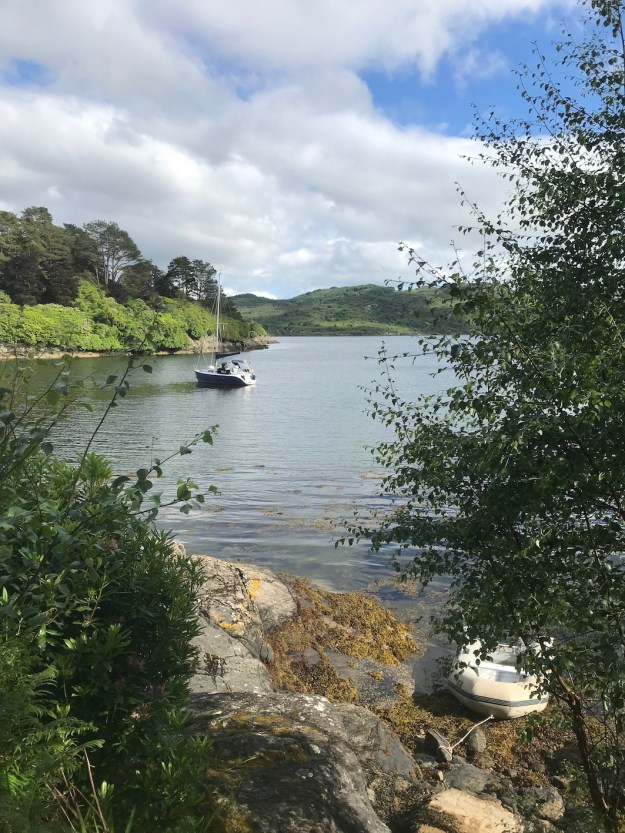
Milo anchored in Caladh Harbour with her tender drawn up at the bottom of Andrew and Rebecca’s garden at Pheasantry Cottage. We now have choice – good weather – sailing and staying on the boat – bad weather – landlubbers staying in the cottage.





 milosails