Monthly Archives: June 2017

Fort William to Oban: The Falls of Lorna at Dunstaffnage

Leaving the Caledonian Canal, we had a very cold, wet and windy motor into the prevailing south westerlies, as well as a few overfalls, to get to Ballachulish Marina.

Nine months earlier we’d  rendezvoused there with Andrew and the boys (https://milosails.com/2016/09/).  That weekend in September 2016 there had been even more severe weather than this one, with gale force winds as well as rain.  This time we were expecting it to clear by evening so that we could walk to the Leroch restaurant and then be greeted by a lovely sunset on our return to Milo.

Meal at the Leroch and the sunset at Ballachulish Marina

We left early the next day to sail on to Dunstaffnage Marina.  This was another cold, hairy, rainy and “on-the-nose” windy trip, but this time we hugged the coast and used the Isle of Shuna as a shield from the wind and to keep the wave height down.  Two times we headed SE and could sail on the Jib for some time, increasing our speed to over 6kn when we’d hardly managed 4kn against the wind with only the motor.

Sheltering under the spray hood, setting waypoints with the iPad – the course hugged the coast and sheltered behind islands to keep the wave height down

Dunstaffnage Marina has a difficult approach as you must enter between an island and the mainland into a narrow channel and the whole marina is subjected to a large diameter 1-2kn whirlpool which can make berthing difficult.  The plan had been to sail under Connel Bridge the next day, past the Falls of Lorna, but we found that the “Etive Explorer” could be hired for the day for private trips, so we thought it prudent to do this and get as much experience from the experts before trying for ourselves when we return at the beginning of July.

IMG_1411

Etive Explorer for trip round Loch Etive – www.etiveboattrips.co.uk

The approach to Loch Etive (pronounced “Etiff”) is under the Connel Bridge, which only has a clearance of 14m (our mast height is 12m).  Just 100m beyond the bridge most of the width of the “bottleneck” entrance is straddled by a rocky ledge that is covered at high tide.  A tidal swing of 4m at Oban will be less than 2m inside the Loch.  There are slacks (where the levels are the same), but these are about 3 hours different from the normal high and low tides at Oban and the timing can vary considerably due to atmospheric pressure changes and wind strength – in other words the more inside information you can get the better.  These differences in water levels create high flows, eddies and whirlpools either side of the falls.  Chris Jackson, the skipper of the Etive Explorer, showed us how to approach Connel Bridge and aim for a small red mark on the right-hand side of the bridge – although the overall channel was wide, any diversion from this narrow track could result in you going on the rocks of Lorna; he then showed us how to negotiate through the Kilmaronag Narrows – Chris pointed out a faint line in the water marking the line of the underwater spit.  Further on we passed Ardchatten House, off which there was another shoal called “Ardchatten Shoal”.

Top right: The Falls of Lorna in Spring Tide floods from the Connel Bridge; Top right: canoeists enjoying the falls: Right Centre: view higher up the Loch of Glen Noe; Bottom: Lorna falls as we passed during a Neap Tide.

Bonawe used to have a ferry crossing until the 1930s, but only the ruins could now be seen – there was an active quarry beyond Bonawe and a listed jetty or pier on the southern shore which used to be used for loading locally quarried iron ore in the Crimean War.  There were several buoys that could be picked up on this southern side of the Loch, and it was possible to catch a train from Taynuilt to Glasgow,  just 0.5km inland.

Further up the loch beyond Bonawe, there was another hazard.   Power lines spanned the Loch hanging in a catenary that only had a 13m clearance at its centre.  After that it was, as they say, plain sailing and the views would have been stunning if the weather was clearer.  We went on for lunch to “Seal Rock” where there was a colony of seals basking in the seaweed looking like floating washed up bloated bodies.

IMG_1389

Seal Rock and view toward the top of Loch Etive

We returned to Dunstaffnage Marina after lunch passing two superyachts on the way in – one called “Catalina” and the other “Song of the Sea”.  Catalina (a huge 44m x 10m beam yacht) had missed the marked channel coming into the marina a few days earlier and crossed what Chris called “the trots” passing through the buoyed area.  Inevitably it got a mooring chain wrapped around its propeller stalling the engine.  The marina staff had to come out in their launches to carry lines ashore – apparently, it was quite a spectacle and when divers eventually freed their prop and they could moor they fortunately found no serious damage only the loss of their rope cutter. “Song of the Sea”, although she was smaller (34m, 7.4m beam), was a much more elegant yacht.

The Super Yachts – Song of the Sea on the left and Catalina, the one whose prop got tangled up in a mooring chain, on the right

We spent the afternoon getting packed and getting Milo ready for our departure.  While at the marina we noticed a number of ducks with their ducklings – these were Eider Ducks traditionally used for eiderdown with their distinctively shaped beaks.

IMG_1410 (1)IMG_1410

Eider Ducks and their chicks in the Marina

On the return train journey to Glasgow Central, we had fleeting views of Loch Etive to begin with and the second stop was at Taynuilt Station near Bonawe – we look forward to returning in two weeks time to take Milo under the Connel Bridge.  There was a heat wave when we landed in Bristol – after the cold and rain of Scotland, it was very welcome – we had a bar-b-que on the roof – we only hope this weather will reach Scotland when we next go north.


Fort Augustus to Fort William – the final stretch of the Caledonian Canal

Our main problem was the weather – it was still “low” after “low” after “low” and we were travelling SW into the nose of the wind – the sails were having a real rest. The main highlights of this last section of the Caledonian canal were “going over the top”, returning once more to the Corriegour Lodge Hotel on Loch Lochy and the next day descending the eight locks of Neptune’s staircase.

The top section of the canal through Loch Oich is quiet, serene and wooded – we were following a Danish crew aboard Aurora, a new 36ft Luffe, and Ros started chatting to them in the locks and we agreed to lead them to the jetty at the Corriegour Lodge Hotel as we had told them that the food there was good.  Would there be enough depth by the jetty for them to berth?


This slideshow requires JavaScript.

Passing through Loch Oich and then the canal leading to Loch Lochy

 We agreed to berth first.  We nearly went aground ourselves and found that we had to pull Milo back to the end of the jetty, before we had more than 0.7m under our keel – enough for them to berth in.  We radioed them to come in carefully and we’d take their ropes to slow them down before they went aground.  This worked well – with them projecting about 2m from the end of the jetty.  We walked up to the hotel together, and, over pre-dinner drinks in the lounge discussed with the patron, Christian, the possible lengthening of the jetty for fin-keel yachts.  She was very keen to encourage more boating people to come to her hotel and encouraged me to email later with suggestions and some ideas on the yachting/boating terminology she would need.  The Danes, over the meal tried to encourage us to sail across the North Sea next year to visit Denmark – who knows – we could be tempted, if Ros would consider night sailing.

Milo berthed with Aurora at the rickety jetty of the Corriegour Lodge Hotel, the walk through the woods for the evening meal, the view from the dining room and of the dessert.

 The Danes left early, but we stayed on the Jetty until lunchtime as it was pouring with rain.  In fact, the rain hardly stopped all day, so again we motored head-to-wind (and rain) to pick up the canal again and managed to get to the top of Neptune’s Staircase by late afternoon and arranged our descent for 8am the next morning.  We’d forgotten how isolated the staircase was – the nearest shop was over a mile away, so we battened down and ate a lovely meal on board of Lamb steaks we’d bought at the butchers in Fort Augustus, followed by Ambrosia Creamed Rice with Mrs Bridges Scottish Raspberry Preserve.

Descending the staircase, the next morning was much more efficient and quicker than when we had come up.  We were following a much larger yacht called Maxi Cosi and at first I thought we’d encountered mysterious aliens and was about to call in “the Doctor” when Ros realised they were like bee keeper’s hoods that the crew were wearing to keep off the midges.  It was then that I realised that my head was a bit itchy and perhaps, despite wearing a hat – I’d been midged around the edges. As we progressed down the locks Ros walked Milo down from above while I tended to the rear warp and the engine.

This slideshow requires JavaScript.

Ros walking Milo down Neptune’s Staircase following the “beekeepers” on Maxi Cosi – toward the bottom we were drawing quite a crowd

When we eventually arrived at the sea lock we berthed outside for a while to prepare ourselves for sea sailing once again and getting kitted up to sail once more into wind and rain, but this time against waves and tides as well.

IMG_1311

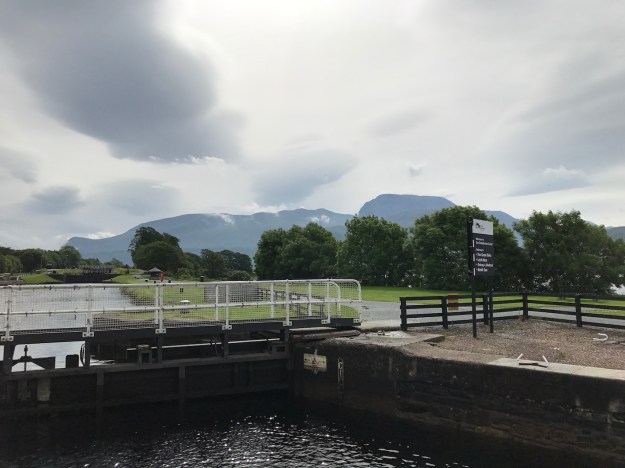
Final view of Ben Nevis from the sea loch as we left the Caledonian Canal.


Sailing through Loch Ness – Temple Quay to Fort Augustus

They say that Scotland only has about three “Highs” per summer, and by “Highs” we mean a period of high pressure where the sun is shining most of the time.  We were lucky to experience one of them last year, but now, perhaps because of the election, and the loss of seats by the SNP, Scotland is experiencing a series of “Lows”.  It’s teasing weather – the sailer’s windfinder app seems to be the most reliable – it predicted sunshine this morning at 7am and sure enough, we awoke to sunshine and made an early start to visit Urquhart Castle.  Ian had tried to walk there the evening before, but gave up, as there were no coastal paths and the road was busy with traffic, which spoilt the feeling of isolation and remoteness you get when on a boat.

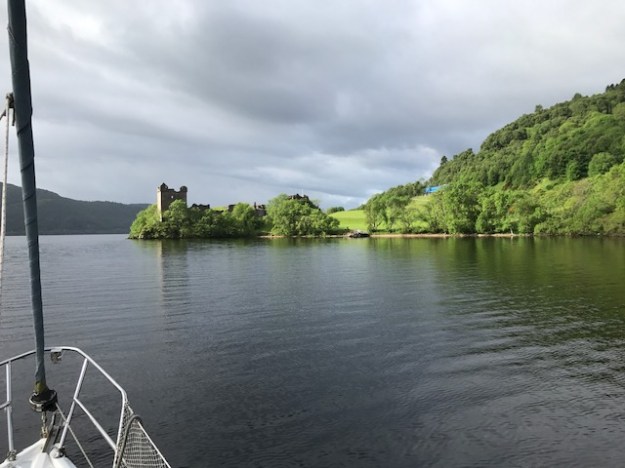
Urquhart Castle looked impressive from the Loch.  It was once one of Scotland’s largest castles, it saw great conflict during its 500 years as a medieval fortress. Control of the castle passed back and forth between the Scots and English during the Wars of Independence. The power struggles continued, as the Lords of the Isles regularly raided both castle and glen up until the 1500s.

The last of the government troops garrisoned there during the Jacobite Risings blew up the castle when they left. Urquhart’s iconic ruins remain, offering glimpses into medieval times and the lives of its noble residents.

IMG_1179

Urquhart castle from Loch Ness

Sun turned to cloud and then turned to rain as our dress turned from jeans to full wets and eventually bluff and hood. Ros, when we started, tried a bit of sunbathing while listening to the “Andrew Marr” show – the ongoing politics were still intriguing us.

No sailing yet – the light wind was again from the south west exactly “on the nose” so we set the autohelm to track toward the canal entrance at Fort Augustus and both put our feet up – there was not much traffic on the Loch and we did not see any monsters. While Ros “Andrew Marr’d”, I whipped a few ropes and wharfs to prevent them fraying.

IMG_1193

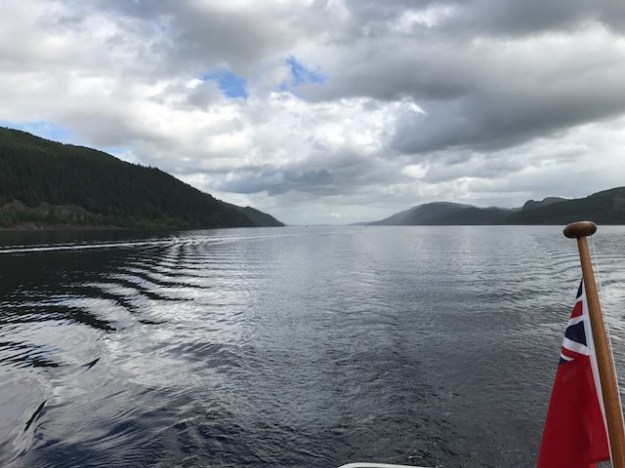
Motoring head-into-wind SW down Loch Ness

Radioing through to Fort Augustus Lock we were told we were ahead of 3 cabin cruisers and that we should berth on the pontoon to wait for them and then they’d let us through.  But after we’d berthed the lock keepers (there were two of them) told us they had a problem – the top lock hydraulics had failed and they had a number of boats “stuck” in the top lock, so first they had to get them down, then get an engineer to fix the broken pipe and then we’d be on our way – which is why, for a change, the twins, Skye and Vyvyan got post cards and we were able to send letters to other friends in the old-fashioned way. Eventually after a three hour wait and time to provision, post letters/postcards and have lunch we were told we could go.  The lock keeper though was a bit like a film producer trying to stage manage the entrance to the lock.  First the large yacht on the starboard side followed by the cruiser in front of us and then the large cruiser behind us on the port side followed by us behind her.

What was amazing in Fort Augustus was that the raising of four boats through the four locks in the staircase was like theatre in the round.  There were crowds of people surrounding the locks and taking pictures from atop the lock gates. Even prior to departing we felt like pop stars for Chinese tourists, holding their hands boat-to-shore for their pictures to be taken for their folks back home.

Proceeding up the Fort Augustus staircase lock in the rain – Ros distinctive in her yellow

Finally, we berthed on a pontoon at the top of the Fort August staircase locks – planning to relax rather than rush – visit the butcher and wine merchant the next day and set off with a well provisioned boat – ready for anything.  Great meal again on the boat with the rain beating intermittently on the roof making us feel warm and secure – not quite strong and stable, but near enough, and much more sustainable!


Milo 2017 – Life Goes on with a change of plan

We had much to celebrate on our return to Milo on the June 9th, 2017.  First was Ian’s “all clear” on the cancer front; second was joining the twins in Edinburgh for their 10th birthday celebrations on June 6th and third was the surprise meeting up with Ken and Gina Falcon on Tiftie on our first day starting on our journey back through the Caledonia Canal.

The transformation of Ian’s 8-year-old Non-Hodgkin Lymphoma (NHL) cancer from the slow growing to the fast growing variety meant 3 months of a rather aggressive chemotherapy for Ian starting in January and a delay to our plans for joining the boat in late April, sailing to the Orkney’s and returning to Lyme Regis via the East Coast by the end of the season to guarantee that we kept our mooring.  Dorset CC and the harbourmaster at Lyme Regis came up trumps and allowed us an extra year away, so the plan changed – if Ian was well enough we’d return through the Caledonian Canal to the Western Islands – Why?  We’d been advised by Ian’s consultant to take it easy, to begin with, as it could take Ian 3 months to get back to full strength.  So, doing a week through the canal would be a gentle lead-in to sailing again. And, who knows, by September when both of us will be fully retired, we may have the time and energy to round Cape Wrath and circumnavigate Sutherland and Caithness, a long-term aim of Ian being to visit the land of his forefathers.

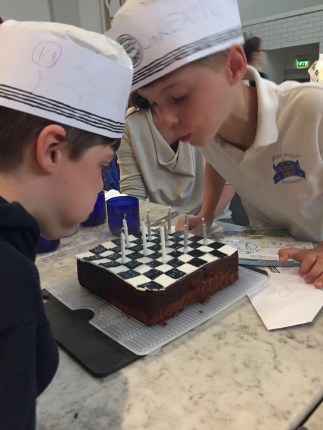
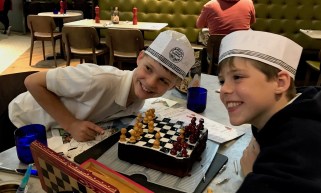
Receiving the “all clear” at the end of May, we flew to Edinburgh to help look after the twins, Hugh & Percy, and Skye while Andrew and Rebecca were on call. What a busy schedule the children have.  With their sport, music, school fete and other extra-scholarly activities, they kept us really busy.  The plan for their birthday had been a barbecue on the beach but the forecast was for heavy rain all day, so it was postponed and we went to see the fabulous Wonder Woman film instead,  followed by a birthday meal at the Pizza Express culminating in a special birthday cake lovingly made and decorated by Rebecca in the form of a chess board (Percy’s passion).

IMG_1121IMG_1124 (1)

A Chess Board Cake – it was sad to eat it after that first game of chess.

The following day we took the train to Inverness, but it arrived quite late, so rather than staying on the boat which would require a degree of decommissioning from its winterisation, Ros had found an interesting hotel, 2 miles out on the Beauly road called the Bunchrew House Hotel, looking more like a castle than a house and described on the web as “steeped in history, a 17th century Scottish mansion, offering excellent hotel accommodation and award-winning cuisine”. We had a room overlooking the Moray Firth and although facing north we had stunning views of the sunset in the NW and its rise again before 5am in the NE.

The Bunchrew House Hotel is steeped in history from its earliest settlement in the early 16th century, through the times of the Jacobite rebellion, the battle of Culloden and the Highland clearances.

The boat was much cleaner than we expected after being in the Marina for 6 months, particularly as it had been covered in an industrial dust at one point following an “incident” after which the Marina management had to arrange for the professional cleaning of every boat in the Marina. After cleaning, provisioning and having a last meal out in Inverness, we stayed up till 11pm to hear the first results come in from the election.  We could not believe the exit polls, but when we woke in the night at 2pm we stayed up until 3:30am fascinated by what was developing and that the exit polls, predicting a hung parliament, were right after all.

We eventually left early the next morning for the sea lock of the Caledonian Canal, half an hour later than expected and made good progress through the initial staircase locks to Caley Marina, but they had no berths available and so we headed on through Tomnahurish Swing Bridge toward Dochgarroch lock where we planned to berth. Two miles on from Tomnahurish Swing Bridge, we passed another yacht, Tiftie, going in the opposite direction – they gave us a friendly wave and Ian thought the helmsman looked rather like Ken Falcon who he was at university with – Ros immediately looked up “Ken Falcon Tiftie” and found their blog “TIFTIE – around mainland Britain and beyond” so we did an immediate “U” turn and tried to call them on the VHF radio on the Canal channel 74 to no avail.  Ian then called up the Swing Bridge operator at Tomnahurich to ask him to give the crew of Tiftie a message that they’d just passed the Sutherlands and that we were coming back to rendezvous with them.

Tiftie – best restaurant on the water we’ve been to for a long time!

Meanwhile at the swing bridge, Tiftie and her crew were waylayed by the swing bridge operator who kept the bridge closed – “friends of your are coming back to meet you”.  Ken said later, “we knew some Sutherlands, but they were in Bristol – they could not possibly be up here, I thought it may be some Sutherlands who knew the previous owner as our boat was well known in the area”.  But then we turned up and all became clear.  A great reunion took place and a wonderful improvised meal and lots of wine was enjoyed by all.  They tried to persuade us to turn round and join them on the way to the Orkneys.  It was tempting, but we decided to take the easy option of heading west.

IMG_1166

Sunset from Tomnahulich Swing Bridge after a wonderful meal on Tiftie

Next day Tiftie left early at 8am and had already passed under the Moray of Firth Bridge by 10am.  They continued all day arriving in Wick at about 10:30pm in the evening.  In contrast, we left in the afternoon after the rain stopped, had wind on the nose in Loch Ness and had to motor all the way to our planned overnight destination of Temple Quay, one third of the way down Loch Ness near Urquart Castle. We arrived at 4pm, both had a nap and then enjoyed a leisurely meal.