
When we had our early morning dip in our sheltered mooring at Corriegour Lodge we were not expecting conditions to be quite as wild as they were when we headed out into the main part of Loch Lochy to continue our voyage to the head of the loch. It was too windy to raise the sail – we had a following wind (luckily) which blew us along with our spray hood acting as a shute! Winds were force 6 gusting to force 8 so we motored as fast as we could toward the shelter of Ceann Loch at Laggan Locks. As we approached the head of the loch, the waves were high and over spilling, pitching us this way and that – as we arrived a small motor cruiser was leaving and I thought that I would not like to head into wind in those wave conditions.
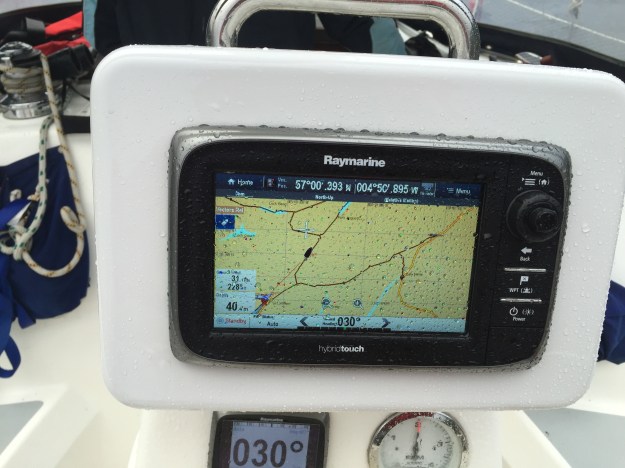 Force 7 gust of 31 knots – later a 35 knot gust (Force 8) was recorded
The lock keeper asked us what the sea conditions were like on the loch – I told him that the sea state was rough and that we’d experienced a gust of 35 knots at gale Force 8 – “Ahhh” he said, “I’ll not let any more small craft out today – it’s a pity about the one I’ve just let through” and as he was speaking we saw that it was returning – we spoke to the skipper later – he’d found it much too rough – he’d hired the cruiser from Inverness and was not experienced.
 Entering the shelter of Laggan Lock
After passing through Laggan locks we were now at the highest point of the Caledonian Canal, but storm force 9 gales were forecast for that night so we turned Milo round and berthed her head to wind on the same side as the Eagle Barge, which we later discovered was a pleasant respite from the storm when we developed cabin fever – it had a wood burning stove, which was very welcome in the wet conditions. It was also a sort of floating museum as well as a bar and a restaurant. Ros and I had a drink there and I enjoyed reading about the Maria Asumpta, a tall ship, which broke up in 5 minutes to matchwood when its engine failed upwind of a rocky coast. A stark reminder to get my engine fixed as soon as we reach a safe marina on the East coast.


The Eagle Barge with its wood burning stove in the bar, display of many artefacts and a pictures of how the tall ship Maria Asumpta met her demise on the rocks
Having time on our hands, we were able to read up on the construction of the canals. I had not realised that Telford had designed them. It was fascinating to see how major construction projects were managed in the early 1800s
 Construction techniques used when building Laggan Locks from 1819 to 1822
Now at the top of the canal we passed through the narrow, windy, but picturesque Loch Oich on our way to Fort Augustus, where we started to go downhill for the first time. There was a four lock staircase at Fort Augustus. Going downhill is much easier than going uphill as there is no turbulence in the lock, as there is when you let the water in. We were both able to leave Milo floating and lead her fore and aft down the staircase. At the bottom we were now at the entrance to Loch Ness but berthed for the night as the weather had turned bad again. Sadly my visit to the Canal Museum was thwarted as it was closed for the two half days we were there.
 Passing through Loch Oich


Leading Milo down the staircase locks at Fort Augustus
With the weather delays, we were behind on our plan to reach Findhorn by Friday evening of 30th September. It was now Thursday morning and the winds were force 6 gusting 9 until 1pm the next day. On Friday we left at 1:15pm with the wind moderating. We motored at first and later came to a safe place where we could head to wind and raise the sails – we were running with the wind most of the length of Loch Ness – 26nm we were told, but my log measured it as 20nm, but with the strong winds we made good time. We thought we saw the Loch Ness monster, but it turned out to be a floating piece of driftwood.


Various scenes from Loch Ness: Ros on the lookout; sighting the monster; the setting sun and one of Povlsen’s houses
Toward the head of Loch Ness going NE we came across a very impressive lochside house. Later we learnt that it belonged to Anders Holch Povlsen a Danish billionaire and the second largest private landowner in Scotland. Ros had learned about him when talking to Ruth Kramer who owns the Danish Moshi Moshi clothes shop in Vals, Switzerland. Ruth has been carrying out the interior designs for Killiehuntley Farmhouse, owned by Povlsen. Ros was interested to learn about this as she remembered reading about Povlsen in Monbiot’s book “Feral”. Monbiot writes in his blog of May 2014 that “Across 100,000 hectares, the RSPB, the Forestry Commission, the National Trust and Wildland Ltd (owned by the Danish textiles billionaire Anders Holch Povlsen) – are seeking to reverse the destruction, reduce the deer to reasonable numbers and get trees back onto the braes. On Povlson’s estates, the area of woodland has doubled (to 1400ha) since 2006, solely through the control of deer. It’s not land reform, but it’s the best that can be done with the current, dire model of Scottish ownership”. Ros is very interested and excited about these experiments in rewilding, and she hopes that Lynx and wolves will be reintroduced to Scotland within her lifetime.
After the narrows at the end of Loch Ness we passed down through two further locks to Dochgarroch where we berthed for our final night on the Canal.
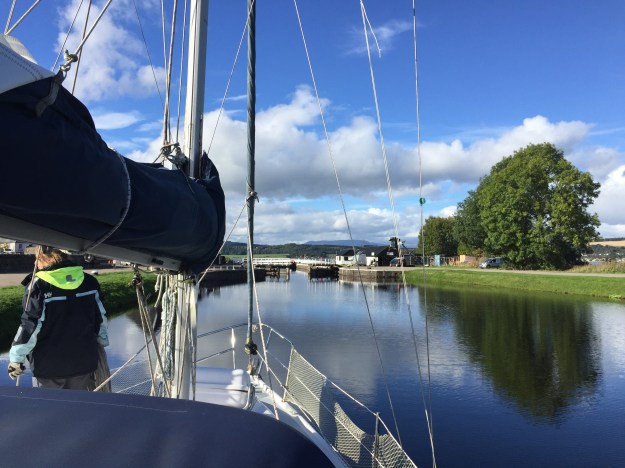
 Approaching the final lock and then the road swing bridge before entering the final approach to the sea lock and the rail swing bridge.
The next day we came into Inverness and down the lock staircase at Muirtown. Finally passing through the last road swing bridge before our final approach to the sea lock. We passed Caley Marina, which later became pivotal for our engine repairs. At the sea lock we learned from the lock keeper that we should take a wide berth in approaching Inverness Marina to avoid the shallows. We radioed ahead to book a berth at the Marina as we realised we could not possible reach Findhorn that day, besides, the chart plotter was not giving any detailed charts – why – I did not know.
 Approaching the final sea lock before leaving the Caledonian canal and entering Beauty Firth on the ebb tide.
As we left the safety of the lock, I was surprise by the strength of the ebbing tide. We headed across the bay but when approaching Kessock Bridge you could see the turbulence at the edge of the rip tide. Approaching river Ness, again I was surprised, from the shifting background, how fast we were being swept sideways – I had to compensate by heading 45 degrees into the ebbing flow. At last we made the harbor entrance to be greeted by the marina manager, David Findlay, who took our lines.
 Passing closed to the Kessock Bridge as we turned to enter the River Ness and Inverness Marina
We soon learned that Findhorn was a long and difficult sail away and challenging to approach. We did not take too much persuasion to stay on a berth in Inverness marina for the winter. David Findlay explained that we were just in time to get the 2016 rate and with our chart plotter not working, we were easily convinced to stay where we were. It was extremely sheltered and with easy access for walking on and off the boat, good proximity to washing facilities and showers plus the electric hook up – we quickly signed up for the winter. The only negative was the one mile walk into the centre of Inverness – we did it once to find that on a Friday night, most restaurants were fully booked – we rather unadventurously decided to eat at the Pizza Express restaurant, relieved to be safe for the winter and thankful to have almost a day to sort out the servicing and maintenance of the boat (later we learned that this was where our son Andrew usually eats when he visits Inverness to carry out his clinics).
 Milo in Berth A16 with the Kessock Bridge in the background
David, the marina manager, drove me next day to Caley Marina, which is on the Caledonian canal, to arrange for the engine to be repaired and winterised before my return at the End of October. Inverness Marina also had a sail repair service offered by Owen Sails – with a pick up point at the marina. I arranged with them to pick up our hood and sail cover for repair while we were away and re-fitted them at the end of October when I returned for a couple of days. By then Caley had fitted a new seawater pump and a new stay to the back of Milo and checked out the batteries. I was hoping to take Milo for a last sail but then remembered that the engine had been winterised– replacing salt water with freshwater antifreeze,– so instead I took the Dolphin Spirit trip out into the bay. Unfortunately we did not see any Dolphins but I learned a lot about the local pods, their names and how long they had been around and how and where they slept – if you think about it, it must be difficult to sleep when you are a breathing mammal in the sea. I learned that they are often sighted on the rising tide. But we did see a lot of birds including a large flock of geese just taking off for their annual migration. We passed nearby Culloden and I’ve heard enough about it now to visit the visitor’s centre next year before we set sail. It signified a turning point in history between the Jacobites and the British government at the time. It was a complicated situation with Britain at war with France and the French supporting the Jacobites who were supporting Prince Charles Stuart in order to return him to the throne – but it was not to be.
So, Milo is now ready for the winter with a refurbished and winterised engine, a sailcover and hood that look like new. We look forward to joining her again in late April when we plan to sail first to Wick to visit the old Pulteney Town (now South Wick) where Ian’s great-great-great grandfather, Robert Sutherland, used to be a fisherman until his untimely death at the age of 40 – Ian is keen to do some research in the local record offices before sailing on to the Orkney Islands and then who knows where the winds will take us. 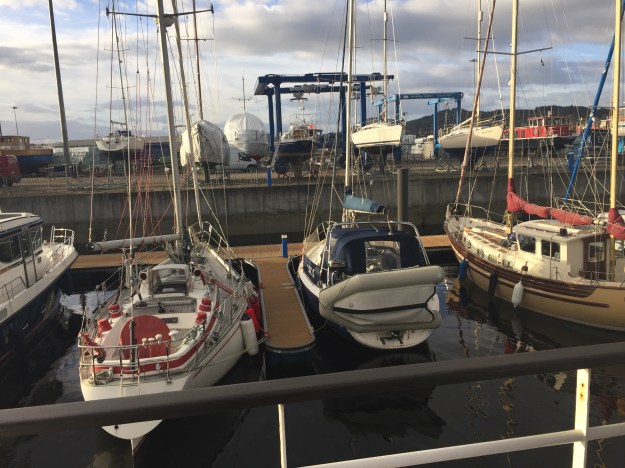 Milo in her final resting place at Inverness Marina (A16) – with refurbished hood, sail cover and engine


 Our Caledonian Canal experience was about to start – next stop Neptune’s Staircase


 Entering the last lock before reaching Loch Lochy at Gairlochy.

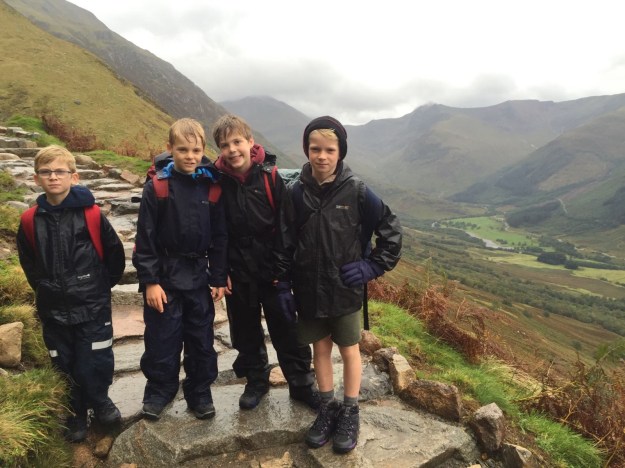 The boys Albie, Hugh, Percy and Patrick after their summit of Ben Nevis (sent later by Adam)
 The rickety and shallow pontoon at Corriegour Lodge hotel and restaurant.
 Wild swimming the next morning
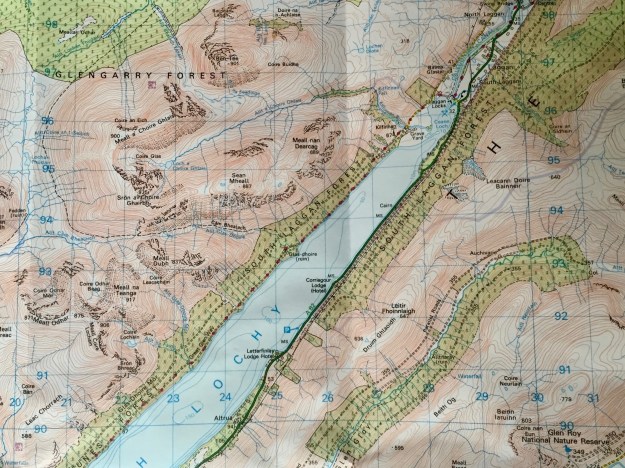 The top of Loch Lochy with the Corriegour Lodge Hotel about central and Laggan Locks in the top right hand corner where we weathered out Force 9 overnight storm force winds.
 milosails